Quant Finance Master’s Guide 2017
Welcome to Risk.net’s guide to the world’s leading quantitative finance master’s programmes

Click on universities in the table below for full course details. If the table is not displaying properly, click here for a pop-out version
Risk.net’s inaugural guide to the world’s leading quantitative finance master’s programmes is the first comprehensive work of its kind. It is aimed at students who want to become the quants of the future – as well as those who create the jobs they’ll end up doing.
The project also seeks to capture the changing nature of the quantitative finance industry, and the evolving skill set required to join it. On the sell side, the profession has fragmented almost beyond recognition, testing the definition of ‘quant’ for most banks; others now see the buy side as the place to be.
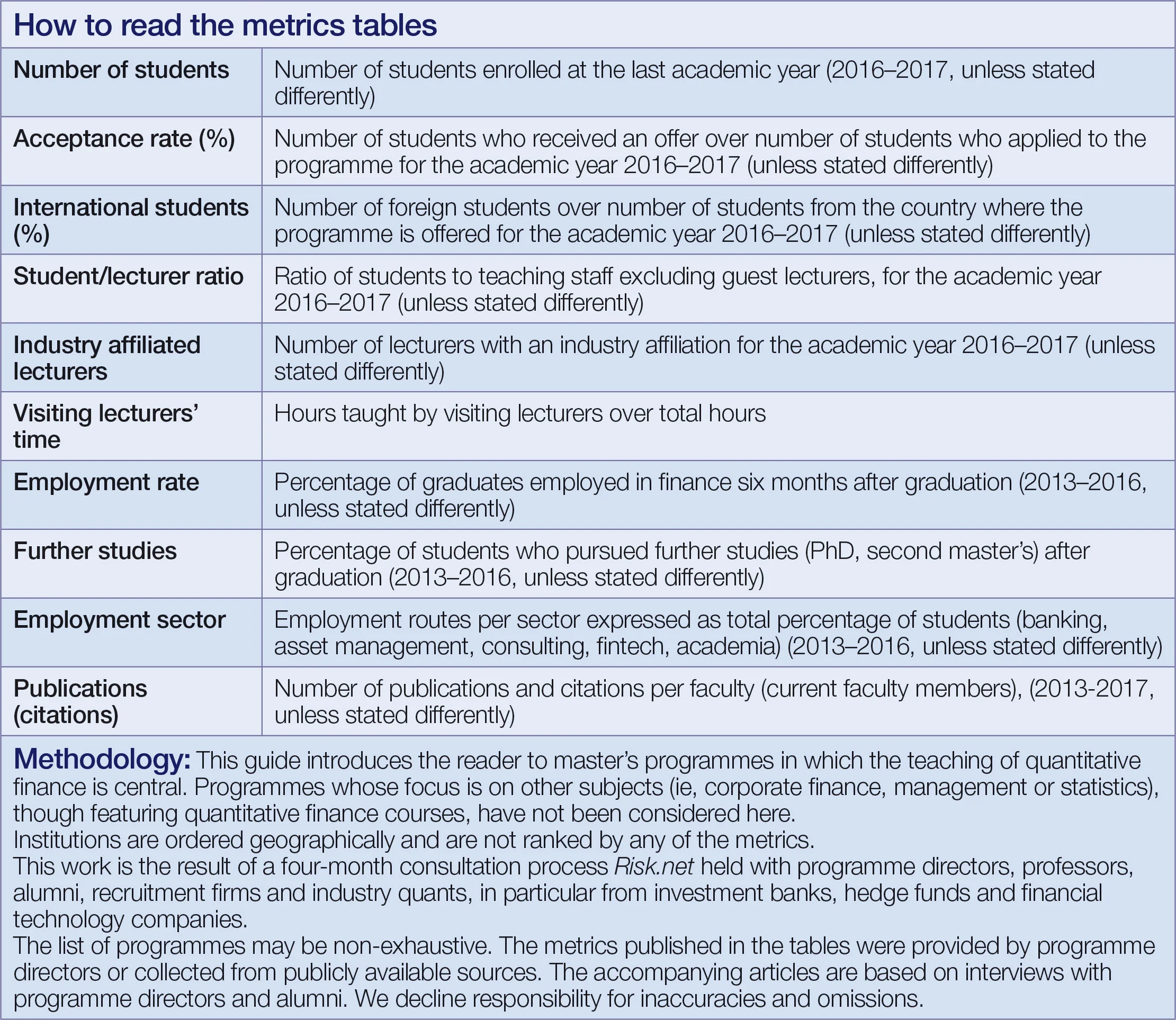
Our survey highlights common trends in the introduction of new courses, consistent with changing market requirements. But it also seeks to highlight how programmes develop their own distinctive features. As well as reporting metrics on students, their lecturers, and employability, we interviewed programme directors and alumni to provide the reader with comments and opinions that statistics alone could not communicate.
Collecting data has been facilitated by the helpfulness of faculty administrators and programme directors, for which we are grateful. In some cases, certain figures were not available, or those contacted – notably the London School of Economics, King's College London and the National University of Singapore – were unwilling or unable to provide metrics.
We initially sought to consider metrics on graduates’ salaries before and after completing a master’s, but ultimately decided not to due to the difficulty in verifying statistics and achieving a meaningful comparison between different countries and markets – and because some countries’ privacy laws impede their collection outright.
The guide is not intended to be read as a ranking of the various programmes on offer; Risk.net bears no responsibility for exceptions, oversights or omissions. The guide should not be relied on for advice – but at the very least, we hope it proves helpful to would-be master’s students, their teachers, and their future employers.
Research and reports: Sebastian Day and Alina Haritonova
Americas
Baruch College, City University of New York
University of California, Berkeley
Boston University
Carnegie Mellon University
University of Chicago
Columbia School of Engineering
Columbia University
Massachusetts Institute of Technology
NYU Courant Institute
NYU Tandon School of Engineering
Princeton University
Rutgers University
Stony Brook University
University of Washington
University of Toronto
University of Waterloo
IMPA
Europe
City, University of London
Imperial College London
Imperial College Business School
King’s College London
LSE
University of Oxford
University of Warwick
University of York
Bocconi University
University of Bologna
University of Florence
University of Turin
EISTI
Paris Diderot University
Pierre and Marie Curie University
University of Amsterdam
Erasmus University Rotterdam
EPFL
ETH Zurich/University of Zurich
WU (Vienna University of Economics and Business)
University of Leuven
University of Copenhagen
Technical University of Munich
Asia-Pacific
University of Sydney
Hong Kong University of Science and Technology
Maharishi University of Information Technology
National University of Singapore
This guide is the third part of a series on the future of quantitative finance, part of Risk’s 30th anniversary coverage. The first part, an opinion piece from UBS’s Gordon Lee, is available here. The second part, a feature on the changing role of the quant, is available here.
コンテンツを印刷またはコピーできるのは、有料の購読契約を結んでいるユーザー、または法人購読契約の一員であるユーザーのみです。
これらのオプションやその他の購読特典を利用するには、info@risk.net にお問い合わせいただくか、こちらの購読オプションをご覧ください: http://subscriptions.risk.net/subscribe
現在、このコンテンツを印刷することはできません。詳しくはinfo@risk.netまでお問い合わせください。
現在、このコンテンツをコピーすることはできません。詳しくはinfo@risk.netまでお問い合わせください。
Copyright インフォプロ・デジタル・リミテッド.無断複写・転載を禁じます。
当社の利用規約、https://www.infopro-digital.com/terms-and-conditions/subscriptions/(ポイント2.4)に記載されているように、印刷は1部のみです。
追加の権利を購入したい場合は、info@risk.netまで電子メールでご連絡ください。
Copyright インフォプロ・デジタル・リミテッド.無断複写・転載を禁じます。
このコンテンツは、当社の記事ツールを使用して共有することができます。当社の利用規約、https://www.infopro-digital.com/terms-and-conditions/subscriptions/(第2.4項)に概説されているように、認定ユーザーは、個人的な使用のために資料のコピーを1部のみ作成することができます。また、2.5項の制限にも従わなければなりません。
追加権利の購入をご希望の場合は、info@risk.netまで電子メールでご連絡ください。
詳細はこちら リスク管理
Trading platforms evolve for a cross-asset market
As trading becomes increasingly cross-asset, platforms are evolving to deliver consistent workflows, connectivity, intelligence and end-to-end execution efficiency

Industry urges EU exchanges to solve equity post-trade frictions
Deutsche Bank, Goldman Sachs and JP Morgan join calls for mandatory cash CCP interoperability

US Treasury clearing: competition, choice and readiness move to the fore
US Treasury clearing mandates and market reforms are reshaping clearing models, risk transfer and market infrastructure ahead of key implementation milestones

バークレイズは、暴走する可能性のあるAIエージェントを検知するシステムを構築した
LLMベースのエージェントの「思考」を読み取り、リスクを伴う行動をとろうとしている場合に警告を発する研究計画

オペリスクデータ:EFG、20年にわたるマネーロンダリングで巨額の損失を被る
また、ディープフェイクによる音声クローンがインテサの部門を騙し、仮想通貨関連のハッキング事件が相次いでいます。データ提供:ORX News
Managing risk to accelerate agentic AI value creation
Banks can accelerate agentic AI adoption by aligning each use case’s risks, controls and capabilities, enabling safe, accountable and value-driven deployment

One legal entity. Multiple IDs. Three business risks.
How fragmented entity IDs undermine risk, compliance and revenue decisions

エージェント型銀行?待った!
明確な定義やROIを測定する方法がないため、AI導入に関する主張は、一粒の塩を添えて受け止めるべきでしょう