

Policy-makers must keep the heat on climate transition
As the financial industry shows signs of climate fatigue, regulators need to pick up the slack

Ethics and economics often make uncomfortable bedfellows.
Sales of organic food in the UK boomed during the early part of the noughties. Consumers were happy to pay a premium for outdoor-reared chicken or vegetables free of pesticides. Then came the post-financial crisis squeeze on household finances. Between 2008 and 2009, food sales withered by 12%, according to the Soil Association. Back to the value range.
Today, as a global recession looms, some firms may be viewing the ESG – or environmental, social and governance – label in a similar light: a luxury, a nice-to-have rather than a must-have.
Data seems to bear this out. Issuance of green bonds – which allow companies to raise funds for environmental projects and, in some cases, pin interest payments to sustainability targets – slumped 27% in the first half of the year against the same period in 2021, the Climate Bonds Initiative reports. Issuance of all bonds also fell during the same timeframe, but only by 11%, says Standard & Poor’s.
ESG derivatives are faring even worse. Open interest on Stoxx ESG-X index futures – which screen major equity indexes for sustainability criteria – slid by 46% in the first eight months of 2022 compared with the same period last year, according to Eurex.
Look beyond the stats and there are signs that financial institutions are cooling on global warming initiatives. Two pension funds have quit the much-vaunted financial alliance on climate change, set up by former Bank of England governor Mark Carney only 18 months ago, citing a lack of internal resources. Several major banks are also having second thoughts about the initiative, media outlets report.
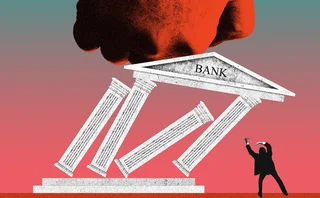
These developments raise an uncomfortable question: can the financial sector be left in charge of its climate transition? Market forces alone are unlikely to push banks and investors towards net zero. Instead, governments and regulators may have to step up their efforts to cajole – or bully – the industry in the required direction.
Regulators are already acting. The European Banking Authority is drafting guidance on how to reflect environmental risks in the bloc’s prudential regime. And the UK’s banking supervisor is looking to flesh out its own approach to climate-related financial risk by year-end.
As a global recession looms, some firms may be viewing the ESG label as a luxury: a nice-to-have, rather than a must-have
In many cases, financial institutions are proving amenable. In September, six large US banks agreed to participate in a pilot climate scenario analysis exercise to be conducted next year by the US Federal Reserve. More than 100 European banks took part in the EU’s climate stress test this year.
But the process of embedding climate risk into the working practices of financial institutions is not without friction. A political spat has erupted over the EU’s plan to introduce climate risk weights to bank capital requirements. The proposals include a 150% risk weight for existing fossil-fuel exposures, and an alarming 1,250% risk weight for new lending.
The logic behind the draft rules is clear: by levying punitive amounts of regulatory capital against fossil-fuel exposures, lawmakers hope to force banks to scale back lending for oil, gas and coal projects.
There are two problems with the idea, though. One, choking off funds from the likes of BP and Total may end up stunting oil majors’ investment in renewable energy projects. Two, war in Ukraine has forced energy-deprived European countries to dust off gas storage facilities and rekindle coal-fired power stations. Now may not be the best time to punish banks for funding such activities.
A political squall has also whipped up in Texas, after the state passed a law preventing its public-sector pension plans from engaging financial companies that use ESG screening. The state has drawn up a blacklist of 10 investment firms, including BlackRock, BNP Paribas and UBS. Many view the Texan shakedown on ESG investors as a political move to appease an energy industry that dominates the state’s economy.
And while the politicians and lobbyists bicker, the doomsday clock continues to tick. After record heatwaves, floods and wildfires across the globe, activists are urging lawmakers to turn up the heat on legislative progress. The pace of change, they say, is not fast enough to meet net-zero commitments.
Take the Basel Committee on Banking Supervision. The global standard-setter created a task force on climate-related financial risks in 2020. More than two years later, the body released a 15-page document with a handful of high-level principles on climate risk. In that time, around 2.5 trillion tonnes of ice around the world have melted and sea levels have risen a centimetre.
Extrapolate that same rate of progress – which critics have described as glacial – and even the glaciers may have melted into oblivion.
コンテンツを印刷またはコピーできるのは、有料の購読契約を結んでいるユーザー、または法人購読契約の一員であるユーザーのみです。
これらのオプションやその他の購読特典を利用するには、info@risk.net にお問い合わせいただくか、こちらの購読オプションをご覧ください: http://subscriptions.risk.net/subscribe
現在、このコンテンツを印刷することはできません。詳しくはinfo@risk.netまでお問い合わせください。
現在、このコンテンツをコピーすることはできません。詳しくはinfo@risk.netまでお問い合わせください。
Copyright インフォプロ・デジタル・リミテッド.無断複写・転載を禁じます。
当社の利用規約、https://www.infopro-digital.com/terms-and-conditions/subscriptions/(ポイント2.4)に記載されているように、印刷は1部のみです。
追加の権利を購入したい場合は、info@risk.netまで電子メールでご連絡ください。
Copyright インフォプロ・デジタル・リミテッド.無断複写・転載を禁じます。
このコンテンツは、当社の記事ツールを使用して共有することができます。当社の利用規約、https://www.infopro-digital.com/terms-and-conditions/subscriptions/(第2.4項)に概説されているように、認定ユーザーは、個人的な使用のために資料のコピーを1部のみ作成することができます。また、2.5項の制限にも従わなければなりません。
追加権利の購入をご希望の場合は、info@risk.netまで電子メールでご連絡ください。
詳細はこちら 我々の見解
なぜ破綻処理計画を骨抜きにするのは良くないのか
銀行の破綻は避けられないものですが、銀行危機はそうではありません
日本の「大還流」?急速なリパトリは期待できない
GPIFによる米国債から日本国債への切り替えは段階的に行われる見通しであり、これはヘッジファンドにとってさらなる悪材料となる可能性があります

AIエージェントが、信頼できないスタッフのような存在である理由
GenAIシステムに内在する不確実性により、リスク管理担当者はより対立的なアプローチをとらざるを得ません

批判派は、パーペチュアルはすべてフロスだと言っています。しかし、数字はそうではないことを示唆している
TradFiを原資産とする永久先物に対する堅調な未決済建玉は、CMEやEurexといった既存の取引所にとって脅威となる可能性があります

SpaceXがCMEの個別銘柄先物に待望の追い風をもたらした
S&P 500先物契約へのIPO関連の追加契約として、新たな契約が急増する可能性があります
Bank vs non-bank: FX’s two-tier reality
CME and LSEG data show banks provide sticky and broad liquidity, while non-banks cling tightly to the price

規制当局はエンフォースメントを甘くしているのか?(そして、私たちはそれを気にするべきなのか?)
米国の規制当局は、技術的な規則違反に対する罰則を緩和しており、小さくとも重要なリスクが見過ごされてしまうのではないかという懸念が高まっています

FX HedgePoolを超えて:オール・トゥ・オール(All-to-All)の今後はどうなる?
この取引モデルの支持者たちは、その将来性を明るく見ていますが、普及に向けた障壁は依然として残っています。
