Swaps data: the monopoly effect in clearing
There are only a handful of products where clearing volumes are evenly split between rivals

Regulators made swaps clearing a plank of their post-crisis reforms for good reasons – they wanted the management of counterparty risk to be carried out by tightly regulated, centralised hubs, in a more visible, standardised way. They probably did not want to create a tiny group of systemically important monopolies, but that was always one possible outcome.
Exchanges and central counterparties (CCPs) benefit immensely from netting effects, so scale tends to win out.
This tendency can be seen when breaking down cleared derivatives volumes for the full year of 2017 by asset class. LCH dominates the interest rate and foreign exchange markets, while Ice is by far the biggest clearer of credit derivatives.
A more nuanced picture emerges when asset classes are broken down by currency. Suddenly, other names appear: for example, ASX in Australian dollars, CME in Brazilian reals, Mexican peso and US dollar, Comder in Chilean peso, Japan Securities Clearing Corporation (JSCC) in yen, Shanghai Clearing House in yuan.
In some cases, these CCPs have a foothold, in others they are completely dominant – only in a couple of cases is market share evenly split between a couple of strong venues.
There are reasons to think this may change for some products over the coming year – Eurex may be able to capitalise on the uncertainty created by Brexit, for example. But if liquidity continues to attract liquidity, it will be interesting to see how regulators – and the market itself – responds.
Cleared interest rate swaps in major currencies
First, let’s look at gross notionals for cleared swaps in 2017 – encompassing vanilla interest rate swaps, overnight index swaps, basis swaps, zero coupon swaps and variable notional swaps for the six major currencies.
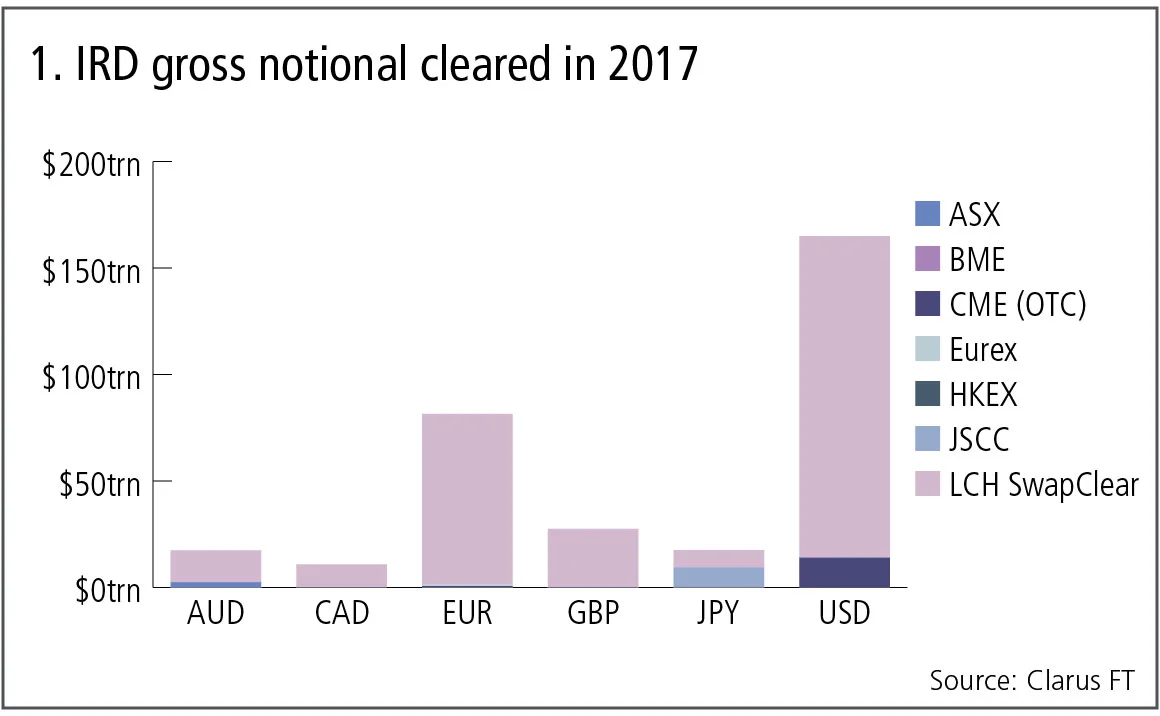
Figure 1 shows:
- The US dollar is by far the largest with $165 trillion of gross notional (single-sided).
- Euro next with $81.5 trillion of gross notional.
- Sterling follows with $27.5 trillion.
- Australian dollar and yen are similar with $17.5 trillion.
- Canadian dollar has $11 trillion.
- This means there is a cumulative gross notional of $320 trillion.
LCH’s SwapClear dominates the volume in each of these major currencies, which we can represent in a 100% stacked bar chart.
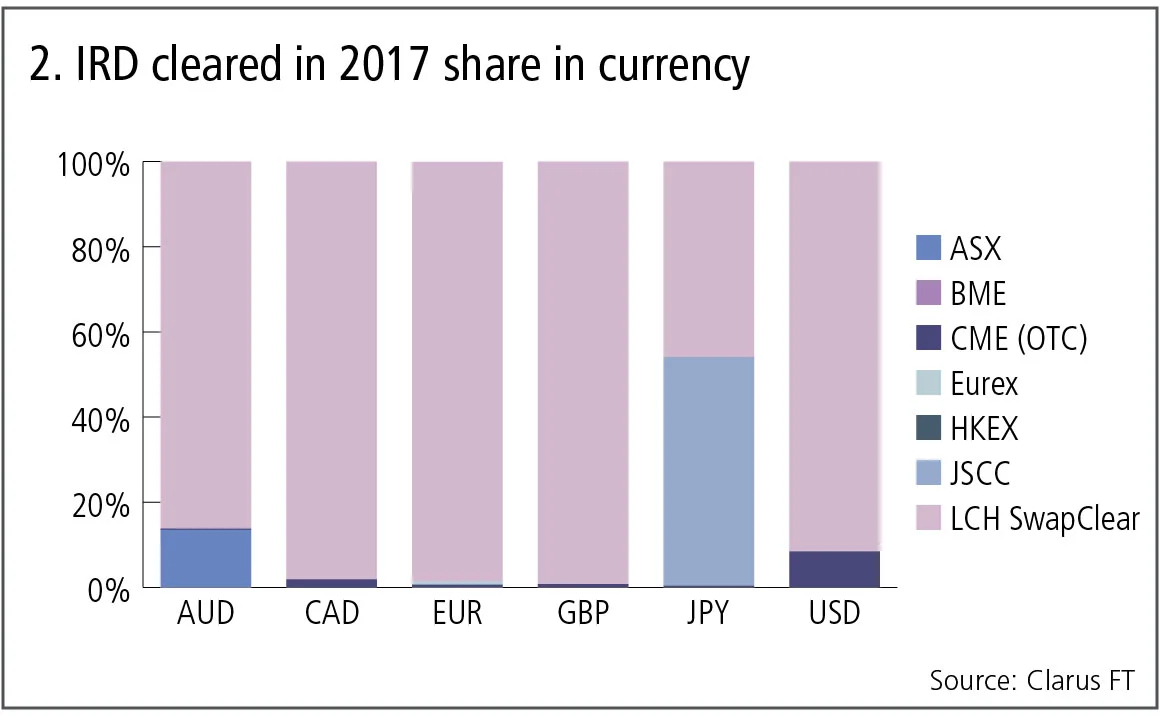
Figure 2 shows:
- In Australian dollars, SwapClear has 86% share and ASX 13.5%.
- In Canadian dollars, euros and sterling, SwapClear has more than a 98% share.
- In yen, JSCC has 53.7% and SwapClear has a 45.9% share.
- In US dollars, SwapClear has 91.6% and CME has an 8.4% share.
The dominance of LCH SwapClear is understandable as it was the first clearing house to offer interest rate swaps clearing – starting in 1999 – and there are significant network netting and cost efficiencies for members and clients in having all currencies in one clearing service.
However, the growth of JSCC, which for the first time in 2017 exceeded SwapClear in yen volume, shows it is possible for regional clearing houses to dominate in their domestic currency. ASX and CME have also captured positions in their domestic currencies.
Leading up to Brexit in March 2019, it is likely we will see BME and Eurex gain market share. Whether this reduces SwapClear’s share in euro swaps to 90% or 50% - and in what timeframe – is impossible to predict. The best we can do is observe month-on-month data and project trends. Last year’s data doesn’t suggest an impending sea-change, but 2018 is a key year in this regard.
Cleared interest rate swaps in more currencies
Let’s now turn to other currencies where 2017 cleared gross notional exceeded $1 trillion.
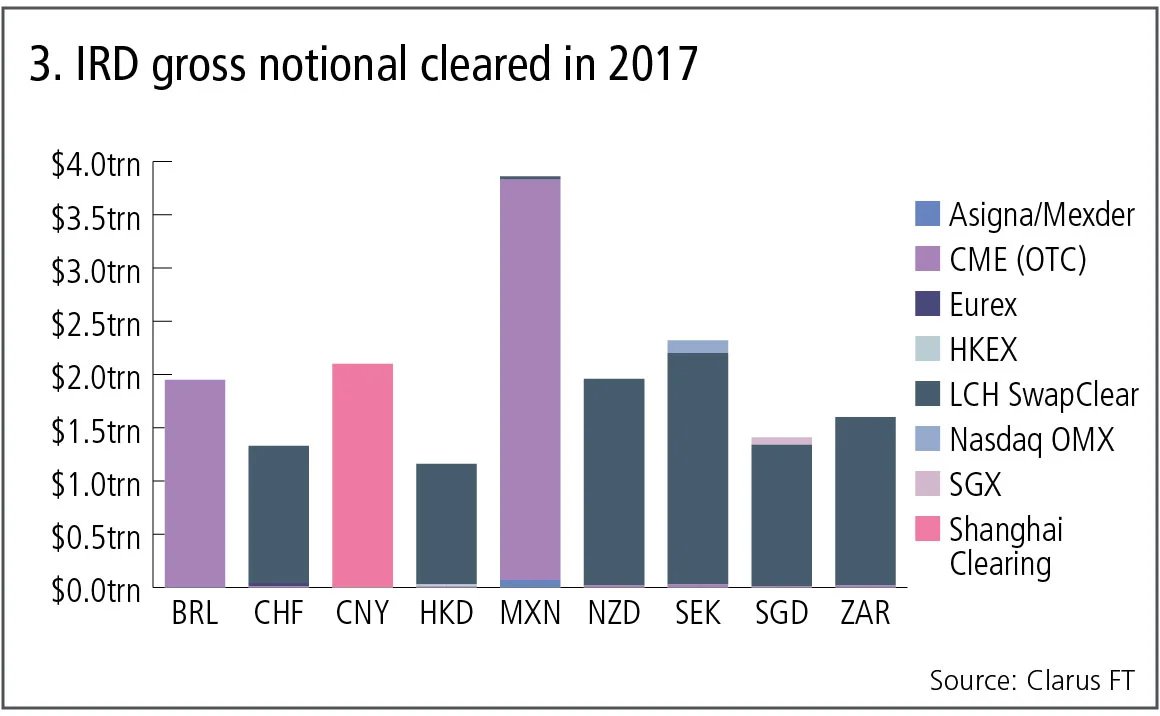
Figure 3 shows:
- The Mexican peso is by far the largest with $4 trillion gross notional.
- The Swedish krona is next with $2.3 trillion.
- The yuan, Brazilian real and New Zealand dollar follow, each with around $2 trillion.
- The cumulative gross notional in these nine currencies is $18 trillion.
- CME dominates the Brazilian real and Mexican peso.
- Yuan is dominated by Shanghai Clearing House.
- LCH dominates in the rest.
- Nasdaq in Swedish krona, SGX in Singapore dollar and Mexder in Mexican peso are also visible in the chart.
Interestingly, none of the Danish krone, Hungarian forint, Norwegian kroner or Polish zloty – each active swap markets – makes this list.
Cleared credit derivatives
Next up: volumes of cleared credit index trades and single-name credit default swaps (CDSs).
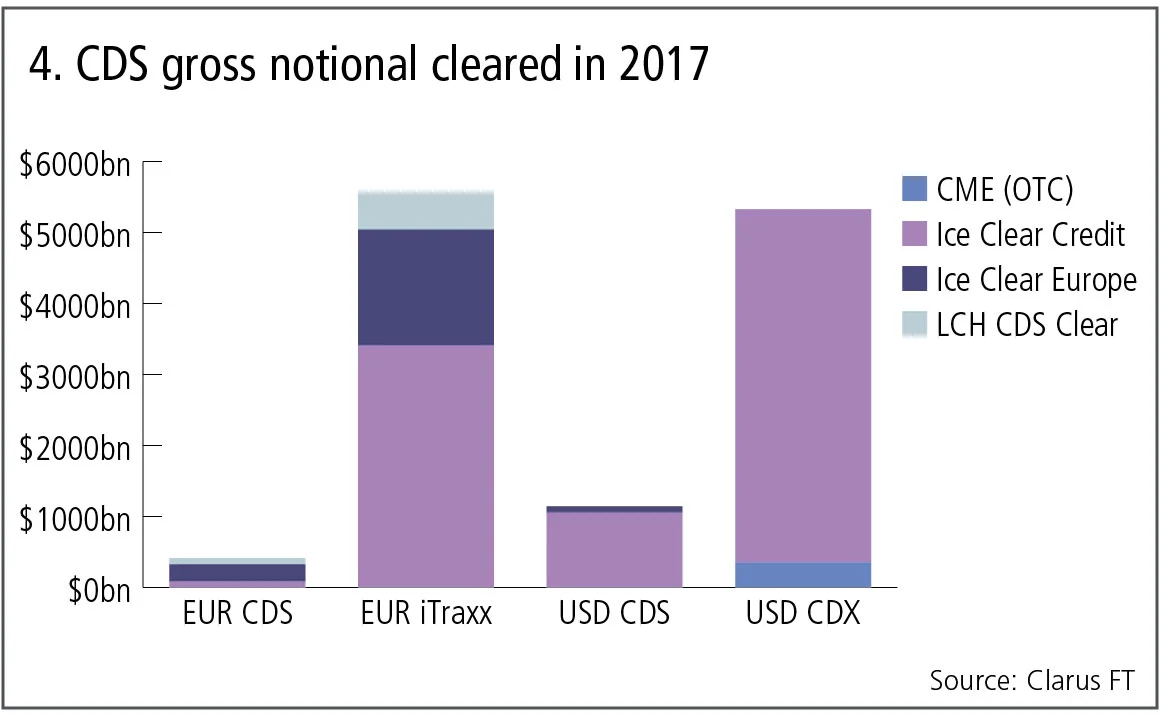
Figure 4 shows:
- Euro iTraxx and US dollar CDX are similar in size, each at $5.5 trillion gross notional.
- US dollar CDS notionals are much lower at $1.1 trillion.
- Euro CDS notionals are lower still at $400 billion.
- Yen iTraxx and CDSs – at JSCC – are too small to show on the chart.
- Ice Clear Credit dominates US dollar CDX with 93% share and US dollar CDSs with 92% share.
- Ice Clear Credit is also the largest in euro iTraxx with 61%.
- Ice Clear Europe has 59% of euro CDS notionals and 29% of euro iTraxx.
- LCH CDSClear has 21% of euro CDS notionals and 9.5% of euro iTraxx.
In a similar manner to interest rates, one clearing house – in this case, Ice – dominates volumes.
Cleared foreign exchange derivatives
Non-deliverable forwards (NDFs) are currently the only cleared OTC forex derivative, so let’s look next at their volumes in 2017, broken out by the largest currency pairs.
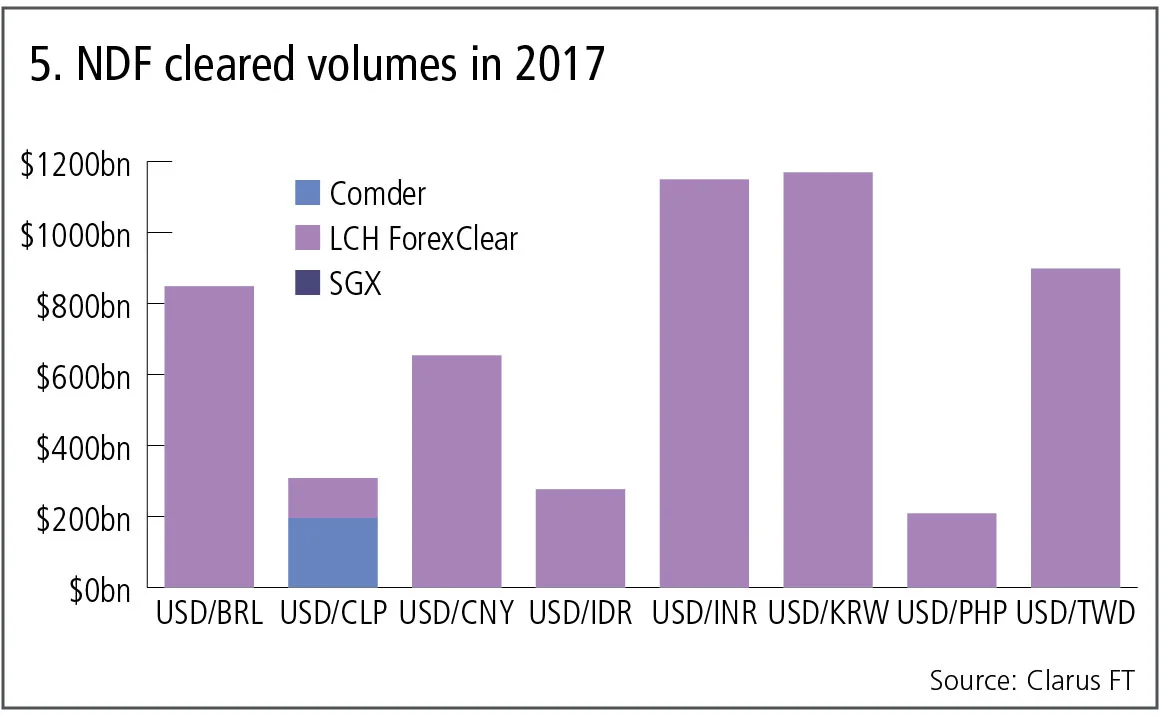
Figure 5 shows:
- South Korean won and Indian rupee are the largest currency pairs, each with $1.15 trillion gross notional.
- Taiwan dollar and Brazilian real are next with $0.9 trillion and $0.85 trillion, respectively.
- Yuan with $0.65 trillion is the other currency greater than $0.5 trillion.
- The cumulative volume of the largest eight currencies is $5.5 trillion.
- That makes the market roughly comparable to US dollar CDX or euro iTraxx.
- Volumes are dominated by LCH’s ForexClear.
We know cleared NDF volumes at ForexClear saw massive year-on-year growth in 2017 – a well-reported consequence of the imposition of new margin requirements for non-cleared derivatives. It will be interesting to see whether this growth continues into 2018 and beyond.
Even more interesting is the fact that both CME and LCH expect to launch clearing of forex options this year – a big derivatives product, and one to watch in 2018.
In summary, the data shows market share in each asset class is currently dominated by a single clearing house with a few regional exceptions.
コンテンツを印刷またはコピーできるのは、有料の購読契約を結んでいるユーザー、または法人購読契約の一員であるユーザーのみです。
これらのオプションやその他の購読特典を利用するには、info@risk.net にお問い合わせいただくか、こちらの購読オプションをご覧ください: http://subscriptions.risk.net/subscribe
現在、このコンテンツを印刷することはできません。詳しくはinfo@risk.netまでお問い合わせください。
現在、このコンテンツをコピーすることはできません。詳しくはinfo@risk.netまでお問い合わせください。
Copyright インフォプロ・デジタル・リミテッド.無断複写・転載を禁じます。
当社の利用規約、https://www.infopro-digital.com/terms-and-conditions/subscriptions/(ポイント2.4)に記載されているように、印刷は1部のみです。
追加の権利を購入したい場合は、info@risk.netまで電子メールでご連絡ください。
Copyright インフォプロ・デジタル・リミテッド.無断複写・転載を禁じます。
このコンテンツは、当社の記事ツールを使用して共有することができます。当社の利用規約、https://www.infopro-digital.com/terms-and-conditions/subscriptions/(第2.4項)に概説されているように、認定ユーザーは、個人的な使用のために資料のコピーを1部のみ作成することができます。また、2.5項の制限にも従わなければなりません。
追加権利の購入をご希望の場合は、info@risk.netまで電子メールでご連絡ください。
詳細はこちら コメント
オペリスク・データ:日本のレストラン向け決済企業が7億ドルの損失を計上
また、バローダ銀行の詐欺事件の提訴、ウェルズ・ファーゴのポンジ・スキーム問題、そしてスウェドバンクのパナマ文書関連の賠償金支払いについても取り上げます。データ提供:ORX News

プライベートクレジットリスクは、システミックなものでなくても深刻になり得る
リスク管理のリーダーが、プライベートクレジット部門のリスクは抑制されているという共通認識に存在する3つの欠陥について概説しました

無期限先物:満期がなくなる時代、ガバナンスが鍵となる
ヴィシャル・グプタ氏は、無期限先物が先物のロールオーバー問題を解決する一方で、市場構造や規制上のリスクを抱えていると警告しています

オペリスクに関するデータ:ペントウォーター社、エイビス株の試運転に多額の費用を投じる
また、ルーマニアのロボル監督当局がベンチマーク操作に対して厳しい姿勢を示しました。Wamcoによる「チェリーピッキング」も阻止されました。データ提供:ORX News

ユーロ対米ドルのステーブルコインをめぐる議論は的外れである
Flow Tradersのデジタル資産部門責任者は、ステーブルコインの流動性の進化において、市場構造と規制の整合性が中心的な役割を果たしていると述べています。

AIのコンピューティングにあるガバナンス問題
取引所がコンピューティング先物の導入に乗り出す中、ヴィシャル・グプタ氏は、真の試練は製品の革新性ではなく、ガバナンスがその進展に追いつけるかどうかにあると主張しています

なぜ価格が急騰する?
「長年にわたる調査を経ても、依然としてはっきりとは分かっていない」とジャン=フィリップ・ブショー氏は述べています

ギャップリスクは気にしないで:クレジット・リパックの規制上の取り扱い
シニア・クオンツのアンデレイ・チリキン氏は、リパッケージングにおけるギャップ・リスクは、バーゼルIIIの自己資本規制上の信用評価調整には該当しないと主張しています