Credit data: UK retail sector’s woes continue
High street fails to get over Christmas slump; elsewhere, global PDs remain in flux, writes David Carruthers of Credit Benchmark

If Britain is a nation of shopkeepers, it is not presently a happy one. The UK’s looming exit from the European Union has been widely blamed for damaging confidence among employers, which has had the knock on effect of damping wage growth and, in turn, eroding consumer confidence. The rise in import costs stemming from the collapse in sterling that followed the vote certainly hasn’t helped.
The effects on the high street have been calamitous (see figure 2): the surprise 1.4% drop in UK retail sales data in the key month of December was followed by a flat January, with sales growing just 0.1%. Overall, sales volume growth in 2017 was the lowest since 2013. Rising costs and weak demand, coupled with the impact of the inexorable shift towards online shopping among consumers, has led some British mainstays to consider closing stores (clothes retailers such as Debenhams and New Look) while others have recently fallen into administration (children’s store Toys R Us and electrical goods retailer Maplin).
Elsewhere, the credit outlook for global corporates across a range of sectors finds itself in an odd state of equilibrium: upgrades dominate downgrades in three out of nine reported industries; three industries are dominated by downgrades; and three are balanced. The global steel sector – currently wrestling with US president Donald Trump’s imposition of protectionist tariffs – is a case in point (see figure 3). Probabilities of default (PDs) for US steelmakers continue to steadily improve, while that of non-US steelmakers continues to decline – though the former are coming off a much lower base, and are yet to match the latter in terms of average credit quality.
Global credit industry trends
Figure 1 shows industry migration trends for the most recent published data.
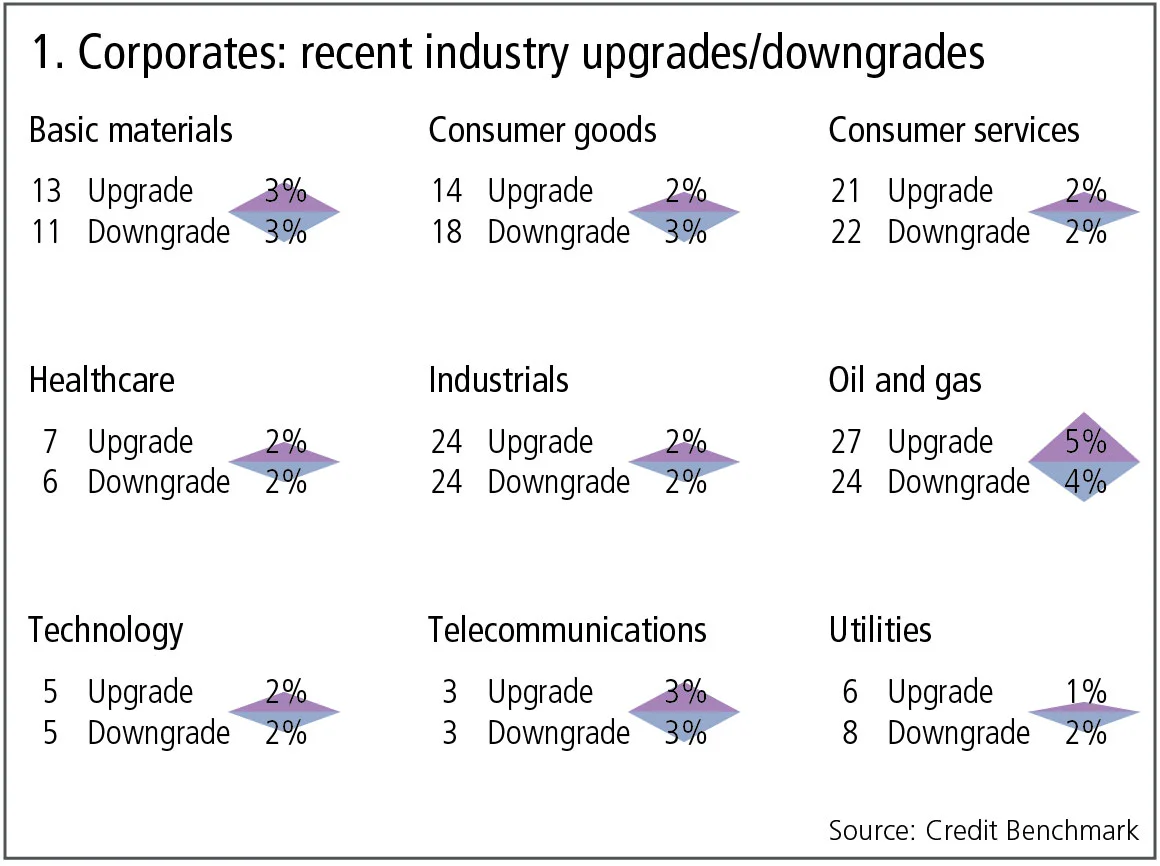
Figure 1 shows:
- Overall, 3% of the global corporates obligors have improved and 3% show a deterioration. Compared with the previous month, the imbalance between upgrades and downgrades has decreased.
- Basic materials and oil and gas continue to show a balance in favour of upgrades, continuing their recent patterns.
- In healthcare, upgrades continue to outweigh downgrades after a period where downgrades dominated.
- Consumer goods have returned to their recent pattern of downgrades outnumbering upgrades.
- After favouring upgrades for a number of months, utilities now show a balance of downgrades.
- Consumer services, industrials, technology and telecommunications are balanced or close to balanced.
UK retail
Figure 2 shows credit risk trends and the credit distribution for 370 large UK companies in the general retail sector.
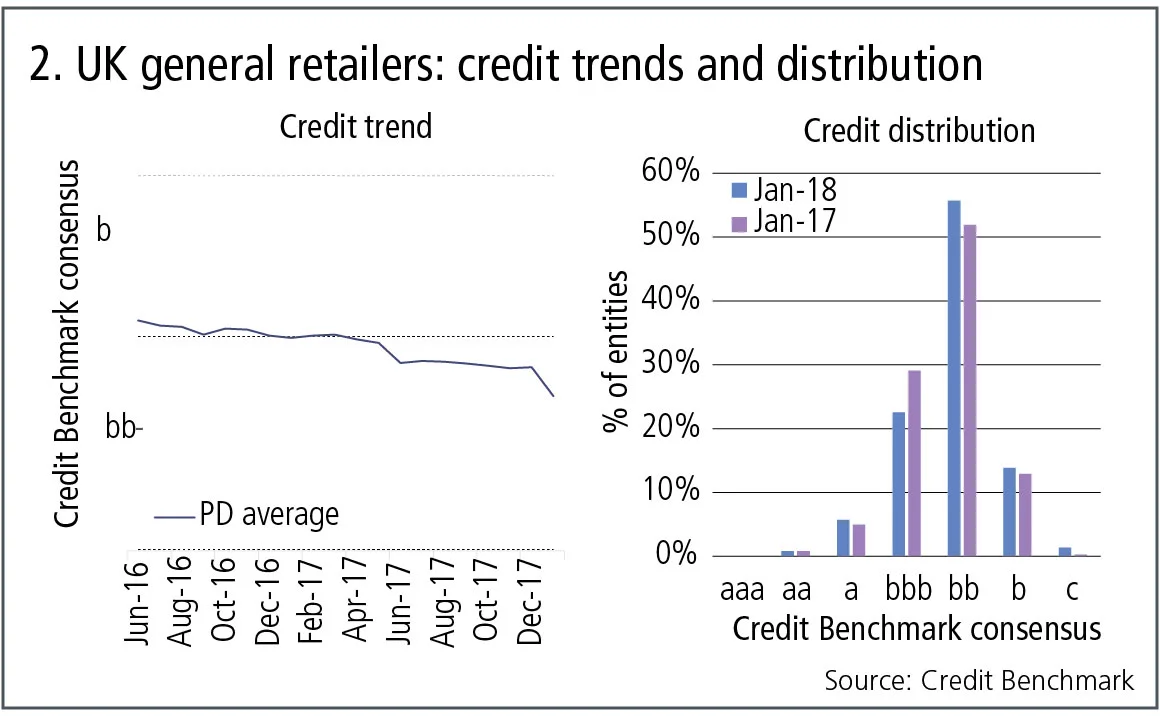
Figure 2 shows:
- The left-hand chart shows that the credit risk of UK general retailers has been increasing over the past 20 months.
- The sector was downgraded from bb to bb– in April 2017. The average probability of default (PD) increased by 20% between January 2017 and January 2018.
- The right-hand chart shows that more than 70% of the UK general retailers are now viewed as non-investment grade, an increase from 65% in January 2017.
US steel
Donald Trump’s presidential campaign promised to protect the US steel industry and boost employment in the Rust Belt; the industry currently employs around 80,000, down from its peak of 700,000 in the 1950s. The latest executive order imposes 25% tariffs on all steel imports, and some mothballed mills are already coming back on stream as a result. Various countries are lobbying for exemptions but the main target is China, which now produces half of the world’s steel.
Figure 3 shows the contrasting credit trends for US and ex-US steel companies since September 2016. This sample officially covers iron and steel companies.
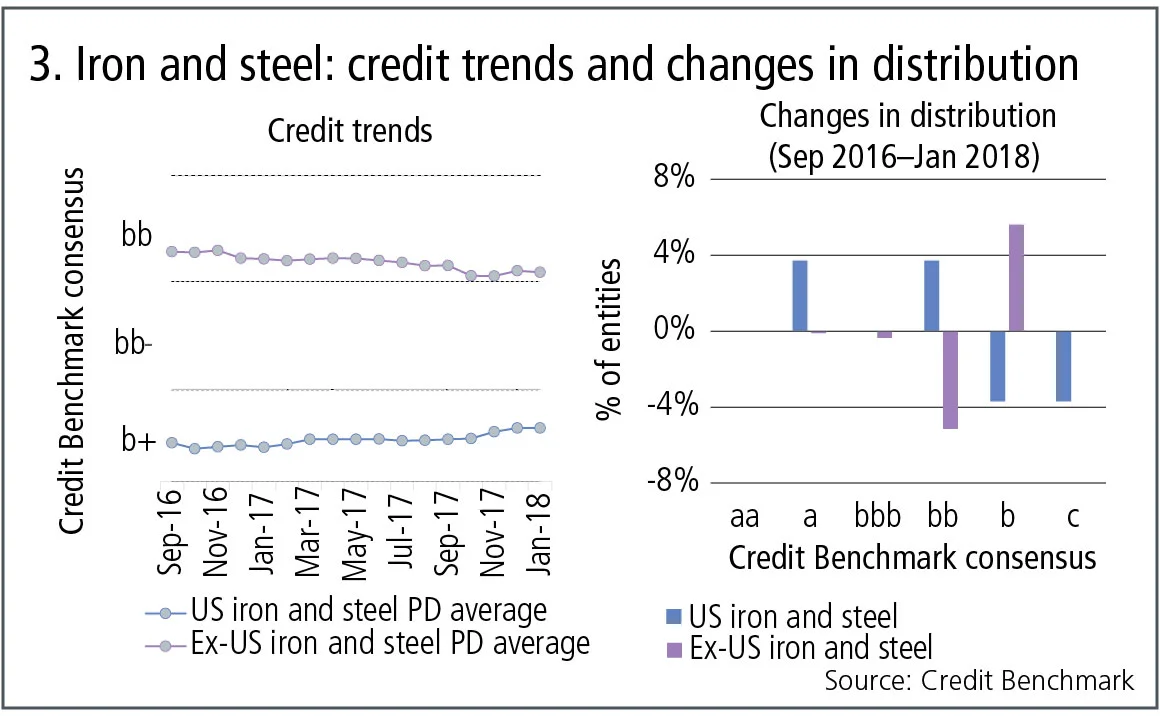
Figure 3 shows:
- Credit risk in US iron and steel has been steadily improving, while credit risk for ex-US iron and steel has deteriorated. If these trends continue, the typical credit rating of ex-US iron and steel companies could drop from bb to bb–.
- US iron and steel has a lower level of credit quality over this period; but based on recent trends the US and ex-US indexes are slowly converging.
- Over the past 15 months, US iron and steel has seen an improvement in its lower-quality names while ex-US iron and steel has seen deterioration in the a, bbb and bb categories.
Global mining
The past few years have been volatile for the global mining industry. Yields are declining as existing ore bodies are worked out, which is constraining supply. At the same time, battery-driven demand for “tech metals” – nickel, lithium, vanadium, cobalt, graphite and a range of rare earths – is set to accelerate. This is mainly due to the wider global adoption of electric vehicles, solar cells and mobile phones; as well as the broader need to store electricity from renewable sources. Figure 4 plots the 2017 credit trends for 184 international companies in the gold and general mining sectors.
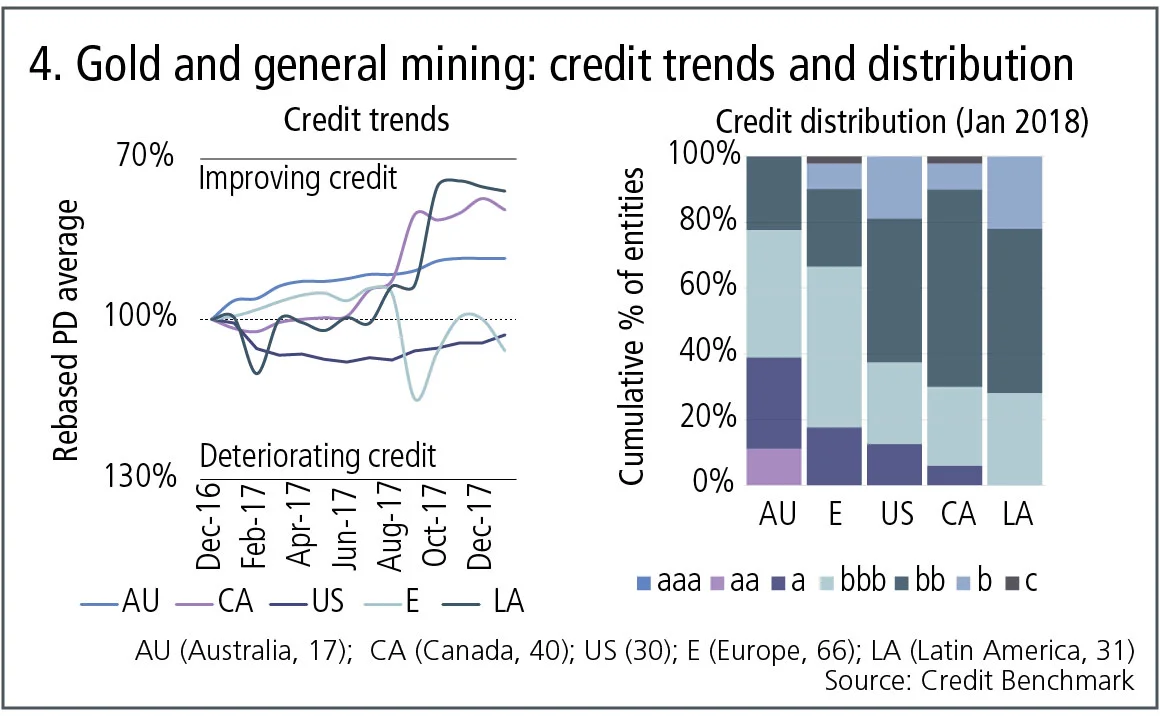
Figure 4 shows:
- The left-hand chart shows that credit quality of Canadian and Latin American mining companies has improved in 2017, especially in the final quarter of the year.
- Australian mining companies show a steady upward trend.
- Europe has been very volatile – partly a reflection of the large but diverse sample of companies in the index.
- The US is showing a slight recovery after a decline in the first half of the year.
- The right-hand chart shows that 78% of Australian mining companies are investment grade; for Canada, Latin America and the US, the figure is closer to 40%.
Global media
The global media industry faces some major challenges. Sluggish consumer spending has pushed various companies to cut back on advertising spend in order to restore margins. Procter & Gamble, for example, reduced its digital marketing spending by $100 million in Q2 of 2017. This is one example of a growing trend that questions the value of online advertising in particular – a previously lucrative area for advertising companies. Traditional media companies are suffering from online competition; companies such as Netflix have overturned the traditional business model for film and TV content.
Figure 5 shows the credit trends for the media industry over the past 15 months.
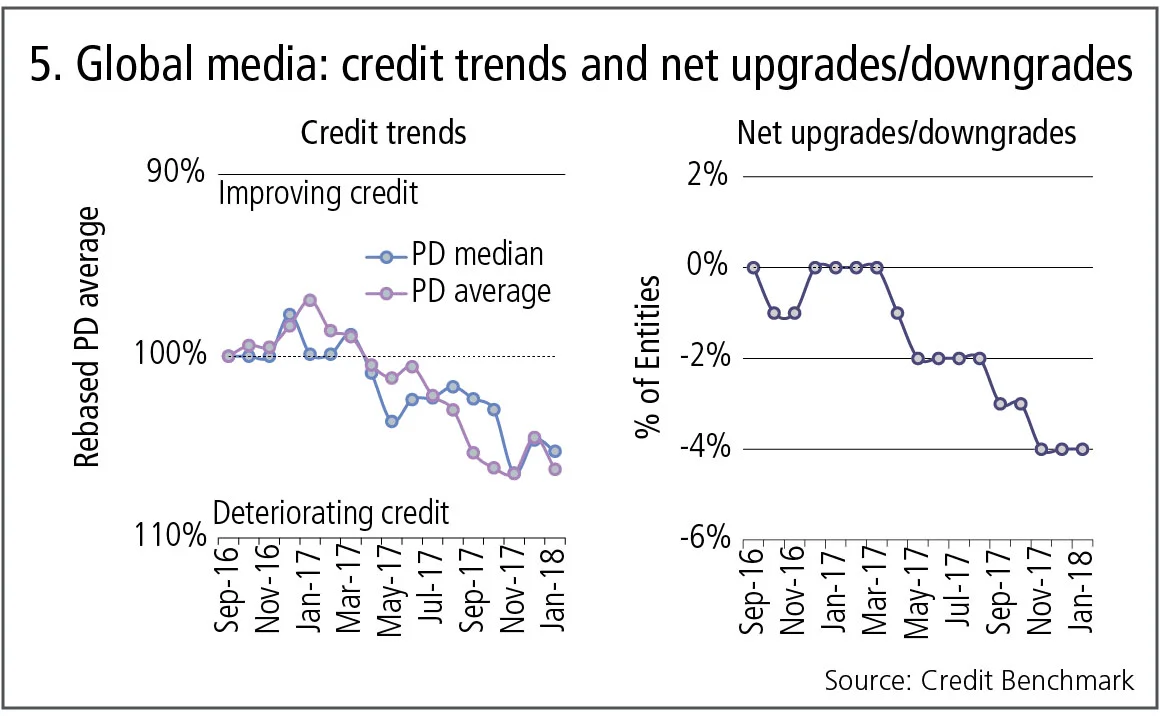
Figure 5 shows:
- The left-hand chart shows that from March 2017, there has been an overall deterioration in both the PD median and PD average of the global media industry.
- Over time, the number of downgrades has outweighed upgrades, with a net 4% of entities being downgraded across the 15-month time period.
About this data
The Credit Benchmark dataset is based on internally modelled credit ratings from a pool of contributor banks. These are mapped into a standardised 21-bucket ratings scale, so downgrades and upgrades can be tracked on a monthly basis. Obligors are only included where ratings have been contributed by at least three different banks, yielding a total dataset of roughly 14,500 names, which is growing by 5% per month.
David Carruthers is head of research at Credit Benchmark, a credit risk data provider.
Editing by Tom Osborn
コンテンツを印刷またはコピーできるのは、有料の購読契約を結んでいるユーザー、または法人購読契約の一員であるユーザーのみです。
これらのオプションやその他の購読特典を利用するには、info@risk.net にお問い合わせいただくか、こちらの購読オプションをご覧ください: http://subscriptions.risk.net/subscribe
現在、このコンテンツを印刷することはできません。詳しくはinfo@risk.netまでお問い合わせください。
現在、このコンテンツをコピーすることはできません。詳しくはinfo@risk.netまでお問い合わせください。
Copyright インフォプロ・デジタル・リミテッド.無断複写・転載を禁じます。
当社の利用規約、https://www.infopro-digital.com/terms-and-conditions/subscriptions/(ポイント2.4)に記載されているように、印刷は1部のみです。
追加の権利を購入したい場合は、info@risk.netまで電子メールでご連絡ください。
Copyright インフォプロ・デジタル・リミテッド.無断複写・転載を禁じます。
このコンテンツは、当社の記事ツールを使用して共有することができます。当社の利用規約、https://www.infopro-digital.com/terms-and-conditions/subscriptions/(第2.4項)に概説されているように、認定ユーザーは、個人的な使用のために資料のコピーを1部のみ作成することができます。また、2.5項の制限にも従わなければなりません。
追加権利の購入をご希望の場合は、info@risk.netまで電子メールでご連絡ください。
詳細はこちら コメント
ポッドキャスト:アリエ・シェーター氏とハリオム・タツァット氏によるAIの説明可能性に関する対談
バークレイズのクオンツたちが、メカニスティックな解釈可能性を用いたAIの監視手法について語ります

スイスフラン建てローンの損失は、EUの消費者金融業界にとっての灰色のサイである
mBankのCROであるマレク・ルシュティン氏は、ポーランドの銀行への影響が、法的リスクのモデリングにおける盲点を浮き彫りにし、それがより広範な影響を及ぼしていると述べています。

オペリスクデータ:EFG、20年にわたるマネーロンダリングで巨額の損失を被る
また、ディープフェイクによる音声クローンがインテサの部門を騙し、仮想通貨関連のハッキング事件が相次いでいます。データ提供:ORX News
ナビエ・ストークス方程式からキロ単位の論文まで:AIがクオンツ研究に与える影響
AIが大量の成果を生み出す中、金融業界では、その出所、信頼性、重要性を評価するための信頼できる手段が必要とされています

AIを正しい軌道に乗せ続けるには、継続的な検証が鍵となる
意思決定ごとの検証を行うことで、ユーザーがAIの判断を信頼できるようになります

AIがリスク管理の業務をうまくこなせるようになったら、どうなるのか?
リスク担当幹部であるアレックス・ゴルビン氏は、エージェント型AIが分析業務をますます担うようになる中、リスク分野で価値あるキャリアを築くにはどうすればよいかと問いかけます

変動の激しいエネルギー市場におけるインフレリスクの再評価
バークレイズのサミー・ベン・アウン氏は、インフレ・スワップのエネルギーショックに対する感応度をモデル化する手法について概説しています
KKR、合併前の届出不備により独占禁止法違反の罰金額で過去最高を記録した
また、メキシコ国債の相場操作スキャンダルでディーラー各社が多額の賠償金を支払うこととなりました。UBSではAMLのチェックが不十分だったことも判明しています。データ提供:ORX News