Podcast: Barzykin and Guéant on FX market-making
Industry quant teams up with academics to build better risk tools for FX markets


Foreign exchange is the largest financial market in the world. It is also among the least well understood. Much of the academic literature focuses on the dealer-to-client market and assumes banks simply quote prices and wait for clients to trade. The reality is far more complex, leading a trio of researchers to take a stab at designing better models for the market.
“In our two papers, we build models in which market-makers skew their quotes, but they can also unwind in the inter-bank segment of the market. So we have the dealer-to-dealer and the dealer-to-client markets,” says Olivier Guéant, professor of applied mathematics at Université Paris 1 Panthéon-Sorbonne.
Trading over-the-counter with other dealers greatly mitigates execution uncertainty, which is crucial for risk management. But it also means dealers face transaction costs and market impact, which must be factored into models. “Our model provides a framework for optimal risk management under these conditions,” explains Alexander Barzykin, director of global FX and commodities at HSBC.
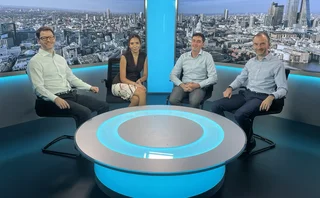
Guéant and Barzykin are our guests on this episode of Quantcast. The discussion focuses on two papers they co-authored with Philippe Bergault, assistant professor at Université Paris Dauphine-PSL, which were recently published in Risk.net.
The first of these works, published in August 2022, presents a market-making model for baskets of currency pairs. The framework can be used for determining the optimal level of externalisation, or hedging in the open market, and by extension, the level of risk that can be held in the portfolio and offset with client trades, or internalised .
The second paper, published in March 2023, builds on the previous work to develop a portfolio-level, multi-currency model that allows the user to determine optimal prices and hedging rates as functions of their inventory, risk aversion and market-driven parameters.
That took some tricks and ad hoc solutions. First, monetary amounts were converted to USD. That may sound trivial, but it significantly simplified the calculations. Second, they had to deal with the curse of dimensionality, a product of a partial integral differential equation in the formulation. Luckily, Guéant and Bergault had previously developed a solution that reduced the problem to a linear quadratic control problem, which turned out to be applicable to this case.
Guéant sees clear benefits in a portfolio-level approach: “The consequence for clients of the market-maker using a portfolio-level model is that they should experience better prices and less market footprint because there is less externalisation.”
Guéant and Barzykin also discuss their long collaboration, which is likely to continue with further extensions of their model – though they are confident the current version is now ready for use. Meanwhile, the model has caught the attention of the IEF/SCOR Foundation for Science, which recognised Guéant as best young researcher in finance and insurance on March 21.
Index
00:00 Introduction
03:46 Inventory risk, internalisation and externalisation
08:45 The currency-pairs approach
10:55 The multi-currency, portfolio-level approach
22:43 Applicability and results of the multi-currency model
32:02 Risk management using the model
35:25 Collaboration between industry and academia
42:10 The next version of the model
To hear the full interview, listen in the player above, or download. Future podcasts in our Quantcast series will be uploaded to Risk.net. You can also visit the main page here to access all tracks, or go to the iTunes store, Spotify or Google Podcasts to listen and subscribe.
コンテンツを印刷またはコピーできるのは、有料の購読契約を結んでいるユーザー、または法人購読契約の一員であるユーザーのみです。
これらのオプションやその他の購読特典を利用するには、info@risk.net にお問い合わせいただくか、こちらの購読オプションをご覧ください: http://subscriptions.risk.net/subscribe
現在、このコンテンツを印刷することはできません。詳しくはinfo@risk.netまでお問い合わせください。
現在、このコンテンツをコピーすることはできません。詳しくはinfo@risk.netまでお問い合わせください。
Copyright インフォプロ・デジタル・リミテッド.無断複写・転載を禁じます。
当社の利用規約、https://www.infopro-digital.com/terms-and-conditions/subscriptions/(ポイント2.4)に記載されているように、印刷は1部のみです。
追加の権利を購入したい場合は、info@risk.netまで電子メールでご連絡ください。
Copyright インフォプロ・デジタル・リミテッド.無断複写・転載を禁じます。
このコンテンツは、当社の記事ツールを使用して共有することができます。当社の利用規約、https://www.infopro-digital.com/terms-and-conditions/subscriptions/(第2.4項)に概説されているように、認定ユーザーは、個人的な使用のために資料のコピーを1部のみ作成することができます。また、2.5項の制限にも従わなければなりません。
追加権利の購入をご希望の場合は、info@risk.netまで電子メールでご連絡ください。
詳細はこちら カッティング・エッジ
ポッドキャスト:アレクサンダー・バルジキン氏によるFXマーケットメイキングのモデリングについて
HSBCのクオンツが、逆選択、価格の読み取り、および内部流動性管理について論じます

逆選抜と価格観測下における最適な価格提示
現実世界における重要な影響を考慮するために、マーケットメイキング・モデルが導入されています。

ポッドキャスト:バーネット氏とピアウ氏が語る、XVAに関する包括的なフレームワーク
バークレイズのクオンツ担当者が、長年の課題に対する同行のアプローチについて解説します
価格調整の基本的な表現
デリバティブ価格調整の統一的な表現について提示します

混合モデルフレームワークにおけるテールの調整
ファットテール特性を再現するために、ガウス分布とスチューデントのt分布を組み合わせたデータ生成器をご紹介します

一味違う微分機械学習
不連続なペイオフを持つデリバティブの価格算定における近似精度を向上させる手法が提案されています

ポッドキャスト:リプトン氏とロペス・デ・プラド氏による、プライベート・エクイティへのクオンツ・アプローチについて
両氏は、プライベート・アセットへの投資の評価および配分に関する分析手法を紹介しています。

金融分野におけるランダム化準モンテカルロ法の驚くべき有効性
シミュレーション手法の分析により、アジア型オプションに最も適した手法が明らかになりました