
Technical paper
Monthly snapshot
market data
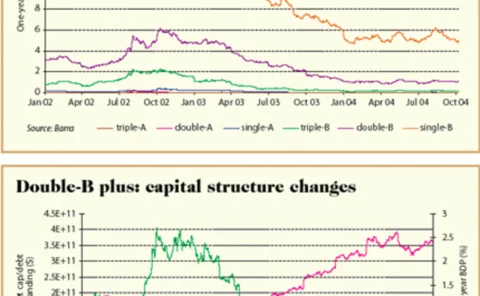
Default lines
market graphics

Counting on foreign cash
foreign investment
Earnings at risk
The structure of a typical energy portfolio often contains a different assetand contract mix from the simple derivatives instruments in a more standard portfolio.This requires a different approach to risk. Here, Les Clewlow and ChrisStrickland make the…
In the core of correlation
The single-factor Gaussian copula model has become a benchmark for the pricing and risk management of basket credit derivatives and synthetic CDO tranches. However, recent months have seen the development of a market for tranched synthetic indexes,…
Detecting market abuse
Financial regulators need a way to detect market abuse in real time. Marcello Minenna has developed such a procedure that can detect, for each quoted stock and on a daily basis, the presence of market abuse phenomena by means of a set of tripwires that…
Maximum drawdown
The maximum loss from a market peak to a market nadir, commonly called the maximum drawdown (MDD), measures how sustained one’s losses can be. Malik Magdon-Ismail and Amir Atiya present analytical results relating the MDD to the mean return and the…
HSBC
Quant analysis by Arete Consulting
CIC
Quant analysis by Arete Consulting
Nvesta
Quant analysis by Arete Consulting
CNP
Quant analysis by Arete Consulting
Smile dynamics
Traditionally, smile models have been assessed according to how well they fit market option prices across strikes and maturities. However, the pricing of most recent exotic structures, such as reverse cliquets or Napoleons, is more dependent on the…
Correlating market models
While swaption prices theoretically contain information on interest rate correlation, Bruce Choy, Tim Dun and Erik Schlögl argue that, for any practical purpose, this information cannot be extracted. Care must therefore be taken when pricing correlation…
A decent exposure
Weather risk
A credit loss control variable
Viktor Tchistiakov, Jeroen de Smet and Peter-Paul Hoogbruin explain and demonstrate how the efficiency of Monte Carlo simulation in valuing a portfolio of credit risky exposures is improved by the use of the Vasicek distribution as a control variable. An…
Estimating economic capital allocations for market and credit risk
Value-at-Risk (VAR) measures often are used as a basis for setting so-called"economic capital" or buffer stock measures of equity capitalization requirements.VAR measures do not account for the time value of money or theequilibrium required return…