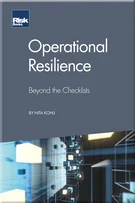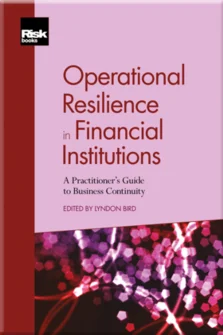
Operational Resilience in Financial Institutions
First published:
ISBN: 9781782720966
If you are a Risk.net subscriber you are entitled to 20% off your Risk books purchases. Please email enquiries@riskbooks.com for more information.
As part of your Risk.net subscription you are entitled to 20% off all of your Risk Books purchases. If you would like to place an order please email enquiries@riskbooks.com
What Does Good Business Continuity Management Look Like? Metrics and Performance Indicators
Frank Lady
What Does Good Business Continuity Management Look Like? Metrics and Performance Indicators
Introduction
The Value of Horizon Scanning in Setting Business Continuity Policy
Monitoring Emerging Risks
Understanding and Analysing the Consequences of Business Disruption
Managing Operational Risk
Building a Resilient Capability
Cyber Resiliency: A Business Continuity Perspective
Business Continuity Management and Compliance: Legislation, Regulation and Standards
Effective Crisis Management
Embedding Business Continuity Management into Business Culture: An Asian Perspective
Scenario-based Crisis Management Exercising
The Future of Business Continuity Tools and Techniques
The Business Benefits of Business Continuity
Engaging the Board: Resilience Measured
What Does Good Business Continuity Management Look Like? Metrics and Performance Indicators
The previous chapters have outlined the essential components of successful business continuity management (BCM), with a particular focus on the financial sector: identifying potential threats; mitigating their impact; providing an effective response process; and safeguarding the interests of an organisation’s stakeholders (shareholders/owners, employees, customers).11 Adapted from BCM definition, ISO22301: 2012. Three more simply stated themes emerge from this concept that illuminate the enduring objectives of BCM: managing risk, improving resilience and controlling cost. With these objectives in view, this final chapter will focus on how BCM’s leadership measures success, as the programme navigates along the pathway of creating and sustaining excellence.
Successful BCM must achieve a balanced approach to meeting these three competing objectives. Threats typically increase over time in strength and number. Institutions cannot mitigate all risks or achieve perfect resilience. BCM leadership must therefore strive to achieve the greatest amount of organisational resilience for the least expense.
This chapter will address the key elements of these three themes: what to measure
Copyright Infopro Digital Limited. All rights reserved.
As outlined in our terms and conditions, https://www.infopro-digital.com/terms-and-conditions/subscriptions/ (point 2.4), printing is limited to a single copy.
If you would like to purchase additional rights please email info@risk.net
Copyright Infopro Digital Limited. All rights reserved.
You may share this content using our article tools. As outlined in our terms and conditions, https://www.infopro-digital.com/terms-and-conditions/subscriptions/ (clause 2.4), an Authorised User may only make one copy of the materials for their own personal use. You must also comply with the restrictions in clause 2.5.
If you would like to purchase additional rights please email info@risk.net