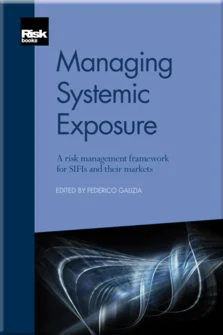
Managing Systemic Exposure
First published:
ISBN: 9781782720102
If you are a Risk.net subscriber you are entitled to 20% off your Risk books purchases. Please email enquiries@riskbooks.com for more information.
As part of your Risk.net subscription you are entitled to 20% off all of your Risk Books purchases. If you would like to place an order please email enquiries@riskbooks.com
Remuneration at Large Financial Services Firms
Mark Carey
Managing Systemic Exposure: A Risk Management Framework for SIFIs and their Markets
SIFIs and the Financial Crisis
Remuneration at Large Financial Services Firms
What Drives Banking Industry Ratings? An Empirical Analysis
Leverage: A Research Agenda for SIFIs
Bank Off-balance-sheet Leverage: Some Lessons from the Financial Crisis
Systemic Wrong-way Risk
The OTC Derivatives Market: Risks and Regulations
Balance Sheet Management for SIFIs
Managing Concentration Risk
Capital Adequacy Ratio: A Managerial Framework
Appendix: G-SIB Regulatory and Supervisory Regime
Remuneration has been a challenge for directors and senior managers of large financial services firms in the wake of the financial crisis that began in 2007. A lack of attention to risk-taking incentives was identified as one of the contributors to risks that proved costly to individual firms and the industry during the crisis, leading to initiatives by regulators in many nations and attention from shareholders and the press. Remuneration in the financial industry also became a focal point for those who believe that levels of pay are too high at corporations of all kinds, or that pay is not structured to serve share-holder interests. Policy actions and public attention were especially intense at firms that required injections of capital from governments, but major European and North American banks were all singled out for attention, in part because of a perception that all would have failed if extraordinary assistance had not been forthcoming from governments and central banks.
This chapter will describe some of the actions and motivations of firms and stakeholders, as well as strategies
Copyright Infopro Digital Limited. All rights reserved.
As outlined in our terms and conditions, https://www.infopro-digital.com/terms-and-conditions/subscriptions/ (point 2.4), printing is limited to a single copy.
If you would like to purchase additional rights please email info@risk.net
Copyright Infopro Digital Limited. All rights reserved.
You may share this content using our article tools. As outlined in our terms and conditions, https://www.infopro-digital.com/terms-and-conditions/subscriptions/ (clause 2.4), an Authorised User may only make one copy of the materials for their own personal use. You must also comply with the restrictions in clause 2.5.
If you would like to purchase additional rights please email info@risk.net