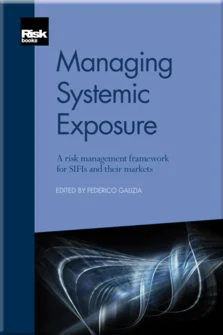
Managing Systemic Exposure
First published:
ISBN: 9781782720102
If you are a Risk.net subscriber you are entitled to 20% off your Risk books purchases. Please email enquiries@riskbooks.com for more information.
As part of your Risk.net subscription you are entitled to 20% off all of your Risk Books purchases. If you would like to place an order please email enquiries@riskbooks.com
What Drives Banking Industry Ratings? An Empirical Analysis
Claudio Calì, Barbara Marchitto and Andrea Resti
Managing Systemic Exposure: A Risk Management Framework for SIFIs and their Markets
SIFIs and the Financial Crisis
Remuneration at Large Financial Services Firms
What Drives Banking Industry Ratings? An Empirical Analysis
Leverage: A Research Agenda for SIFIs
Bank Off-balance-sheet Leverage: Some Lessons from the Financial Crisis
Systemic Wrong-way Risk
The OTC Derivatives Market: Risks and Regulations
Balance Sheet Management for SIFIs
Managing Concentration Risk
Capital Adequacy Ratio: A Managerial Framework
Appendix: G-SIB Regulatory and Supervisory Regime
The 2007–09 financial crisis has prompted renewed interest by national authorities and researchers on macroprudential models that assess the quality of financial systems as a whole. The manifold inter-connections among lenders and between them and other financial institutions calls for an integrated analysis of national banking systems that goes beyond the assessment of individual entities on a stand-alone basis. This has led rating agencies to develop or revamp a special class of ratings that evaluate the risk of banking industries as a whole, rather than that of individual banks.11This class of ratings was first issued by Fitch Ratings in 2005 and grades were made more granular in 2012; Standard and Poor’s began issuing industry ratings in 2006, but criteria were thoroughly re-designed in 2011; in 2007, Moody’s started aggregating bank financial stability ratings countrywide to provide an indicator of the vulnerability of national banking systems. These banking industry ratings (BIRs) prove of special interest to institutions doing business with systemically important banks (SIBs), given
Copyright Infopro Digital Limited. All rights reserved.
As outlined in our terms and conditions, https://www.infopro-digital.com/terms-and-conditions/subscriptions/ (point 2.4), printing is limited to a single copy.
If you would like to purchase additional rights please email info@risk.net
Copyright Infopro Digital Limited. All rights reserved.
You may share this content using our article tools. As outlined in our terms and conditions, https://www.infopro-digital.com/terms-and-conditions/subscriptions/ (clause 2.4), an Authorised User may only make one copy of the materials for their own personal use. You must also comply with the restrictions in clause 2.5.
If you would like to purchase additional rights please email info@risk.net