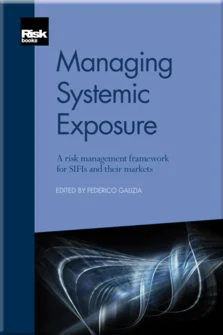
Managing Systemic Exposure
First published:
ISBN: 9781782720102
If you are a Risk.net subscriber you are entitled to 20% off your Risk books purchases. Please email enquiries@riskbooks.com for more information.
As part of your Risk.net subscription you are entitled to 20% off all of your Risk Books purchases. If you would like to place an order please email enquiries@riskbooks.com
Bank Off-balance-sheet Leverage: Some Lessons from the Financial Crisis
Nikolaos I Papanikolaou
Managing Systemic Exposure: A Risk Management Framework for SIFIs and their Markets
SIFIs and the Financial Crisis
Remuneration at Large Financial Services Firms
What Drives Banking Industry Ratings? An Empirical Analysis
Leverage: A Research Agenda for SIFIs
Bank Off-balance-sheet Leverage: Some Lessons from the Financial Crisis
Systemic Wrong-way Risk
The OTC Derivatives Market: Risks and Regulations
Balance Sheet Management for SIFIs
Managing Concentration Risk
Capital Adequacy Ratio: A Managerial Framework
Appendix: G-SIB Regulatory and Supervisory Regime
Leverage is one of the main underlying features of banks’ balance sheets. Traditionally, leverage arises directly through the use of deposited funds or other balance-sheet items, such as bonds and credit lines, as a supplementary tool of banks’ equity capital in financing fresh loans and investments. However, leverage can also be traced off the balance sheet of banking organisations. More specifically, in the years before the outbreak of the crisis in the late 2000s, banking firms took advantage of financial engineering that allowed them to transfer a large part of their leverage off their balance sheets.
This chapter will examine how modern banking and the related off-balance-sheet leverage activities have affected the individual soundness of US banks, as well as the systemic health of the US banking industry, both before and after the onset of the 2007–09 financial crisis. To help achieve this, we will capture off-balance-sheet leverage with different, yet complementary, measures, and also empirically assess the impact of these measures on the overall risk-taking behaviour of US banks
Copyright Infopro Digital Limited. All rights reserved.
As outlined in our terms and conditions, https://www.infopro-digital.com/terms-and-conditions/subscriptions/ (point 2.4), printing is limited to a single copy.
If you would like to purchase additional rights please email info@risk.net
Copyright Infopro Digital Limited. All rights reserved.
You may share this content using our article tools. As outlined in our terms and conditions, https://www.infopro-digital.com/terms-and-conditions/subscriptions/ (clause 2.4), an Authorised User may only make one copy of the materials for their own personal use. You must also comply with the restrictions in clause 2.5.
If you would like to purchase additional rights please email info@risk.net