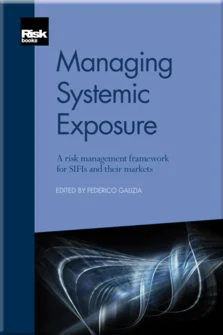
Managing Systemic Exposure
First published:
ISBN: 9781782720102
If you are a Risk.net subscriber you are entitled to 20% off your Risk books purchases. Please email enquiries@riskbooks.com for more information.
As part of your Risk.net subscription you are entitled to 20% off all of your Risk Books purchases. If you would like to place an order please email enquiries@riskbooks.com
Capital Adequacy Ratio: A Managerial Framework
JM Magnette
Managing Systemic Exposure: A Risk Management Framework for SIFIs and their Markets
SIFIs and the Financial Crisis
Remuneration at Large Financial Services Firms
What Drives Banking Industry Ratings? An Empirical Analysis
Leverage: A Research Agenda for SIFIs
Bank Off-balance-sheet Leverage: Some Lessons from the Financial Crisis
Systemic Wrong-way Risk
The OTC Derivatives Market: Risks and Regulations
Balance Sheet Management for SIFIs
Managing Concentration Risk
Capital Adequacy Ratio: A Managerial Framework
Appendix: G-SIB Regulatory and Supervisory Regime
Managers of systemically important financial institutions (SIFIs) need to establish explicitly the risk appetite of their institution, taking into account not only the capital structure (including leverage), but also the target level of solvency.
The language of risk management commonly used by managers is now based on the guidance provided by the Basel Committee on Banking Supervision: key terms are “risk-weighted assets” and “capital adequacy ratio”. However, the Basel Committee does not explicitly set a level of solvency for SIFIs, it simply requires that they provide for a higher percentage of risk-weighted assets to be covered by their own funds compared to non-systemically important financial institutions.
Rating agencies have also developed new rules which give indications on the appropriate level of the capital adequacy ratio in order to obtain a given rating.
This chapter will explicitly connect the language of the Basel Committee with the level of solvency. More specifically, it determines the level of the capital ratio compatible with a target solvency level of the financial
Copyright Infopro Digital Limited. All rights reserved.
As outlined in our terms and conditions, https://www.infopro-digital.com/terms-and-conditions/subscriptions/ (point 2.4), printing is limited to a single copy.
If you would like to purchase additional rights please email info@risk.net
Copyright Infopro Digital Limited. All rights reserved.
You may share this content using our article tools. As outlined in our terms and conditions, https://www.infopro-digital.com/terms-and-conditions/subscriptions/ (clause 2.4), an Authorised User may only make one copy of the materials for their own personal use. You must also comply with the restrictions in clause 2.5.
If you would like to purchase additional rights please email info@risk.net