Podcast: Georgios Skoufis on RFRs, convexity adjustments and the Sabr model
Bloomberg quant discusses his new approach for calculating convexity adjustments for RFR swaps
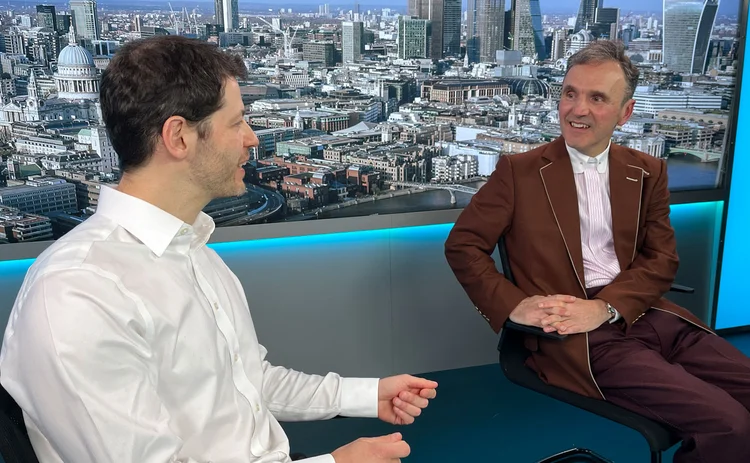

Interest payments linked to risk-free rates (RFR) are typically calculated by compounding the string of overnight fixings over a given period. This is the norm for transactions between financial counterparties. Corporate clients, however, often find it more intuitive to use an arithmetic average of overnight rates. While this makes life easier for clients, it leaves dealers with a tricky problem to solve.
The arithmetic average and compounded rate can diverge over time. At times, the difference can be greater than the bid-offer spread. So, dealers must calculate a convexity adjustment to keep the rates aligned and avoid being arbitraged.
“The convexity adjustment for a 30-year average rate RFR swap with the market standard one-year frequency is roughly around -2 basis points,” says Giorgios Skoufis, cross-asset quant analyst at Bloomberg, while the bid-ask spread is normally around half a basis point.
In this episode of Quantcast, Skoufis explains how this convexity adjustment can be calculated more efficiently for interest rate swaps that reference RFRs.
Dealers typically use one of two standard approaches to calculate the convexity adjustment.
The first is the Hull-White model, which has the advantage of being an efficient, closed-form solution. The downside is that it is insensitive to the volatility smile and doesn’t work for all products, resulting in pricing inconsistencies when applied to a derivatives portfolio.
The second is the Carr-Madan replication formula, which takes smile dynamics into account but is computationally intensive, as the convexity adjustment needs to be calculated for each payment period.
Skoufis’ approach, detailed in a recent Risk.net paper, aims to combine the best bits of the Hull-White and Carr-Madan models while overcoming their drawbacks – in other words, create an efficient solution that accounts for smile dynamics.
“What I do in my particular approach is to use […] an accurate approximation, in which I boil down the convexity adjustment to be expressed as what I call a quadratic swap,” says Skoufis.
This is done by taking the square of the netting value of the swap’s two legs – the floating and the fixed leg. That matches the quadratic form of the combination between the swap and the convexity adjustment, which is expressed in terms of another swap. Skoufis explains that this approach is intuitive because the value of the swap is obtained from the yield curve and the addition of a correction that involves this quadratic swap.
In his paper, the closed-form solution developed to assess the convexity adjustment is applied to the Sabr model, the stochastic volatility model commonly used to price interest rate derivatives.
In this podcast, Skoufis also shares his thoughts on the quantitative challenges posed by the transition away from Libor. While much of the groundwork for derivatives linked to the US secured overnight financing rate has been completed, more work remains to be done in Europe, where Euribor and €str are set to co-exist for the foreseeable future. And if a derivatives market on term RFRs were to develop, additional quant tools will be needed to price those products, he says.
As for his own research, Skoufis plans to expand on his most recent paper and develop a new approach for calculating the average-rate convexity adjustment of RFR-based caps and floors. That could be the subject of a future podcast.
Index
00:00 Introduction and benchmark reforms
03:43 Arithmetic averaging of RFR swaps
06:45 Convexity adjustment
12:30 The Hull-White and Carr-Madan models
15:50 Skoufis’ closed-form solution
20:30 The Sabr model
32:55 Convexity adjustments and the Sabr model
34:30 Building a volatility smile for €str
40:55 Research on caps and floors
To hear the full interview, listen in the player above, or download. Future podcasts in our Quantcast series will be uploaded to Risk.net. You can also visit the main page here to access all tracks, or go to the iTunes store or Google Podcasts to listen and subscribe.
Now also available on Spotify and Amazon Music
コンテンツを印刷またはコピーできるのは、有料の購読契約を結んでいるユーザー、または法人購読契約の一員であるユーザーのみです。
これらのオプションやその他の購読特典を利用するには、info@risk.net にお問い合わせいただくか、こちらの購読オプションをご覧ください: http://subscriptions.risk.net/subscribe
現在、このコンテンツを印刷することはできません。詳しくはinfo@risk.netまでお問い合わせください。
現在、このコンテンツをコピーすることはできません。詳しくはinfo@risk.netまでお問い合わせください。
Copyright インフォプロ・デジタル・リミテッド.無断複写・転載を禁じます。
当社の利用規約、https://www.infopro-digital.com/terms-and-conditions/subscriptions/(ポイント2.4)に記載されているように、印刷は1部のみです。
追加の権利を購入したい場合は、info@risk.netまで電子メールでご連絡ください。
Copyright インフォプロ・デジタル・リミテッド.無断複写・転載を禁じます。
このコンテンツは、当社の記事ツールを使用して共有することができます。当社の利用規約、https://www.infopro-digital.com/terms-and-conditions/subscriptions/(第2.4項)に概説されているように、認定ユーザーは、個人的な使用のために資料のコピーを1部のみ作成することができます。また、2.5項の制限にも従わなければなりません。
追加権利の購入をご希望の場合は、info@risk.netまで電子メールでご連絡ください。
詳細はこちら カッティング・エッジ
ポッドキャスト:アレクサンダー・バルジキン氏によるFXマーケットメイキングのモデリングについて
HSBCのクオンツが、逆選択、価格の読み取り、および内部流動性管理について論じます

逆選抜と価格観測下における最適な価格提示
現実世界における重要な影響を考慮するために、マーケットメイキング・モデルが導入されています。

ポッドキャスト:バーネット氏とピアウ氏が語る、XVAに関する包括的なフレームワーク
バークレイズのクオンツ担当者が、長年の課題に対する同行のアプローチについて解説します

価格調整の基本的な表現
デリバティブ価格調整の統一的な表現について提示します

混合モデルフレームワークにおけるテールの調整
ファットテール特性を再現するために、ガウス分布とスチューデントのt分布を組み合わせたデータ生成器をご紹介します

一味違う微分機械学習
不連続なペイオフを持つデリバティブの価格算定における近似精度を向上させる手法が提案されています

ポッドキャスト:リプトン氏とロペス・デ・プラド氏による、プライベート・エクイティへのクオンツ・アプローチについて
両氏は、プライベート・アセットへの投資の評価および配分に関する分析手法を紹介しています。

金融分野におけるランダム化準モンテカルロ法の驚くべき有効性
シミュレーション手法の分析により、アジア型オプションに最も適した手法が明らかになりました