

Podcast: Mats Kjaer on how trades affect the balance sheet
Bloomberg quant has developed a balance-sheet model for XVA pricing
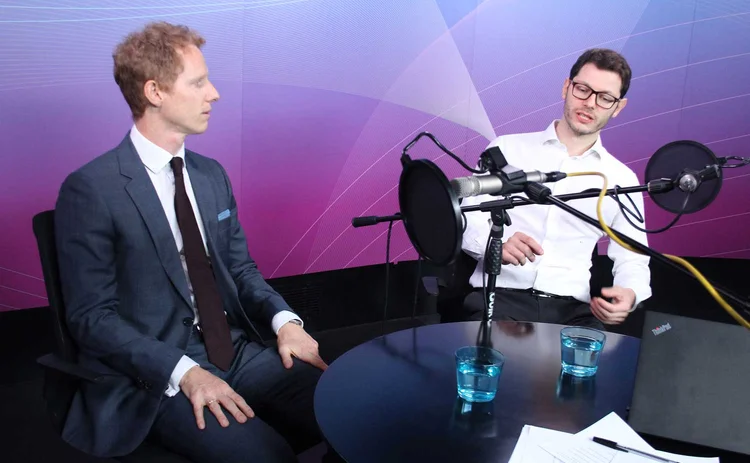

In this Quantcast podcast, I talk to Mats Kjaer, head of quantitative XVA analytics at Bloomberg, about his latest work on capital valuation adjustment (KVA).
Kjaer is well known in the industry for having produced a number of highly cited papers on derivatives pricing and, in particular, on credit valuation adjustment (CVA) and funding valuation adjustment (FVA). One of these works led him and his co-author at the time, Christoph Burgard, to be named Risk’s quants of the year in 2015.
In the balance redux, Kjaer’s newly published paper, which will also appear in the November issue of Risk, presents a structural model developed on the dealer’s balance sheet.
The balance-sheet approach was largely inspired by a recent paper by Leif Andersen, Darrell Duffie and Yang Song titled Funding value adjustments, and it’s a clear departure from the semi-replication method Kjaer adopted in his most previous works. “I wanted to have something consistent for KVA to fit in with other XVA metrics, but I didn’t want to use semi-replication,” Kjaer explains.
The model, set up so that it considers equity financing, regulatory capital and hedging, was initially developed in a single-period setting and later extended to continuous time to make it applicable in practice. “I’m proud to say that the resulting work was released in production last month,” Kjaer reveals.
Investigating XVAs from a balance-sheet perspective also offered him some valuable insights. “I started off with the aim of looking at KVA,” says Kjaer, but he gained “more knowledge about the other valuation adjustments like FVA and CVA”.
The method proves to be a comprehensive pricing tool, and quantifies the profitability of a trade from the viewpoint of the firm and that of the shareholder.
Furthermore, it aids in the visualisation of how much more expensive an unmargined swap is compared with a margined one, and shows how the credit rating of a counterparty affects the cost of the deal, making lower-rated firms less attractive.
Index:
00:00 Intro
02:05 XVAs so far, a brief recap
05:52 What is In the balance, redux contributing
06:52 What are the results?
09:18 How banks can use the balance sheet approach to XVA
09:55 Impact of counterparty rating and margins on the valuation
11:20 Importance of continuous time models
12:20 Implementation
15:30 Future development of the model
To hear the full interview, listen in the player above, or download. Future podcasts in our Quantcast series will be uploaded to Risk.net. You can also visit the main page here to access all tracks, or go to the iTunes store or Google Podcasts to listen and subscribe.
コンテンツを印刷またはコピーできるのは、有料の購読契約を結んでいるユーザー、または法人購読契約の一員であるユーザーのみです。
これらのオプションやその他の購読特典を利用するには、info@risk.net にお問い合わせいただくか、こちらの購読オプションをご覧ください: http://subscriptions.risk.net/subscribe
現在、このコンテンツを印刷することはできません。詳しくはinfo@risk.netまでお問い合わせください。
現在、このコンテンツをコピーすることはできません。詳しくはinfo@risk.netまでお問い合わせください。
Copyright インフォプロ・デジタル・リミテッド.無断複写・転載を禁じます。
当社の利用規約、https://www.infopro-digital.com/terms-and-conditions/subscriptions/(ポイント2.4)に記載されているように、印刷は1部のみです。
追加の権利を購入したい場合は、info@risk.netまで電子メールでご連絡ください。
Copyright インフォプロ・デジタル・リミテッド.無断複写・転載を禁じます。
このコンテンツは、当社の記事ツールを使用して共有することができます。当社の利用規約、https://www.infopro-digital.com/terms-and-conditions/subscriptions/(第2.4項)に概説されているように、認定ユーザーは、個人的な使用のために資料のコピーを1部のみ作成することができます。また、2.5項の制限にも従わなければなりません。
追加権利の購入をご希望の場合は、info@risk.netまで電子メールでご連絡ください。
詳細はこちら カッティング・エッジ
ポッドキャスト:アリエ・シェーター氏とハリオム・タツァット氏によるAIの説明可能性に関する対談
バークレイズのクオンツたちが、メカニスティックな解釈可能性を用いたAIの監視手法について語ります

ブラックボックスの先へ:金融分野におけるLLMの解釈可能性
メカニズムに基づく解釈可能性、そして計算メカニズムにおける変更点を特定

P・Qキャリブレーションと経路依存的な変動性の整合
校正の堅牢性を向上させることを目的とした混合アプローチを提案します

ポッドキャスト:アレクサンダー・バルジキン氏によるFXマーケットメイキングのモデリングについて
HSBCのクオンツが、逆選択、価格の読み取り、および内部流動性管理について論じます

逆選抜と価格観測下における最適な価格提示
現実世界における重要な影響を考慮するために、マーケットメイキング・モデルが導入されています。

ポッドキャスト:バーネット氏とピアウ氏が語る、XVAに関する包括的なフレームワーク
バークレイズのクオンツ担当者が、長年の課題に対する同行のアプローチについて解説します
価格調整の基本的な表現
デリバティブ価格調整の統一的な表現について提示します

混合モデルフレームワークにおけるテールの調整
ファットテール特性を再現するために、ガウス分布とスチューデントのt分布を組み合わせたデータ生成器をご紹介します
