

Swaps data: Fed’s change of tack on rates fuels volume rise
Cleared dollar rates jump by half year-on-year, as LCH market share tightens

It was a mixed second quarter of 2019. The US Federal Reserve’s protracted signalling of its July rate cut prompted a significant rise in cleared US dollar rate swaps volumes versus the previous quarter and versus the same time last year. Yet cleared volumes in euro-denominated rate swaps are significantly down, as are credit default swaps in all currencies. Yen rate swaps and non-deliverable forwards meanwhile are flat or modestly up.
Little has changed in terms of market share between the big clearing houses. LCH’s SwapClear is slightly up in US dollar rates, while JSCC is slightly up in yen rates. In credit default swaps clearing, LCH’s CDSClear sees its share tick up in euro CDS clearing.
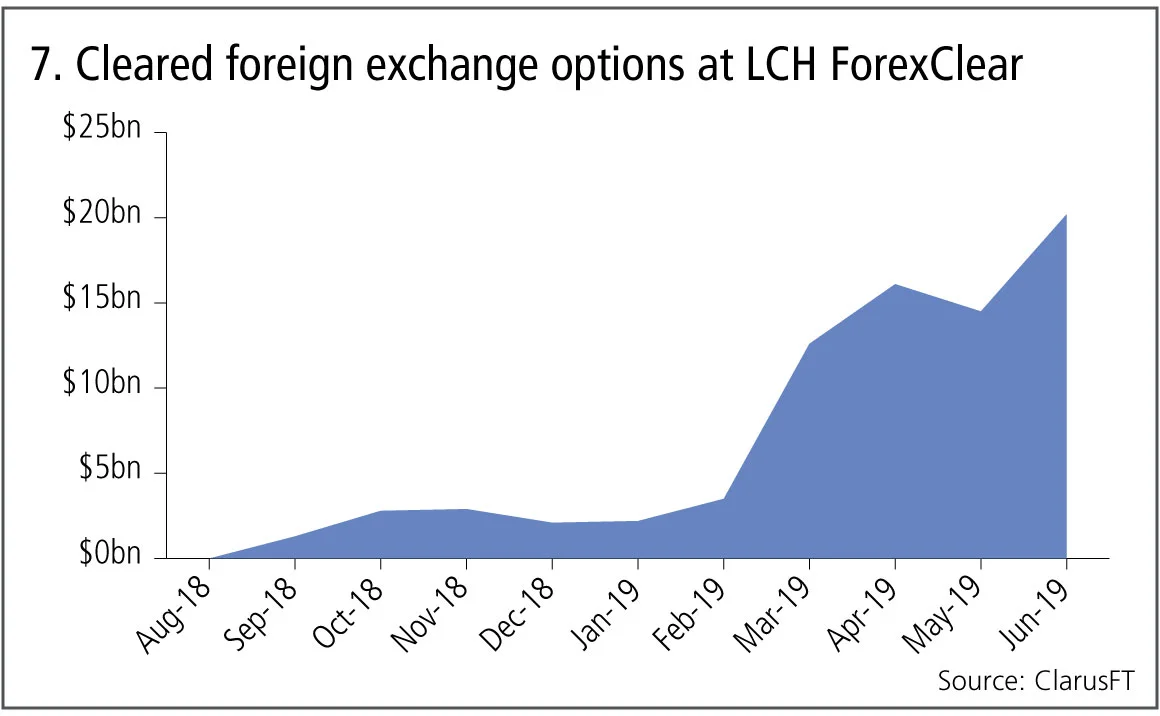
One notable pocket of growth is foreign exchange options clearing, where volumes at LCH ForexClear grew markedly in June. Could this be the first over-the-counter option to move in a big way to clearing? Or will regulators’ decision to split the final ‘big bang’ phase-in of margining for non-cleared derivatives and delay the mandate for smaller swaps counterparties check progress for now?
Some large dealers have historically underpriced their foreign exchange prime brokerage services in order to win more execution business from funds and proprietary trading firms. At least one large bank is repricing its offering to big buy-side users of OTC forex trades, which could be another factor behind the uptick in clearing volumes.
With the costs of trading non-cleared OTC rising significantly for some as a result – and with some banks quietly jettisoning clients in the meantime – the market could yet move to greater use of clearing. LCH should be the main beneficiary, if that happens; if the market instead looks to replicate its currency risk in cash-settled options, however, CME Group could be the happier central counterparty.
Cleared US dollar swaps
We include all clearable types when tracking US dollar interest rate swap volumes – vanilla fixed versus float, overnight index, basis, zero coupon and variable notional – and use single-sided gross notional volumes.
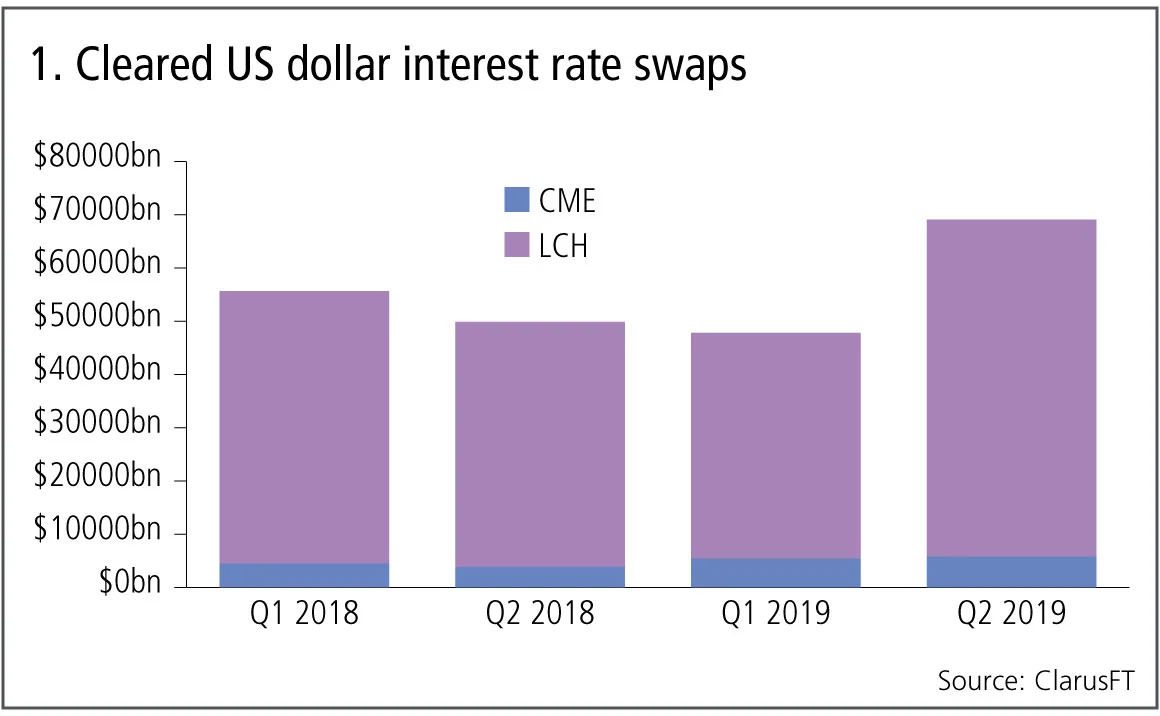
Figure 1 shows:
- Q2 2019 volumes are 44% higher than Q1 2019, at $69 trillion – 38% higher than a year earlier.
- That’s a very different trend to Q1 2019, which saw volumes fall 14% from a year earlier.
- LCH SwapClear sees its market share increase to 92% in Q2 2019, up from 89% during the prior quarter, with CME down to 8% from 11%.
- In terms of raw volumes LCH SwapClear is up $17 billion from a year earlier, or 38%. CME is up $1.9 billion or 49% from a year earlier.
The Federal Reserve signalling a cut in US interest rates certainly resulted in much higher dollar swap volumes during the quarter, as firms moved to reprice their expectations of a gradually rising path for US rates. However, how the market reacts to Fed chairman Jerome Powell’s verbal intervention dampening hopes of further rate cuts – much to US president Donald Trump’s ire – remains to be seen.
Cleared euro swaps
Figure 2 shows activity in the second-largest product, cleared euro interest rate swaps, across all clearable instrument types.
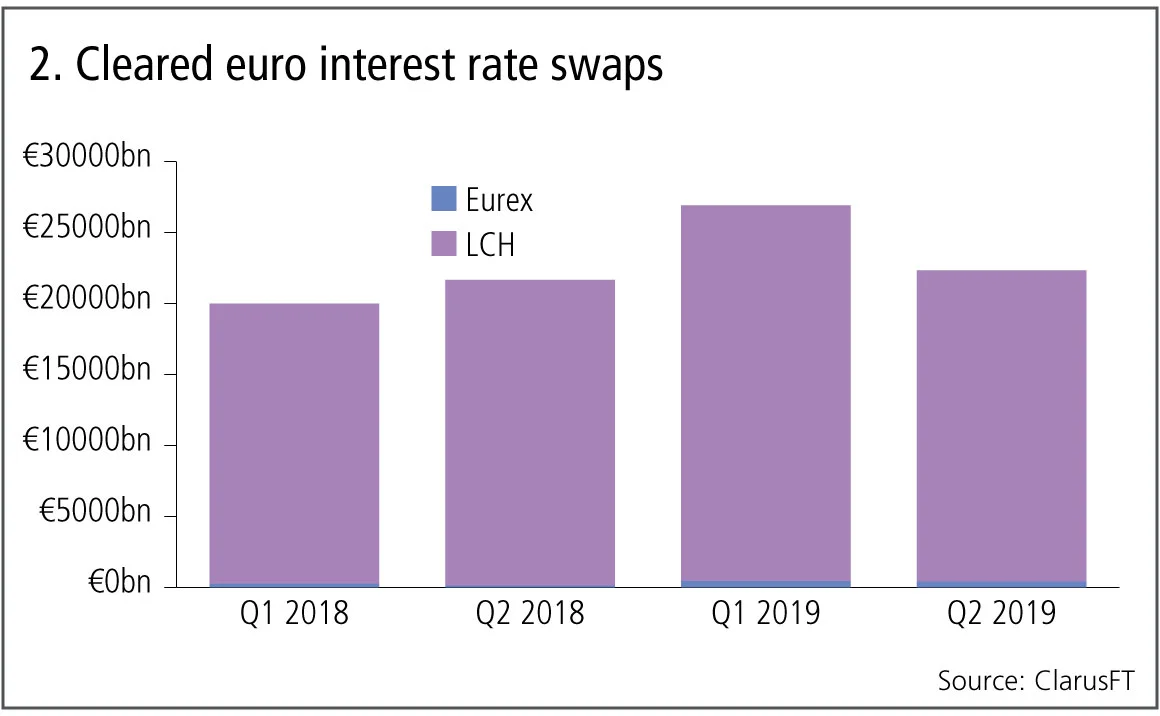
Figure 2 shows:
- At €22 trillion ($24.6 trillion), Q2 2019 volumes are 17% lower than Q1 2019, and 3% higher than a year earlier.
- Market share split is little changed from Q1 2019: LCH SwapClear has a 98.1% share, Eurex 1.9%.
- In terms of raw volumes, LCH SwapClear is up 2% or €386 billion from a year earlier, while Eurex is up 209% or €286 billion from a year earlier.
So, LCH SwapClear continues its dominance in euro swaps clearing – but Eurex is continuing to grow at a much faster rate, from a much lower base.
Cleared yen swaps
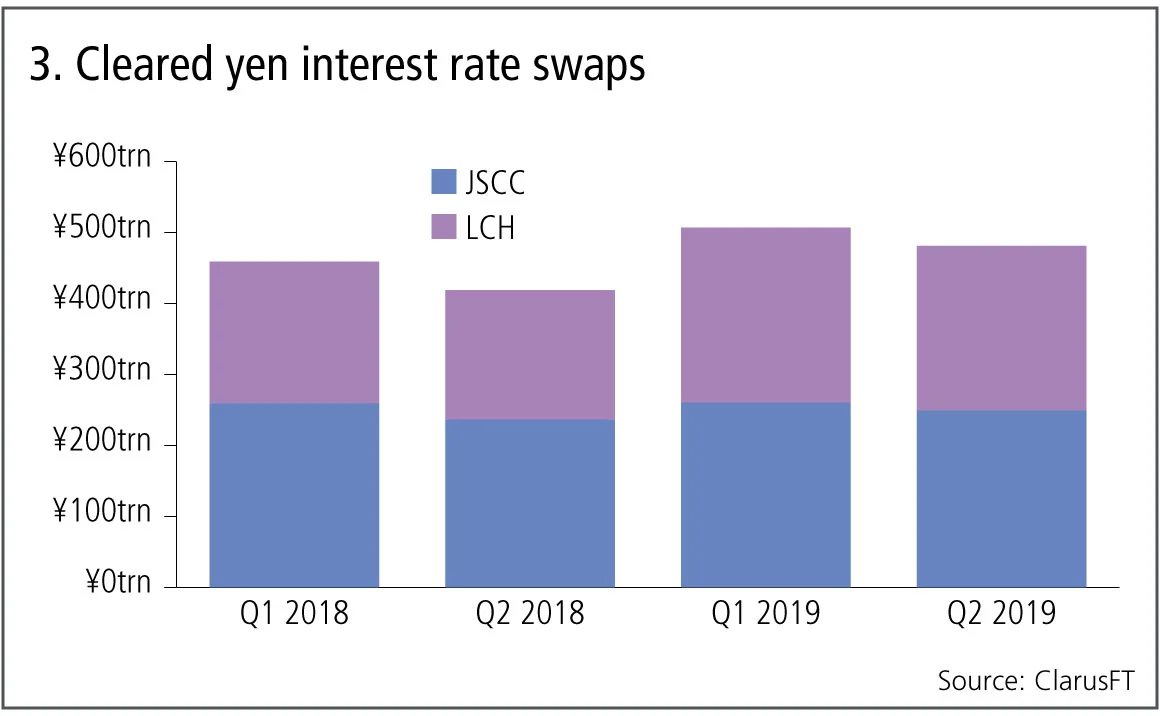
Figure 3 shows:
- At ¥481 trillion ($4.5 trillion), Q2 2019 volumes are 5% lower than Q1 2019, but 15% higher than a year earlier.
- JSCC market share sits at 52% and LCH’s at 48% in Q2 2019 – a gain of 1% in JSCC’s in favour compared with Q1 2019. A 52:48 split sounds like unfinished business.
- In terms of raw volumes, JSCC is up 5% or ¥13 trillion from a year earlier; LCH is up 26% or ¥49 trillion.
Cleared US dollar credit default swaps
Next, let’s take a look at volumes in cleared dollar-denominated credit default swaps.
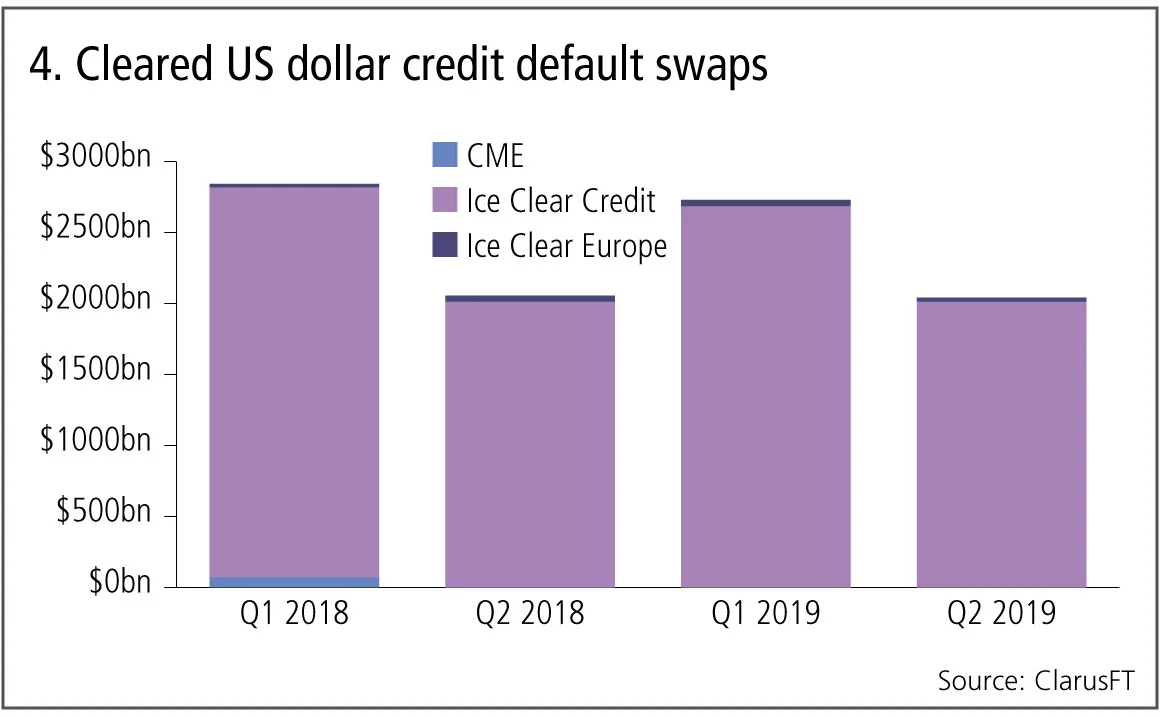
Figure 4 shows:
- Q2 2019 volumes are 25% lower than Q1 2019 at $2 trillion, and 1% or $13 billion lower than a year earlier.
- Ice Clear Credit dominates with a 99% market share.
Cleared euro credit default swaps
Next, the volume of credit indexes and single names in euros.
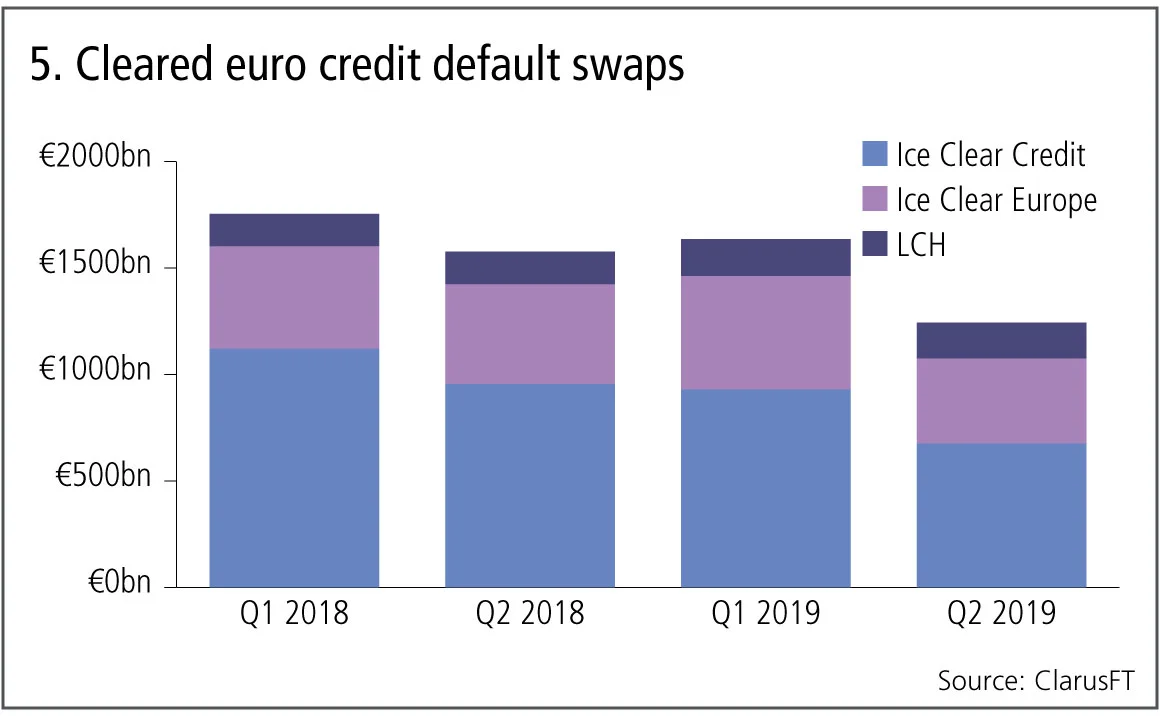
Figure 5 shows:
- Q2 2019 volumes are 24% lower than Q1 2019 at €1.25 trillion, and 21% lower than a year earlier.
- Ice Clear Credit with 54.3%, Ice Clear Europe 32% and LCH CDSClear with 13.7% market share in Q2 2019, which compares with 56.8%, 32.6% and 10.6% in Q1 2019, respectively.
- Ice Clear Credit’s volumes are down 29% from a year earlier, Ice Clear Europe down 15% and LCH CDSClear up 10%.
Cleared credit derivatives volumes denominated in euro mirror the drop in US dollars for the most recent quarter, and show a much larger drop year-on-year, with only LCH CDSClear increasing its volumes and share.
Cleared non-deliverable forwards
Finally, let’s take a look at cleared non-deliverable forwards.
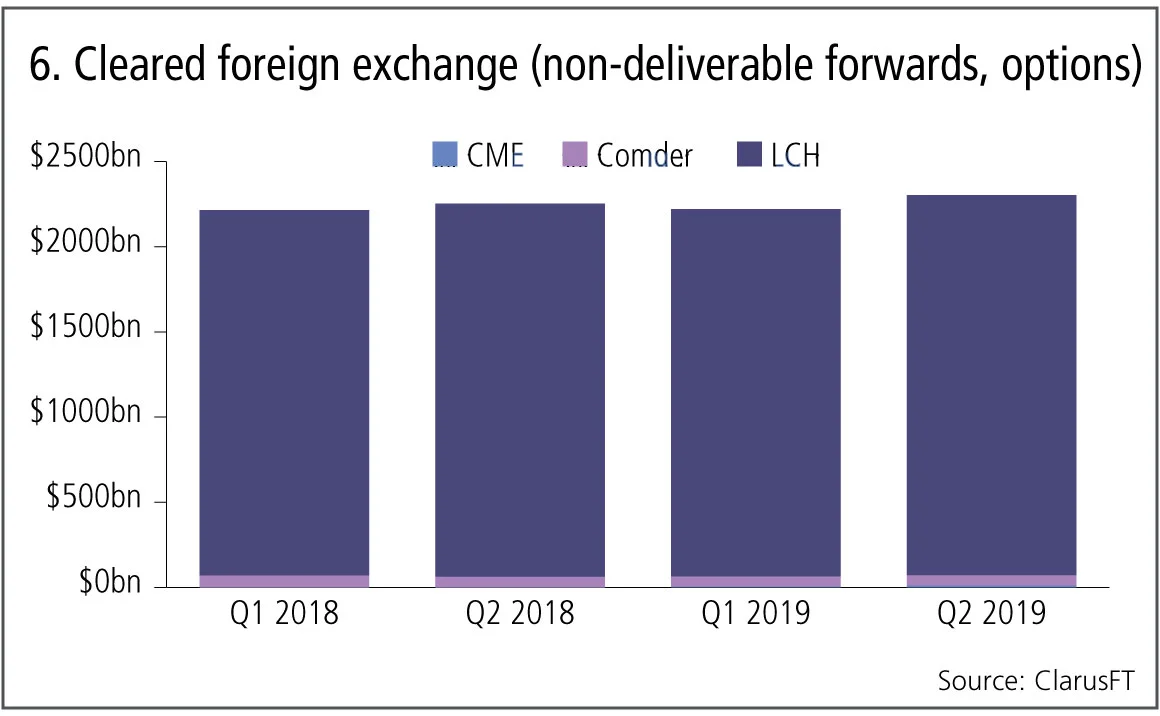
Figure 6 shows:
- Q2 19 volumes are 2% higher than a year earlier at $2.3 trillion.
- LCH ForexClear with 97% share in the quarter, with Comder on 2.6% and CME with 0.5%.
Cleared non-deliverable forwards volumes no longer show their long-running trend of high growth, pre-2018. We may have to wait for non-cleared margin rules phase 4, 5 and 6 for a return to that.
However, delving further into the LCH ForexClear numbers, we do see growth in forex options clearing, with $20 billion gross notional in June 2019, up from $14.5 billion in May 2019.
Amir Khwaja is chief executive of Clarus Financial Technology
コンテンツを印刷またはコピーできるのは、有料の購読契約を結んでいるユーザー、または法人購読契約の一員であるユーザーのみです。
これらのオプションやその他の購読特典を利用するには、info@risk.net にお問い合わせいただくか、こちらの購読オプションをご覧ください: http://subscriptions.risk.net/subscribe
現在、このコンテンツを印刷することはできません。詳しくはinfo@risk.netまでお問い合わせください。
現在、このコンテンツをコピーすることはできません。詳しくはinfo@risk.netまでお問い合わせください。
Copyright インフォプロ・デジタル・リミテッド.無断複写・転載を禁じます。
当社の利用規約、https://www.infopro-digital.com/terms-and-conditions/subscriptions/(ポイント2.4)に記載されているように、印刷は1部のみです。
追加の権利を購入したい場合は、info@risk.netまで電子メールでご連絡ください。
Copyright インフォプロ・デジタル・リミテッド.無断複写・転載を禁じます。
このコンテンツは、当社の記事ツールを使用して共有することができます。当社の利用規約、https://www.infopro-digital.com/terms-and-conditions/subscriptions/(第2.4項)に概説されているように、認定ユーザーは、個人的な使用のために資料のコピーを1部のみ作成することができます。また、2.5項の制限にも従わなければなりません。
追加権利の購入をご希望の場合は、info@risk.netまで電子メールでご連絡ください。
詳細はこちら コメント
KKR、合併前の届出不備により独占禁止法違反の罰金額で過去最高を記録した
また、メキシコ国債の相場操作スキャンダルでディーラー各社が多額の賠償金を支払うこととなりました。UBSではAMLのチェックが不十分だったことも判明しています。データ提供:ORX News

トークン化:ロンドンの金融市場にとっての単なるでたらめ?
デジタルトランスフォーメーションという文脈でテクノロジーに焦点を当てすぎると、1980年代の「トーラス」の大失敗を繰り返す恐れがあります

米国債の買い戻しは、(担保の)連鎖反応を引き起こす恐れがある
あるエコノミストは、債券の満期構成の再調整により、担保の連動関係が限界まで逼迫する恐れがあると指摘しています

ECBの地政学的ストレステストにはコストが伴う
ある学者は、地政学的リスク事象による損失を補償するための保険料がいくらになるべきかについては、市場だけが判断できるものであり、現時点ではそのような市場は存在しないと主張しています。

ポッドキャスト:アレクサンダー・バルジキン氏によるFXマーケットメイキングのモデリングについて
HSBCのクオンツが、逆選択、価格の読み取り、および内部流動性管理について論じます

オペリスク・データ:日本のレストラン向け決済企業が7億ドルの損失を計上
また、バローダ銀行の詐欺事件の提訴、ウェルズ・ファーゴのポンジ・スキーム問題、そしてスウェドバンクのパナマ文書関連の賠償金支払いについても取り上げます。データ提供:ORX News

プライベートクレジットリスクは、システミックなものでなくても深刻になり得る
リスク管理のリーダーが、プライベートクレジット部門のリスクは抑制されているという共通認識に存在する3つの欠陥について概説しました

無期限先物:満期がなくなる時代、ガバナンスが鍵となる
ヴィシャル・グプタ氏は、無期限先物が先物のロールオーバー問題を解決する一方で、市場構造や規制上のリスクを抱えていると警告しています
