Doubts cast on Europe’s IFRS 9 transition period
Dynamic transition viewed as too complicated for banks to use or investors to understand


Doubts have been raised over the usefulness of a transition period designed to mitigate the day one capital impact of new accounting rules, owing to the complexity of the European Union’s chosen approach.
International Financial Reporting Standard 9 (IFRS 9), which comes into force for European banks in January 2018, will upend current accounting convention by forcing banks to recognise expected losses on loans when the likelihood of the borrower defaulting increases materially. This is expected to increase provisions significantly, especially for smaller banks.
The likely knock-on effects on bank capital, with dealers forced to divert retained earnings to increase loss provisioning, has prompted the EU to offer a five-year transitional arrangement, but banks have criticised its approach as too complex to be of use.
“Personally, I would prefer to have no transition. The reason is that the impact studies are showing the one-off impact is not going to be that big, so therefore I don’t think there is any institution that is going to struggle with a one-off application of IFRS 9,” said Adrian Docherty, head of financial institutions advisory at BNP Paribas, speaking at the Banking Book Summit in London on November 28.
“If it reduces the impact, then great, but the cost of that is complexity. Europe has decided to allow a multitude of approaches and to allow the dynamic approach, which is very difficult to understand,” he added.
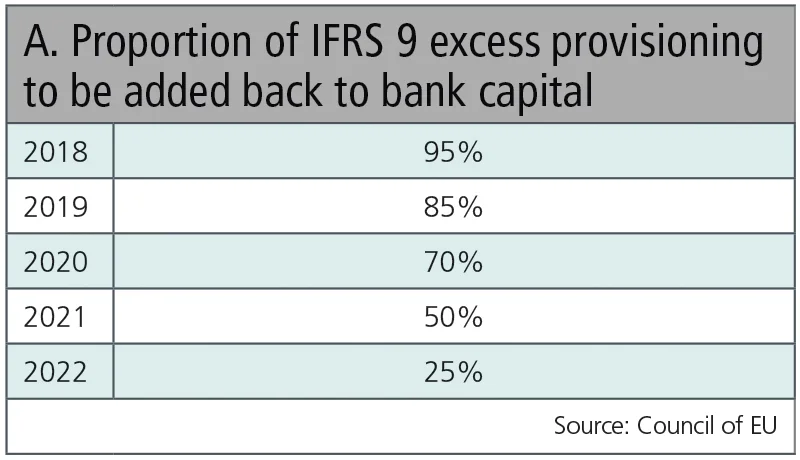
On 15 November, the Council of the EU endorsed an agreement with the European Parliament for a five-year transition period, which will allow banks to add their expected credit loss provisions resulting from IFRS 9 back to their capital in a decreasing amount over five years (see table A).
This is designed to offset the impact of extra provisioning on capital, particularly for banks using the standardised approach to calculate credit risk-weighted assets, rather than using forward-looking loan-loss models.
We have seen with Basel transitioning that the market, faced with all of this complexity and lack of harmonisation, just says ‘give me fully loaded’
Adrian Docherty, BNP Paribas
The final transition package allows banks to choose between static or dynamic approaches – that is, to calculate the capital offset once at the start of the transition period or to update it each year. The European Banking Authority had earlier advised against the dynamic approach, which is much more complicated to calculate – for banks and their investors.
“We have seen with Basel transitioning that the market, faced with all of this complexity and lack of harmonisation, just says ‘give me fully loaded’. With the phase-in, I know the provisioning is coming, so it may as well be shown in today’s numbers anyway,” said Docherty.
Speaking on the same panel, Ingrid Nemetz, an IFRS 9 specialist at the Austrian Financial Market Authority, acknowledged Docherty’s concerns.
“It is a difficult compromise solution. There were many views contradicting each other, and what we are now getting in the end is a very complex transitional arrangement. In this way, it has quite some similarity with IFRS 9 itself, which had a simple goal, and there were so many views and [so much] lobbying that it is rather complicated. Personally, I would have preferred, if we had a transitional arrangement, to have a simple one that is easy to understand, which would have been a static one,” said Nemetz, who emphasised she was speaking in a personal capacity.
“But, on the other hand, there was reasoning, which was the fear of volatility and the dynamic nature of IFRS 9 itself, so now we have this dynamic component of the transition period. I think it is hard to understand and even harder to implement technically, because there are so many consequential calculations you have to do for exposure values and for deferred tax assets. If you want to do that, it is quite an effort, and I’m not sure if banks are going to use it,” she added.
Nemetz also agreed with Docherty that investors are likely to look through the transitional number to the final IFRS 9 reported balance sheet.
Waiting for Basel
However, Docherty emphasised the transition period could be useful if it gave time for the Basel Committee to agree changes to credit risk capital rules that would allow all banks to add back to capital any accounting provisions beyond the regulatory expected 12-month losses. This is essential for banks on the standardised approach to credit risk, which must otherwise double-count the cost of the additional IFRS 9 provisions in their capital ratios.
“If it’s the wrong destination, then any transition is the wrong thing to do… But any solace, any mitigant, any reduction or neutralisation of IFRS 9 is welcome,” said Docherty.
He said the European Banking Federation was already in contact with the Basel Committee, which understood the situation, but he warned the market needed clarity quickly.
“That process is happening, but I don’t think the Basel process is going to adapt to IFRS 9 very quickly. The transition helps, but we have to make sure the market realises there is going to be some sort of ‘compatible-isation’ of the capital with the provisions framework, and try to keep it together until Basel can do something. But, as we have seen with Basel IV, the Basel process is quite difficult when working internationally,” said Docherty.
In its half-yearly Financial Stability Report, also published on November 28, the Bank of England made clear the need for the capital impact of IFRS 9 to be neutralised: “The Financial Policy Committee will take steps to ensure the interaction of IFRS 9 accounting with its annual stress test does not result in a de facto increase in capital requirements.”
Nemetz also expressed pessimism regarding how fast the Basel Committee could proceed with adapting the credit risk capital framework for IFRS 9.
“It is good to have simple solutions and equal methods, but that is hard to reach – there are different goals from the prudential point of view and the accounting point of view, [which is] the true and fair view. I am not sure if that is going to be reached in the mid- or long-term. We didn’t even reach common accounting standards with US GAAP,” said Nemetz.
Following six years of negotiation, a project to converge IFRS with the US Generally Accepted Accounting Principles failed in February 2014.
コンテンツを印刷またはコピーできるのは、有料の購読契約を結んでいるユーザー、または法人購読契約の一員であるユーザーのみです。
これらのオプションやその他の購読特典を利用するには、info@risk.net にお問い合わせいただくか、こちらの購読オプションをご覧ください: http://subscriptions.risk.net/subscribe
現在、このコンテンツを印刷することはできません。詳しくはinfo@risk.netまでお問い合わせください。
現在、このコンテンツをコピーすることはできません。詳しくはinfo@risk.netまでお問い合わせください。
Copyright インフォプロ・デジタル・リミテッド.無断複写・転載を禁じます。
当社の利用規約、https://www.infopro-digital.com/terms-and-conditions/subscriptions/(ポイント2.4)に記載されているように、印刷は1部のみです。
追加の権利を購入したい場合は、info@risk.netまで電子メールでご連絡ください。
Copyright インフォプロ・デジタル・リミテッド.無断複写・転載を禁じます。
このコンテンツは、当社の記事ツールを使用して共有することができます。当社の利用規約、https://www.infopro-digital.com/terms-and-conditions/subscriptions/(第2.4項)に概説されているように、認定ユーザーは、個人的な使用のために資料のコピーを1部のみ作成することができます。また、2.5項の制限にも従わなければなりません。
追加権利の購入をご希望の場合は、info@risk.netまで電子メールでご連絡ください。
詳細はこちら 規制
ステーブルコイン・コンソーシアムは、銀行による単独発行に向けた「過渡的な」段階である可能性がある
シティグループの元決済部門責任者であり、Ubyxの創業者である同氏は、すべてのG-Sibsが独自のコインを発行するようになると述べています。

単一報告:ESMAの10億ユーロ規模の改革は、全体像を正確に把握できるのか
批判派は、3つの報告制度を統合する計画は、ほとんど成果が上がらず、一方的な報告とは相容れないだろうと指摘しています。

CFTCは、コンピュータ関連先物取引に関して「ダブルスタンダード」をとっていると非難されている
カルシ社がすでに同様の製品を提供しているにもかかわらず、ダフィー氏はCMEの契約について「長期にわたる見直し」を求めています

欧州の銀行は、アウトプット・フロアの是正策について合意に至っていない
市場リスクを除外すべきだと主張する人もいれば、クレジット・モデリングによるコスト削減をさらに進めるべきだと主張する人もいます

SECは2027年にCATを吸収合併することを目指している
SEC委員長が市場監視体制の直接的な管理権限を求めており、FINRAの権限を侵そうとしています

FCMたちは、CMEの監督からの離脱を認めるCFTCの提案を支持している
新たな規則は、垂直統合型取引所グループにおける利益相反に対処することを目的としています

銀行各社は、シンガポールに対し、暗号資産の保有限度額の緩和を求めている
トークン化やステーブルコインに対する資本要件の引き下げは歓迎されますが、上限の設定により、当面は銀行の参入が抑制されることになります

ESMAによると、EUの大手金融機関は清算業務の移転に関して動きが鈍いとのこと
「アクティブ・アカウント」の増加が中小企業の国内移転を後押ししています。立法府が望むならば、規制当局はより大きな役割を担う準備ができています。