Doyne Farmer’s next big adventure: capturing the universe

Quant fund pioneer plans to build an economic super-simulator on a global scale
butterfly-tornado-chaos-theory2.jpg

Counting the number of angels dancing on the head of a pin is not the sort of scholarly endeavour that would distract Doyne Farmer. But identifying a similarly granular level of detail will be a major part of his next big venture – and its scope is immense.

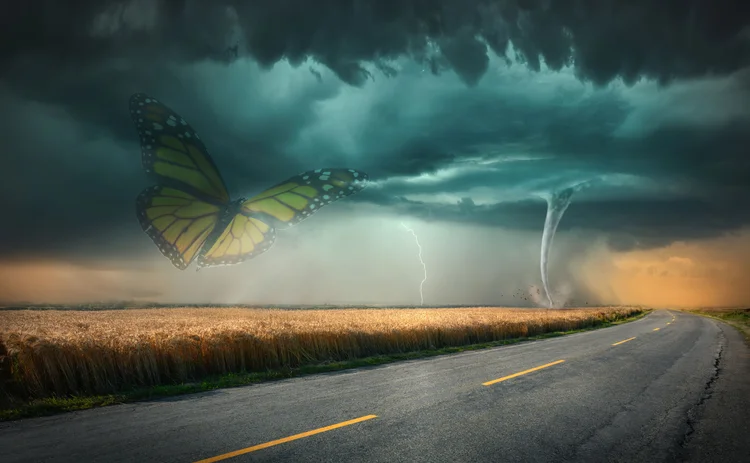
As one of the pioneering ’80s scientists at Los Alamos National Laboratory, Farmer helped develop chaos theory – the branch of mathematics that explains the order in disorder. The theory famously shows how the tiniest of details – like a butterfly flapping its wings in China – can combine with oblique patterns to create seemingly random but significant effects. Like a tornado in Texas.

Farmer later built and launched one of the first quant hedge funds, using models to find regularities in the apparent jumble of market data. The auspiciously named Prediction Company was sold to UBS in 2006 and became part of Millennium Management. And Farmer became a professor at the University of Oxford.

Now, while continuing at Oxford, Farmer is launching a venture that might one day identify butterfly effects in the world economy.

Where ordinary macroeconomic models rely on generalisations, such as universal rates of inflation or country-wide gross domestic product, Farmer wants to model the world economy at “one-to-one scale”. He aspires to capture the behaviour of even single firms among the 50 million that exist. “The plan is to model from the bottom up,” he says.  He calls it “global microeconomics”.

As part of his plan, Farmer has incorporated a company – the aptly titled Macrocosm – with the aim of gathering data on such things as supply linkages, patent filings, labour costs and energy demands – and to build around this information a set of models. In time he intends to join up the models to create – in essence – a global economic simulator.

He sees this super-simulator as a laboratory for experimentation but also as a forecasting machine. It could tell regulators how capital rules will affect systemic risk, say, or inform central bankers on how rates policy will move consumer demand. Perhaps it might tip off investors to the winners and losers of technological progress.

In other projects, unconnected to Macrocosm, Farmer has used models reaching for the same ultra-granular focus, with surprising results.

One recent exercise, for example, simulated the UK government lifting its Covid-19 lockdown for different industries. It showed that sending industries back to work in the wrong order could disrupt the rhythm of supply chains – and even lead to falls in production.

Modelling the universe

Macrocosm, as Farmer envisions it will construct models for production, innovation, energy, occupational mobility, financial investment and technological change. Each will feed on data in the finest grain possible.

He is agnostic about the types of models used. But he is a long-time champion of an agent-based approach, where thousands – or millions – of digital avatars, coded to reflect the behaviour of firms or individuals, are set running in virtual-world simulations. As the team gathers more data, more agent-based models will follow, he says.

Today, Farmer’s team of 20 graduate students and postdoctoral fellows has collected enough data to model supply-chain dependencies at industry level to the level of 55 company types. Macrocosm will need to distinguish between more than a thousand, perhaps three-thousand, Farmer says.

This is not something you do in your kitchen
Doyne Farmer

It will need to tell apart producers of solar power from fossil fuel suppliers, a family business from a conglomerate like Amazon. “Even at the level of 55 industries [as in the Covid-19 study] you’re lumping a lot of stuff together.”

Farmer says he knows where to find the data – he cites VAT receipts, shipping manifests and data collated by credit checkers as examples. US companies must declare their top suppliers in tax filings. Bureau of Labour Statistics data on job moves exist for 770 occupations. Companies like Burning Glass Technologies supply data on job advertisements. Some of the other data that Macrocosm might need is already collated by companies like Bloomberg and FactSet.

The project will cost as much as $10 million a year. It will take about five years to build a working global simulator that is better at understanding the economy than “anything anybody else has”, Farmer reckons. There are 2.6 billion households in the world – 3.5 billion workers. Many of the suppliers of data will likely require assurances on the information staying confidential before they give it over. “This is not something you do in your kitchen,” he says.

Some parts of the system already exist. Farmer and his colleagues have mapped data on patent registrations to construct a model that can recognise when a technology is hot and anticipate when it will get hotter. The team has mapped frictions in the US jobs market. It has a model of investment flows in financial markets.

For “small chunks” of the global economy, Farmer has models that already encompass the activities of individual firms. “In Japan we have data that can get us most of the way there,” he asserts.

Heterodox economics

It’s not his first attempt at modelling the economy in high definition. Farmer worked on the EU’s so-called CRISIS project, which aimed to improve on conventional models that failed to see the global financial crisis coming. The agent-based model it came up with is now run by Sebastian Poledna at the International Institute for Applied Systems Analysis and competes with other models used by central banks.

Farmer is also part of an informal grouping of self-identified “heterodox economists” that have challenged conventional wisdom in the field since the early 1990s.

Most economists follow the principle of rational expectations, treating agents – individuals, companies, investors – as able to compute the best path to their own selfish objective. But to heterodox economists this is an absurd assumption. Farmer disparagingly refers to such imaginary agents as “cognitive superheroes”.

The orthodox approach uncomplicates the maths and produces models that make good-enough predictions, its proponents say.

But the “complexity economists” see in the tangle of human behaviour and economic interactions the key to explain much of what’s going on.

In his work on chaos, Farmer showed how complex systems like the weather can continue in a state of flux due only to forces within the system itself. To understand such systems, scientists must replicate them in models as faithfully as possible, he has argued. He calls it the principle of verisimilitude.

The previous two challenges were to beat roulette using physics and beat the market using machine learning
Doyne Farmer

Conventional economics needs to change course, he believes. “The fundamental assumptions of the models need to be changed for the models to get better.  The economics establishment is strongly resisting this.”

So, as Farmer sees it, the variety in the real economy is critical. Conventional economists will say US inflation has been about 50% for the period from 1998 to now. But healthcare prices have climbed about 200%. The cost of a television has fallen to a fraction of its earlier value. Economic models that are blind to such effects “miss the whole point”, Farmer argues. “That’s what drives us to get down to a finer scale.”

Trying to grasp the supply chain resilience of companies in the face of a shock like the Covid-19 pandemic only underlines the need for data and modelling at a finer scale, he adds. 

Doyne Farmer
Doyne Farmer

Of course, complexity economics has its detractors. One criticism is that such intricacy is impossible to capture accurately – even in the cleverest computer simulations. Another is that models sketched along more general lines are less vulnerable to overfitting – when a model is too tightly calibrated to past data and fails when applied in the real world.

Farmer says the opposite. All of the data used to estimate conventional top-down economic models sums to about 500 bytes, he points out. Calibrating too many parameters to such sparse data is likely to create errors. But micro-level data allows fine tuning of specific models of the individual building blocks of the economy. “The key is the ratio: how much data you have for the number of free parameters.”

What, though, if an economy imitated in superfine detail evolved too fast for the model to keep up? Farmer says the simulator will show that too.

“We want to build the model so we can see when things are changing. We’re building a model that contains the pieces of the economy. We can look at those individual pieces and measure things about them to see what’s different.”

Act three of the big adventure

Above all, it seems, Farmer is an adventurer. He credits boyhood scouting excursions in search of abandoned gold mines with firing his inquisitiveness. As a graduate student, he beat roulette using a computer hidden in his shoe. His website includes video footage of a helicopter rescue from an abortive hiking trip in New Mexico’s Gila Wilderness.

He also talks of Macrocosm as an adventure. “The previous two challenges were to beat roulette using physics and beat the market using machine learning,” he says. Now he wants a test that does something good for the world.

“Can I create a model that allows us when something like the Covid-19 pandemic breaks out to say: this is what is going to happen if you do this or that? I want to create a model with real predictive power that can guide policy. The models we have now can’t do that.”

Farmer concedes his simulator will have limitations. “This is not the Holy Grail,” he says. “We will never be able to reconstruct the global supply chain in [its entire] detail. But with some luck and the right partnerships we will be able to construct it with enough detail to be pretty darn useful.”

That said, Macrocosm has a way to go. Right now, the company doesn’t even have a website. It has applied for an EU tender to study the “ecology of contracts”, a project that could “set things in motion”, Farmer says. He seeks a business partner to take on the “hassle” of running the commercial operation.

My biggest goal is not to get rich. My biggest goal is just to do it
Doyne Farmer

How Macrocosm will make money is also to be determined. Investment managers will be able to buy any forecasts Macrocosm might produce. But any number of possibilities suggest themselves: advising on housing price differences by geography, identifying technologies to invest in, consulting to governments. The first task for the business partner will be to identify opportunities for a viable product to be launched in two to three years, Farmer says.

Farmer will also continue in his role at Oxford, and Macrocosm will be fully independent. Although it has no financial backers at this stage, securing backing will likely be straightforward given Farmer’s profile and past successes.

Covid-19 will no doubt help. “The pandemic has put a spotlight on the global production network, on supply chains.” The time is ripe to get the project going, he says.

One thing Farmer is clear about is that he won’t use the model to invest on his own account. It would mean keeping elements of the findings secret and he wants this project to serve the public good. Convincing corporates to share sensitive data may also be tough if the project were to seek an investing profit.

“My biggest goal is not to get rich. My biggest goal is to just do it,” he says.

Farmer also hopes Macrocosm could make the case for switching to green energy – which his past work indicates would save money long-term – or help find a more equitable balance of wealth.

His other career adventures turned out well. Will this one? “I think it is doable,” he says. “It just requires a lot of work.”

Only users who have a paid subscription or are part of a corporate subscription are able to print or copy content.

To access these options, along with all other subscription benefits, please contact info@risk.net or view our subscription options here: http://subscriptions.risk.net/subscribe

You are currently unable to copy this content. Please contact info@risk.net to find out more.

Most read articles loading...

You need to sign in to use this feature. If you don’t have a Risk.net account, please register for a trial.

Sign in
You are currently on corporate access.

To use this feature you will need an individual account. If you have one already please sign in.

Sign in.

Alternatively you can request an individual account here