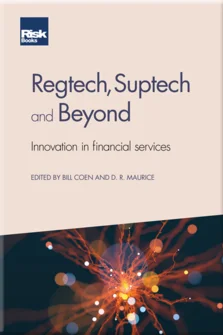
Regtech, Suptech and Beyond: Innovation in Financial Services
First published:
If you are a Risk.net subscriber you are entitled to 20% off your Risk books purchases. Please email enquiries@riskbooks.com for more information.
As part of your Risk.net subscription you are entitled to 20% off all of your Risk Books purchases. If you would like to place an order please email enquiries@riskbooks.com
Regulatory sandboxes: Innovation and financial inclusion
Carmelle Cadet
Foreword
Preface
Preface
Introduction: Suptech/regtech defined: Payments, sandboxes and beyond
The uncertain prudential treatment of cryptoassets
US regulatory certainty versus uncertainty for crypto and blockchain
Bermuda: Suptech and regtech supporting the risk-based approach
Suptech: A new era of supervisory philosophy
Cloud computing in the financial sector: A global perspective
DeFi protocol risks: The paradox of cryptofinance
IT transformation in the Prudential Authority of South Africa: A case study
Making the vision a reality: Perspectives from the Monetary Authority of Singapore
Lessons from Hong Kong through the lens of the HKMA
Technological change: Is it different this time?
The ECB’s suptech innovation house: Paving the way for digital transformation of banking supervision
China’s financing opening up and regulatory convergence with the world
Disclosures and market discipline: The promise of regtech
Regtech and new derivatives developments
Fintech and regtech: Leading the evolution and regulation of alternative investments
The role of artificial intelligence and big data in investment management
The promise and challenges of machine learning in finance
Data privacy and alternative data
Digital ID and financial inclusion
Strategic technology: Regulation and innovation of CBDCs
Regulatory sandboxes: Innovation and financial inclusion
Technology and sandbox development innovation in a transitional market: A case study
Developing the regulatory ecosystem: The evolution of stablecoin
Central bank digital currency, regtech and suptech
Digital dollar: Cryptocurrency for everyday commerce
CFTC regtech implications for virtual currency trading
Fintech, regtech, suptech and central bank decision making
The pressure to innovate and transform financial services comes at a cost. Central banks are continually tasked with designing strategic innovation frameworks, often without solid political commitment or the resources to foster implementation. Efforts to facilitate and enact national objectives, ranging from promoting job growth to enhancing financial and economic inclusion, represent common objectives. Pervasive challenges for central banks, in both transactional and developed markets, often reflect institutional and political roadblocks to implementation.
This chapter will describe sandbox innovation platforms and initiatives that can provide an actionable solutions. More than 30 countries are in various stages of informing and executing an action strategy to foster goals with a regulatory sandbox. Therefore, this chapter will also focus on how regulators can use application programming interfaces (APIs) and blockchain technology given their broad popularity in both payments and banking sectors, as well as their potential in digital currencies.
REGULATORY SANDBOX AS A CATALYST FOR FINANCIAL INCLUSION
Traditionally, a sandbox has been defined as follows. “A regulatory sandbox is a framework set up by a financial sector regulator to allow small scale, live testing of innovations by private firms in a controlled environment (operating under a special exemption, allowance, or other limited, time-bound exception) under the regulator’s supervision” (Jenik and Lauer, 2017). Research from the Institute for Tele-Information at Columbia Business School defines the utility of a regulatory sandbox as providing “a symbiotic environment for innovators to test new technologies and for regulators to understand their implications for the financial sector and consumer protection”, and also observes that such sandbox solutions are “live” in over 30 countries.11 The Digital Financial Services Observatory (see https://dfsobservatory.com/content/regulatory-sandboxes).

Indeed, financial technology (fintech) firms have been able to more easily engage those regulators and adhere to clearly established requirements. Such regulatory clarity can be seen as an advantage for those jurisdictions, as they are able to establish tax revenues from those firms, providing them with legitimacy in the financial markets.
The drivers and benefits of such a framework can best be seen by its popularity among regulators as they embrace the speed of innovation, engage innovators and become innovation hubs. Research from World Bank identified 73 unique fintech sandboxes (both announced and operational) in 57 countries (see Figure 21.1).
Of these sandboxes, nearly one-third were “related to financial inclusion or financial inclusion themes. These include those sandboxes created with specific mandate to advance financial inclusion or those that have been propelled by a national financial inclusion strategy within the country with the specific aim of spurring innovative products for the underserved.”
In fact, according to the IMF and World Bank Global Fintech Survey (IMF, 2019), based on data from nearly 100 member countries, 60% of respondents have incorporated fintech in a national financial inclusion strategy (NFIS), while 84% of the respondents also expect fintech to have a large impact on financial inclusion for households and 73% that it will affect micro-, small- and medium-sized enterprises (MSMEs).
CENTRAL BANKS AND SUPERVISORS AS DRIVERS OF INNOVATION
When one considers the key mandates of central banks and regulatory agencies – maintaining the stability of the financial system as a whole and of the individual financial institutions through regulation and supervision – innovation has never been a principal objective. To date, these mandates have been executed in collaboration with traditional banks and through the monitoring of lagging data, which gets analysed through the lens of the banking system. However, such execution fosters a reactive nature of supervision.
For instance, the path to regulatory compliance for the M-Pesa mobile payment product in Kenya highlights how adoption, and the associated risk of instability or consumer protection, were in advance of the central bank’s then ability to assess and mitigate them proactively (Alliance for Financial Inclusion, 2010). With chronic challenges and growing gaps in the consumer markets, such as unbanked and underbanked populations, regulators have been slow to understand, let alone embrace, the use of innovative technologies that aim to address them. For many years, central banks around the world have prioritised the need for financial inclusion as part of their stability mandate, but have relied on the banks they monitor to “bank the unbanked”.
This was the case in Kenya, when ground-breaking M-Pesa using mobile money technology emerged from outwith the traditional banking system, which surprised many. The results speak for themselves: as of 2017, 73% of Kenyans were “banked” through the mobile service,22 See the Financial Inclusion Insights (FII) programme (http://finclusion.org/country/africa/kenya.html#overview). compared to the 29% who owned bank accounts. Njuguna Ndung’u, former governor of the Central Bank of Kenya, has also discussed how the central bank as regulator only succeeded when adapting an enabling supervisory approach to the new reality (Ndung’u, 2017):
It is tempting to portray the evolution of fintech in Kenya and its regulation as a linear process with a predefined set of policies. In reality, the regulatory response has changed over time to cope with market dynamics. Supervisory authorities have catalysed endogenous demand to improve and adapt the legal and regulatory framework in line with technological and market developments, thus allowing Kenya’s financial infrastructure to grow and develop. This inductive process of regulatory adaption can be termed a “test and learn” approach.
Many central banks view the regulatory framework as a key enabler to deepening financial inclusion, and furthermore see themselves as innovation catalysts for the financial market itself. For these goals, many embrace the regulatory sandbox framework as the best tool to combine the exponential growth in new technology entrants: “Sandboxes are a response to an urgent need felt by regulators to understand fintech. Most respondents reported that their main motivation for launching a sandbox was either to deal with the growing fintech industry (92%) or to learn about emerging innovations (80%),” according to a CGAP study (Jenik, Duff and de Montfort, 2019).
A regulatory sandbox can also support the strengthening of licensing and supervisory frameworks while delivering on increased focus on financial inclusion. This was highlighted by Bank Indonesia’s initiative to: “guarantee the availability of an integrated regulatory, licensing, and supervisory frameworks to mitigate the risks while simultaneously foster innovation for further financial inclusion. This initiative also covers integrated reporting and the utilisation of regtech and suptech for licensing and supervision, as well as strengthening Bank Indonesia’s sandbox function” (Bank Indonesia, 2019).
As sandbox frameworks grow in popularity, central banks and regulators are able to formalise an approach to innovation like never before. In establishing a regulatory sandbox framework, central banks and other regulators can communicate their understanding that solutions to market gaps will not solely come from the traditional banking sector.
Some of the key benefits include:
-
-
proactive engagement with banks and non-banks;
-
-
-
thoughtful risk assessment based on understanding of new technologies; and
-
-
-
dynamic regulatory requirements around know your client (KYC), anti-money laundering (AML) and cross-border payments.
-
INNOVATION IN A SANDBOX: EXECUTION THROUGH TECHNOLOGY
Supervisory institutions across the globe realise it is fundamental to establish a clear approach to innovation outside of the traditional banking sector, mostly driven by technology, and to develop a regulatory approach by function rather than by type of institution, as traditionally carried out. For that, the public announcement regarding the establishment of a regulatory sandbox framework is the first crucial step. It begins a dialogue and mutual learning process between regulators and fintech innovators.
However, for this unique sandbox dynamic to reap tangible outcomes, more than just a published framework is required. In looking at the history of regulatory sandboxes compared to the ever-growing pace of innovation, it is clear that sandboxes will themselves need to evolve: “While it may be relatively straightforward to announce a sandbox framework, the objectives and risks should be carefully evaluated before launching” (UNSGSA and CCAF, 2019).
First, many regulators engage with fintech in person and via email communications. Based on EMTECH’s conversations with fintech’s that have engaged their regulators through this process, the framework can be too theoretical and insufficiently practical. As a result of the manual process that supports the published framework, it can take a regulator on average anywhere between 90 days and 12 months to review all the paperwork submitted by a fintech company looking to go to market.
Second, some frameworks restrict the scope of the types of companies expected to go to market while “being” in a sandbox. Such restrictions limit the effectiveness of the risk’s assessments needed to maintain financial stability and consumer protection. For example, when a framework calls for only “currently licenced” financial institutions to participate, the newcomers – which are the drivers of innovation – are not being engaged. In practice, this over-prudence in sandbox access not only threatens innovation, but crucially hinders the development of enabling regulation and supervision for new market entrants.
These two issues highlight the need for regulators to innovate and embrace the power of technology to address regulatory and supervisory gaps. Furthermore, in establishing a regulatory sandbox “platform” that serves as a digital software application utilising APIs, regulators have to be proactive and effective at regulating these tools and their use in the increasingly digital and technology-driven financial services industry.
API USE CASES FOR REGULATORS/CENTRAL BANKS
APIs for compliance and monitoring
The emergence and fast adoption of APIs in the financial services industry has accelerated how software applications communicate with each other and how consumers can easily manage multiple services on one application. Regulators can equally move from paper- and email-based reporting for risk assessment to real-time data collection from a broader set of stakeholders. In doing so, regulators have an unprecedented opportunity to use trusted data that comes directly of an application available on the market. Fintech companies already collect such data in providing services, while many report the needed data but in a non-digital way.
As regulators consider how best to embrace innovation, the use of APIs can allow solutions to be brought to market quicker and with less requirements than those imposed on traditional banks to address key market challenges. In doing so, they can monitor the use of the application in real time and gain an understanding of consumer preferences for new technologies. In principle, a regulator should be technology-agnostic, and instead focus on maintaining stability, ensuring consumer protection and AML schemes are in place.
Using the sandbox for the initial monitoring of new solutions is just a start. As regulations and requirements change for new solutions that successfully exit the “sandbox stage”, they will continue to adhere to compliance requirements. Instead of retroactive, manual and time-consuming compliance reporting, regulators may define a set of APIs that regulated banks and non-banks can seamlessly integrate to automate their compliance reporting. The use of APIs ensures real-time analysis for regulators, but this digital method also enables rich data analytics that are difficult to analyse when reported via a PDF file sent by email.
APIs can help regulators to significantly improve data integrity. As regulators receive data instantly, it allows them to be more interactive with fintechs about any issues – either with the fintechs’ parameters or the data quality. More importantly, a regulatory sandbox allows supervisors to educate new fintech companies to make their business models and products sensitive to regulatory and compliance rules. This was the case for the sandbox pilot run by the Financial Conduct Authority (FCA, 2021) in the UK, where “successful applicants set up their capabilities subject to regular reporting requirements to monitor how the technology is evolving and how the business is meeting its compliance targets. In this phase, firms have to familiarise themselves with the regulation.”
APIs for RTGS
Central banks (ie, monetary authorities, reserve banks) are first and foremost issuers of sovereign currencies and guardians of national currency stability. Their role in ensuring smooth and efficient operations of the payment system serve their citizens as well as the price stability mandate itself. As more commercial banks embrace APIs and fintech partnerships to ensure proper settlement and that KYC requirements are met, central banks should also consider the use of APIs to streamline access to the payments systems.
The World Bank started to promote the use of real-time gross settlement (RTGS) systems in the 1970s to ensure proper settlement of large amounts among banks. Further, automated clearing houses have played a key role in bank-to-bank settlement. This approach has been key to maintaining efficient payment systems in many developed and emerging countries. Nevertheless, with the growth of financial technology in the financial services industry, banks have been asked to collaborate to provide key services.
However, the risks of such a model are becoming more complicated as banks often see fintechs as competitors, and these risks are masked from regulators. RTGS is therefore seen as a way to broaden access for non-banks to the central bank settlement systems and the more efficient use of reserves. Although there are other limitations to RTGS systems, such as being available only during business hours, the use of APIs can streamline this access and minimise settlement risk. In addition, it could expose market risks in real time and thereby more proactively mitigate such risks.
For instance, the Bank of England has been developing a new RTGS system that will provide an “exposed API to allow external participants to develop sophisticated and automated real-time tools for accessing RTGS transactional and liquidity data. In addition to this, the Bank committed to look at whether other functionality could benefit from being enabled by APIs.” The Bank of England (2019) provided the following reasoning:
The Bank’s RTGS system holds a lot of data, from transactional and liquidity data to account management information. The system also allows for many different functions to be undertaken on accounts, such as requesting defunds or updating contact information. Today, the way firms access this data and execute actions on the ledger or specific accounts is fragmented and inefficient. New technologies such as APIs provide an opportunity for efficient access to more enhanced data, which would promote interoperability, support cost efficiency, and enhance bespoke functionality.
BLOCKCHAIN USE CASES FOR REGULATORS AND CENTRAL BANKS
Supervisors and regulators around the world face unprecedented policy and operational challenges to adequately respond to the combination of data build-up and the proliferation of distributed ledger technology (DLT) use in finance. To keep up, regulators are utilising blockchain as the key technology to supervise both effectively and efficiently. For instance, blockchain delivers efficiency via “lowering costs for both market participants and supervisors, real-time monitoring, deeper insights into the use of internal models, and improved detection of potential window-dressing and other abuses”(Auer, 2019).
The earliest implemented example of blockchain technology developed by a regulator for regulatory purposes was the Bank of Lithuania with its “LBChain”. This was the world’s first blockchain sandbox platform “aimed at serving the key needs of fintechs and start-ups and provide them with the possibility to gain new knowledge, carry out blockchain-oriented research, test and adapt blockchain-based services as well as offer advanced innovations to their clients”.33 See https://www.lb.lt/en/lbchain.
Blockchain for CBDC
The Sveriges Riksbank, the central bank of Sweden, has also been testing and applying blockchain technology in its e-krona (central bank digital currency, CBDC) development project. The central bank highlighted the choice of blockchain as: “A parallel network makes the payment system more robust. A solution based on blockchain technology and tokens means that one creates an infrastructure that to a great extent functions parallel to today’s payment infrastructure” (Sveriges Riksbank, 2021).
CBDC can be viewed as a central bank’s tool to promote and deliver on financial inclusion, and to fill equality gaps in the banking system. Leveraging a digital sandbox platform and APIs for accessing a digital currency could allow for a real-time and inclusive approach to how fintech and banks use the currency and monitor its use more efficiently than was possible with paper cash. As such, central banks have the opportunity to also use blockchain technology to issue sovereign currencies, which would require an assessment of various methods and protocols to achieve set goals.
Nonetheless, the benefits and risks presented by blockchain and digital currencies are worth assessing, given that consumer preference is clearly moving in that direction. In the post-Covid world, consumers and businesses will increasingly transition to digital payments, and central banks would find it beneficial to examine the best way to move from paper cash to digital cash.
Blockchain for digital privacy and financial inclusion
In response to the European Central Bank’s consultation on a digital euro, European citizens stated that privacy was the most important attribute for a potential CBDC (ECB, 2021). This concern is understandable as technology challenges our privacy protections. Many things that individuals and organisations do are now in the public domain. Third parties constantly monitor, store and use personal and organisational data, patterns, preferences and activities, and many emerging business models rely on the collection, organisation and resale of our personal data: “if you aren’t paying for the product, you are the product”.
Blockchain is a powerful tool to limit exposure of personal information by allowing only the temporary release of such information to receive a service. For example, a user could have a blockchain with personal health information and only release particular elements of this information (such as optician prescriptions) briefly to product or service providers (such as contact lens manufacturers) for particular purposes. This is possible with blockchain as it is, in essence, a chronological database of transactions recorded by a network of computers. These computers are called “nodes” – when encrypted and smaller datasets known as blocks are organised into a “linear sequences”, they result in a blockchain. Blocks contain information about number of transactions. A reference to a preceding block in the chain, as well as an answer to a complex mathematical puzzle, is used to validate the data associated with a block.
This key mechanism of blockchain-secure cryptography is not only a force for privacy protection but key to the democratisation of financial inclusion. Deloitte research (Lichtfous, Yadav and Fratino, 2018) has shown that:
the real promise if blockchain technology is its clear and trustworthy value proposition, which fits the social and cultural practices of the unbanked and the underbanked. There is indeed no single authority controlling the ledger; the only rules are dictated by a ‘consensus protocol’ – a mathematical algorithm that requires a majority of other computers on the network to agree on changes.
CONCLUSION
Regulatory sandbox solutions – which are an execution tool for supervisory technology (suptech) and regulatory (regtech) – allow central banks and regulators to align supervision, licensing and compliance with the exponentially fast-paced fintech ecosystem. They offer internal and external stakeholders an advanced and timely risk mitigation mechanism while facilitating more timely and efficient approval of fintech innovations and new business models. Improved regulatory reporting through real-time data integrity monitoring strengthens compliance, consumer protections, privacy, security and other standards, in addition to overall trust and adoption of new financial inclusion products and services.
A regulatory sandbox solution, executed with or without blockchain technology, provides central banks with an actionable and often semi-automated process way to promote timely innovation and introduce innovation strategies. As a suptech tool, there is ample room to incorporate qualitative judgement and technology to promote active testing of private sector innovations aligned with national mandates around financial stability, economic and financial inclusion, as well as job growth. Sandbox innovations can have a sovereign purpose that ranges from promoting distribution of stimulus payments to experimentation with CBDC execution.
The views presented in this chapter represent the personal perspectives of the authors and not the views of any governmental, or related non-governmental entity, past, present or future.
References
Alliance for Financial Inclusion, 2010, “Enabling Mobile Money Transfer – The Central Bank of Kenya’s Treatment of M-Pesa”, Case Study (available at https://www.gsma.com/mobilefordevelopment/wp-content/uploads/2013/09/enablingmobilemoneytransfer92.pdf).
Appaya, M. S., H. L. Gradstein and H. K. Mahjabeen, 2020, “Global Experiences from Regulatory Sandboxes (English)”, Fintech Note No. 8, World Bank Group, Washington, D.C. (available at http://documents.worldbank.org/curated/en/912001605241080935/Global-Experiences-from-Regulatory-Sandboxes).
Auer, R., 2019, “Embedded Supervision: How to Build Regulation into Blockchain Finance”, BIS, Working Paper No. 811, September (available at https://www.bis.org/publ/work811.pdf).
Bank of England, 2019, “Latest Thinking on Using APIs to Enhance how Users Interact with the Renewed Real-time Gross Settlement (RTGS) Service”, June 17 (available at https://www.bankofengland.co.uk/-/media/boe/files/payments/rtgs-renewal-programme/rtgs-renewal-api-updates-june2019.pdf).
Bank Indonesia, 2019, “Synergy, Transformation, and Innovation: Toward an Advanced Indonesia”, Governor’s Speech, Annual Meeting (available at https://www.bis.org/review/r200203d.pdf).
ECB, 2021, “ECB Publishes the Results of the Public Consultation on a Digital Euro”, press release, April 14 (available at https://www.ecb.europa.eu/press/pr/date/2021/html/ecb.pr210414~ca3013c852.en.html).
FCA, 2021, “Supporting Innovation in Financial Services: The Digital Sandbox Pilot” April (available at https://www.fca.org.uk/publication/corporate/digital-sandbox-joint-report.pdf).
IMF, 2019, “Fintech: The Experience So Far”, Fintech Policy Paper, World Bank 2019 Global Fintech Survey, June (available at http://www.imf.org/~/media/Files/Publications/PP/2019/PPEA2019024.ashx).
Jenik, I., S. Duff and S. de Montfort, 2019, “Do Regulatory Sandboxes Impact Financial Inclusion? A Look at the Data”, CGAP blog, April 30 (available at https://www.cgap.org/blog/do-regulatory-sandboxes-impact-financial-inclusion-look-data).
Jenik, I. and K. Lauer, 2017, “Regulatory Sandboxes and Financial Inclusion”, CGAP, World Bank, Working Paper, October (available at https://www.cgap.org/sites/default/files/Working-Paper-Regulatory-Sandboxes-Oct-2017.pdf).
Lichtfous, M., V. Yadav and V. Fratino, 2018, “Can Blockchain Accelerate Financial Inclusion Globally?”, Inside Magazine, Deloitte, 19(2), October (available at https://www2.deloitte.com/content/dam/Deloitte/lu/Documents/technology/lu-blockchain-accele-rate-financial-inclusion.pdf).
Ndung’u, N., 2017, “M-Pesa – A Success Story of Digital Financial Inclusion”, Blavatnik School, University of Oxford, July (available at https://www.bsg.ox.ac.uk/sites/default/files/2018-06/2017-07-M-Pesa-Practitioners-Insight.pdf).
Sveriges Riksbank, 2021, “A Solution for the E-krona Based on Blockchain Technology has been Tested”, Press release, April 6 (available at https://www.riksbank.se/en-gb/press-and-published/notices-and-press-releases/press-releases/2021/a-solution-for-the-e-krona-based-on-blockchain-technology-has-been-tested/).
UNSGSA and CCAF, 2019, “Early Lessons on Regulatory Innovations to Enable Inclusive FinTech: Innovation Offices, Regulatory Sandboxes, and RegTech”, UNSGSA FinTech Working Group and Cambridge Centre for Alternative Finance (available at https://www.jbs.cam.ac.uk/wp-content/uploads/2020/08/2019-early-lessons-regulatory-innovations-enable-inclusive-fintech.pdf).
Only users who have a paid subscription or are part of a corporate subscription are able to print or copy content.
To access these options, along with all other subscription benefits, please contact info@risk.net or view our subscription options here: http://subscriptions.risk.net/subscribe
You are currently unable to print this content. Please contact info@risk.net to find out more.
You are currently unable to copy this content. Please contact info@risk.net to find out more.
Copyright Infopro Digital Limited. All rights reserved.
As outlined in our terms and conditions, https://www.infopro-digital.com/terms-and-conditions/subscriptions/ (point 2.4), printing is limited to a single copy.
If you would like to purchase additional rights please email info@risk.net
Copyright Infopro Digital Limited. All rights reserved.
You may share this content using our article tools. As outlined in our terms and conditions, https://www.infopro-digital.com/terms-and-conditions/subscriptions/ (clause 2.4), an Authorised User may only make one copy of the materials for their own personal use. You must also comply with the restrictions in clause 2.5.
If you would like to purchase additional rights please email info@risk.net