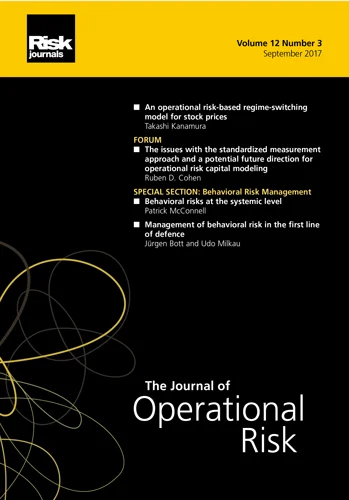
Journal of Operational Risk
ISSN:
1755-2710 (online)
Editor-in-chief: Marcelo Cruz
About this journal
Of the main areas of risk management, operational risk has the shortest history, with the industry beginning to give it serious consideration only 25 years ago. In that time, the industry has made great strides in both the definition and quantification of operational risk. The Journal of Operational Risk has been publishing papers at the forefront of this development since its inception.
On the quantification side, significant progress has been made, with major banks disclosing their operational risk exposures on a yearly basis. For many financial institutions their operational risk exposure is higher than that of market and credit risks. One large operational risk event can be lethal to a financial firm. Operational risk is thus a key concern for the industry as well as for the regulators that supervise financial institutions.
On the definition side, the industry has recently introduced the concept of “Non-Financial Risk” encompassing not just the early definition of operational risk but other risks like strategic, people, cyber, IT, etc. A broader view of operational risk would also consider Enterprise Risk Management, Cyber Risk Management, Information Technology Risks, Data Quality Risks amongst others. The introduction of new technologies like machine learning, artificial intelligence alongside new quantification ideas makes operational risk an intriguing risk domain with a green field for development and implementation of new ideas and theories.
With that in mind, The Journal of Operational Risk welcomes papers on non-financial risks as well as topics including, but not limited to, the following.
- The modeling and management of operational risk;
- Recent advances in techniques used to model operational risk, e.g., copulas, correlation, aggregate loss distributions, Bayesian methods and extreme value theory;
- The pricing and hedging of operational risk and/or any risk transfer techniques;
- Data modeling external loss data, business control factors and scenario analysis;
- Models used to aggregate different types of data;
- Causal models that link key risk indicators and macroeconomic factors to operational losses;
- Regulatory issues, such as Basel II or any other local regulatory issue;
- Enterprise risk management;
- Cyber risk management;
- IT risk management (how systems errors/fails impact an organization and change their risk profile);
- Big data applications to non-financial risk;
- Artificial intelligence and machine learning applications to risk management;
- Qualitative analysis of non-financial risks.
Journal Metrics:
Journal Impact Factor: 0.8
5-Year Impact Factor: 0.7
CiteScore: 1.3
Latest papers
A note on the statistical robustness of risk measures
This paper focuses on the parametric estimators of risk measures and uses Hampel’s infinitesimal approach to derive the robustness properties.
On a family of weighted Cramér–von Mises goodness-of-fit tests in operational risk modeling
This paper applies classical theory to determine if limiting distributions exist for WCvM test statistics under a simple null hypothesis.
Various approximations of the total aggregate loss quantile function with application to operational risk
This paper investigates the mechanics of the empirical aggregate loss bootstrap distribution.
A structural model for estimating losses associated with the mis-selling of retail banking products
In this paper, a structural model is presented for estimating losses associated with the mis-selling of retail banking products. It is the first paper to consider factor-based modeling for this operational/conduct risk scenario.
Standardized measurement approach: is comparability attainable?
This paper considers the claim of improved comparability of SMA outcomes by considering the ability to compare “internal loss experience” between banks.
Operational risk and the three lines of defence in UK financial institutions: is three really the magic number?
This paper examines the three lines of defence in the context of ORM in UK financial institutions.
Hidden Markov regimes in operational loss data: application to the recent financial crisis
The authors propose a method to consider business cycles in the computation of capital for operational risk.
A nonlinear analysis of operational risk events in Australian banks
This paper proposes a methodology applied to complex systems to analyze operational risk events in Australian banks.
The death of one thousand flowers or the AMA reborn?
The author of this paper explores the reasons for the pending demise of the advanced measurement approach (AMA) to operational risk.
Operational risk models and asymptotic normality of maximum likelihood estimation
In this paper, the author studies how asymptotic normality does, or does not, hold for common severity distributions in operational risk models.
Optimal B-robust posterior distributions for operational risk
The aim of this paper is to integrate prior information into a robust parameter estimation via OBR-estimating functions.
The benefit of using random matrix theory to fit high-dimensional t-copulas
This paper uses simulation studies and an example of operational risk modeling to show the necessity and benefit of using RMT to fit high-dimensional t-copulas in risk modeling.
Operational risk and the Solvency II capital aggregation formula: implications of the hidden correlation assumptions
The authors of this paper analyze the Solvency II standard formula for capital risk aggregation in relation to the treatment of operational risk capital.
An assessment of operational loss data and its implications for risk capital modeling
The author of this paper assesses operational loss data and its implications for risk capital modeling.
Comments on the Basel Committee on Banking Supervision proposal for a new standardized approach for operational risk
In this paper, the behavior of the SMA is studied under a variety of hypothetical and realistic conditions, showing that the simplicity of the new approach is very costly.
Should the advanced measurement approach be replaced with the standardized measurement approach for operational risk?
This paper discusses and studies the weaknesses and pitfalls of the SMA and the implicit relationship between the SMA capital model and systemic risk in the banking sector.
Rapidly bounding the exceedance probabilities of high aggregate losses
The authors of this paper assess the right-hand tail of an insurer’s loss distribution for a specified period (a year), presenting and analyzing six different approaches in doing so.
A simulation comparison of aggregation periods for estimating correlations within operational loss data
This paper investigates the differences in the values of correlations based on different aggregation periods of time series loss data.
How to turn uncertainties of operational risk capital into opportunities from a risk management perspective
Going beyond the regulatory requirements to operational risk measurement, the authors of this paper aim to provide relevant business applications to a bank.
Operational risk: impact assessment of the revised standardized approach on Indian banks
This paper focuses on a comparison of the capital for Indian banks as required by the current regime for capital charge calculation, versus the possible revised Standardised Approach.