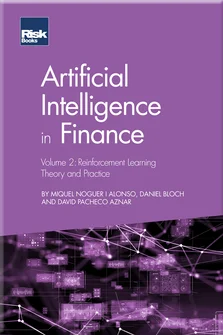
Artificial Intelligence in Finance, Volume 2: Reinforcement Learning Theory and Practice
First published:
ISBN: 9781782724544
If you are a Risk.net subscriber you are entitled to 20% off your Risk books purchases. Please email enquiries@riskbooks.com for more information.
As part of your Risk.net subscription you are entitled to 20% off all of your Risk Books purchases. If you would like to place an order please email enquiries@riskbooks.com
Portfolio optimisation
Miquel Noguer i Alonso, Daniel Bloch and David Pacheco Aznar
Portfolio optimisation
Preface
Introduction
Markov decision problems
Learning the optimal policy
Reinforcement learning revisited
Temporal difference learning revisited
Stochastic approximation in Markov decision processes
Large language models: reasoning and reinforcement learning
Deep reinforcement learning
Applications of artificial intelligence in finance
Pricing options with temporal difference backpropagation
Pricing American options
Daily price limits
Portfolio optimisation
Appendix
13.1 INTRODUCTION
Portfolio optimisation is about computing the optimal weights in a portfolio of assets for a given investment horizon by maximising some objective function. The modern portfolio theory (MPT) (Markowitz 1952a, 1959) entails a two-step construction process.
Estimate population moments. Compute the first two moments of asset returns over a given horizon; this is a prediction problem for the vector of expected returns and covariance matrix.
Portfolio construction. Optimise a mean–variance criteria over possible combinations of assets; this is a quadratic optimisation problem.
Researchers and practitioners have devised several techniques for estimating expected returns and the covariance matrix (James and Stein 1961; Black and Litterman 1992). However, it is extremely difficult to estimate returns accurately because of the lack of a long time series of data (Merton 1980). Further, estimates of variance-covariance are seldom well behaved. This difficulty in estimating the first two moments of returns leads to the error-maximising problem (EMP) of the mean–variance portfolio (Best and Grauer 1991). That is, we get unstable and extremely positive and negative weights in step
Copyright Infopro Digital Limited. All rights reserved.
As outlined in our terms and conditions, https://www.infopro-digital.com/terms-and-conditions/subscriptions/ (point 2.4), printing is limited to a single copy.
If you would like to purchase additional rights please email info@risk.net
Copyright Infopro Digital Limited. All rights reserved.
You may share this content using our article tools. As outlined in our terms and conditions, https://www.infopro-digital.com/terms-and-conditions/subscriptions/ (clause 2.4), an Authorised User may only make one copy of the materials for their own personal use. You must also comply with the restrictions in clause 2.5.
If you would like to purchase additional rights please email info@risk.net