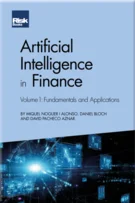
Artificial Intelligence in Finance, Volume 2: Reinforcement Learning Theory and Practice
First published:
ISBN: 9781782724544
If you are a Risk.net subscriber you are entitled to 20% off your Risk books purchases. Please email enquiries@riskbooks.com for more information.
As part of your Risk.net subscription you are entitled to 20% off all of your Risk Books purchases. If you would like to place an order please email enquiries@riskbooks.com
Pricing American options
Miquel Noguer i Alonso, Daniel Bloch and David Pacheco Aznar
Pricing American options
Preface
Introduction
Markov decision problems
Learning the optimal policy
Reinforcement learning revisited
Temporal difference learning revisited
Stochastic approximation in Markov decision processes
Large language models: reasoning and reinforcement learning
Deep reinforcement learning
Applications of artificial intelligence in finance
Pricing options with temporal difference backpropagation
Pricing American options
Daily price limits
Portfolio optimisation
Appendix
11.1 INTRODUCTION
11.1.1 Overview
An American warrant (call option) is a security issued by a company (individual) that gives its owner the right to purchase a share of stock at a given exercise price on or before a given date. In the case of an American put option, the owner has the right to sell a share of stock in the same conditions as the call option. Unlike with European options, at any exercise time the holder of an American option compares the optimal payout from immediate exercise with the expected payout from continuation, and then exercises if the immediate payout is higher. Thus, the optimal exercise strategy is fundamentally determined by the conditional expectation of the payout from continuing to keep the option alive. Samuelson (1965b, 1972) proved that these two contracts may not have the same value. Merton (1973) considered American option pricing, focusing on put options when the underlying stock pays dividends. The notion of dominant and dominated securities was used to show that an American put option was not uniquely determined by the price of a call option and the stock.
Since the key to optimally exercising an American option is identifying the conditional
Copyright Infopro Digital Limited. All rights reserved.
As outlined in our terms and conditions, https://www.infopro-digital.com/terms-and-conditions/subscriptions/ (point 2.4), printing is limited to a single copy.
If you would like to purchase additional rights please email info@risk.net
Copyright Infopro Digital Limited. All rights reserved.
You may share this content using our article tools. As outlined in our terms and conditions, https://www.infopro-digital.com/terms-and-conditions/subscriptions/ (clause 2.4), an Authorised User may only make one copy of the materials for their own personal use. You must also comply with the restrictions in clause 2.5.
If you would like to purchase additional rights please email info@risk.net