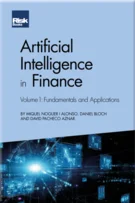
Artificial Intelligence in Finance, Volume 2: Reinforcement Learning Theory and Practice
First published:
ISBN: 9781782724544
If you are a Risk.net subscriber you are entitled to 20% off your Risk books purchases. Please email enquiries@riskbooks.com for more information.
As part of your Risk.net subscription you are entitled to 20% off all of your Risk Books purchases. If you would like to place an order please email enquiries@riskbooks.com
Daily price limits
Miquel Noguer i Alonso, Daniel Bloch and David Pacheco Aznar
Daily price limits
Preface
Introduction
Markov decision problems
Learning the optimal policy
Reinforcement learning revisited
Temporal difference learning revisited
Stochastic approximation in Markov decision processes
Large language models: reasoning and reinforcement learning
Deep reinforcement learning
Applications of artificial intelligence in finance
Pricing options with temporal difference backpropagation
Pricing American options
Daily price limits
Portfolio optimisation
Appendix
12.1 DESCRIPTION
Correctly modelling the dynamics of the underlying stock process by accounting for all market specificities in view of pricing contingent claims is a challenge. In the case of daily price limits (DPLs), the difficulties arise due to the market boundary conditions that restrict the dynamics of stock prices within a single trading day. Such processes are no longer Markov, and the no-arbitrage conditions no longer hold. In this chapter, we shall mainly focus on DPLs, which lead to an acceleration of the stock price movements near an upper or lower boundary.
12.1.1 Overview
The DPL is a financial mechanism restricting the dynamics of stock prices within a single trading day: the price of an individual stock can only increase or decrease by a maximum percentage relative to the closing price on the previous trading day. After a stock hits the DPL, trading is still allowed as long as the transaction prices are within the upper and lower limits. Thus, the stock price process in each trading day evolves inside a corridor (or trading range), which is itself stochastic. Most stock exchanges around the world impose a DPL on stock prices to explicitly restrict price movements on
Copyright Infopro Digital Limited. All rights reserved.
As outlined in our terms and conditions, https://www.infopro-digital.com/terms-and-conditions/subscriptions/ (point 2.4), printing is limited to a single copy.
If you would like to purchase additional rights please email info@risk.net
Copyright Infopro Digital Limited. All rights reserved.
You may share this content using our article tools. As outlined in our terms and conditions, https://www.infopro-digital.com/terms-and-conditions/subscriptions/ (clause 2.4), an Authorised User may only make one copy of the materials for their own personal use. You must also comply with the restrictions in clause 2.5.
If you would like to purchase additional rights please email info@risk.net