

UK swaps carrot for stick in Libor switch
BoE committee mulls policy action, which could include capital hikes on Libor exposures

UK regulators are losing patience with a growing stock of Libor exposures. The Bank of England’s Financial Policy Committee last week threatened policy action to more-forcibly detach participants from the discredited rate before the end of 2021, when it could vanish from view.
“In Q4, the FPC will consider further potential policy and supervisory tools that could be deployed by authorities to reduce the stock of legacy Libor contracts to an irreducible minimum ahead of end-2021,” says the FPC in its October report.
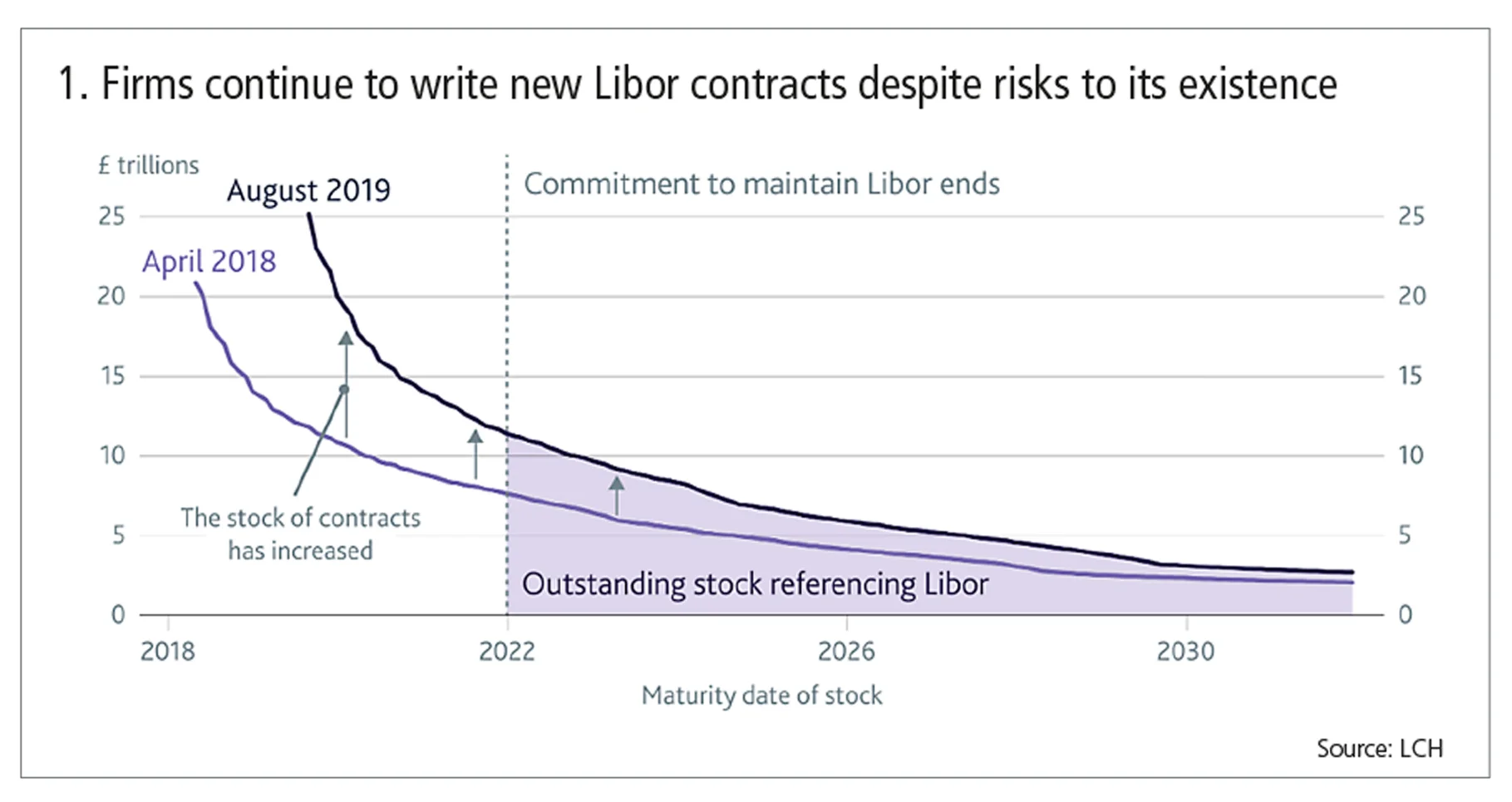
Participants may be dabbling in regulator-preferred risk-free rates (RFRs) such as Sonia in the UK and SOFR in the US, but there appears to be no let-up in firms writing new Libor contracts despite risks to the benchmark’s existence after 2021. The stock of Libor-linked instruments set to mature after the rate’s impending death jumped by around 50% to approximately £12 trillion ($15 trillion) between April 2018 and August 2019, according to LCH data included in the report (see figure 1).
The FPC warns there is “no justification” for firms to increase their Libor exposures. “The pace of market participants’ transition efforts to alternative benchmark rates now needs to accelerate,” it adds.
The latest bout of sabre rattling comes amid growing frustration among UK regulators at the slow pace of transition. The Prudential Regulatory Authority and Financial Conduct Authority are ramping up efforts to closely monitor Libor exposures and transition plans for more firms, starting with an expanded round of ‘Dear CEO’ letters. In September, the FCA called for banks to be making loans pinned to Sonia by the third quarter of 2020 and demanded dealers embed the rate as the norm when quoting sterling swaps.
When it comes to cranking up the pace of transition, regulators have a range of policy tools at their disposal – all of which are complex and time-consuming to implement. One well-flagged option is a hike in the risk weight of Libor-linked assets under Basel III capital rules. Another route is counterparty credit risk. If the regulator identifies a counterparty as a higher credit risk due to a weighty stock of Libor exposures, trading with that institution could attract higher credit valuation adjustment charges.
More likely, according to one London-based consultant, is a ‘skilled person review’ under Section 166 of the Financial Services and Markets Act. This permits the regulator to appoint a third party to perform a forensic assessment of a firm’s transition plans and activities to ensure there is an active winding down of positions.
It’s an intrusion most will be keen to avoid.
“Section 166 is the trump card as you have to throw so many resources at it and you’re under a microscope. Before that, there are a series of actions regulators could take. You could be fined privately or it could become a reputational risk issue. There are a lot of actions available before you need to make a policy change, which takes an inordinate amount of time,” says the consultant.
Other measures already under discussion include plans to restrict Libor collateral in the Bank of England’s sterling liquidity pool. The most radical option would effectively prohibit Libor assets from the sterling monetary framework – a £322 billion source of liquidity for more than 200 banks. The result would likely be to drive a wedge between Libor and Sonia-linked bond valuations, incentivising issuers to switch the rate underlying floating debt instruments through consent solicitation exercises.
Divergence
Participants in the sterling market may feel somewhat hard done by. No other market comes close in embracing Libor successor rates in both cash and derivatives markets. Sonia is already the standard benchmark for sterling floating rate note issuance, underlying £33 billion of debt. The unsecured overnight RFR represents half of sterling swaps notional cleared at LCH over the past year. That is an impressive haul, though growth has plateaued – a bugbear for the FCA.
Any UK policy action would have application beyond sterling contracts, likely impacting US dollar Libor and even Euribor exposures, where there is little or no pressure for local firms to transition.
The eurozone’s new €STR overnight rate, launched on October 2, is intended to replace Eonia – another overnight rate. Euribor, by contrast, is being kept alive indefinitely with support from European Central Bank.
In the current climate, it’s also difficult to imagine US regulators presenting a beefed-up plan to wipe out dollar Libor exposures in the near-term. After all, tough questions are being asked about the suitability of the new secured overnight financing rate since it went rogue on September 23, spiking to an unprecedented 5.25%.
If Libor was an easy target for manipulation, many participants are now scratching their heads over the viability of a benchmark whose stability is being buttressed by the Federal Reserve pumping billions of dollars of repo funding into the system.
At this stage, concrete policy action seems unlikely to be mirrored by global regulators. If the UK goes down that route, it may well be alone. Such a unilateral move could open a new door to regulatory arbitrage. For example, Libor assets traded by UK institutions could be hived into non-UK entities to escape higher charges. With the added spectre of Brexit, it could be a double whammy for market fragmentation.
Some hope the latest threat is more talk than action. But with just over two years until Libor’s possible demise – and seven years since the first Wheatley report put transition on the radar – it is little wonder that talk is turning tough.
“Regulators have to keep the thumbscrews on, otherwise this will just go on and on,” says the consultant.
コンテンツを印刷またはコピーできるのは、有料の購読契約を結んでいるユーザー、または法人購読契約の一員であるユーザーのみです。
これらのオプションやその他の購読特典を利用するには、info@risk.net にお問い合わせいただくか、こちらの購読オプションをご覧ください: http://subscriptions.risk.net/subscribe
現在、このコンテンツを印刷することはできません。詳しくはinfo@risk.netまでお問い合わせください。
現在、このコンテンツをコピーすることはできません。詳しくはinfo@risk.netまでお問い合わせください。
Copyright インフォプロ・デジタル・リミテッド.無断複写・転載を禁じます。
当社の利用規約、https://www.infopro-digital.com/terms-and-conditions/subscriptions/(ポイント2.4)に記載されているように、印刷は1部のみです。
追加の権利を購入したい場合は、info@risk.netまで電子メールでご連絡ください。
Copyright インフォプロ・デジタル・リミテッド.無断複写・転載を禁じます。
このコンテンツは、当社の記事ツールを使用して共有することができます。当社の利用規約、https://www.infopro-digital.com/terms-and-conditions/subscriptions/(第2.4項)に概説されているように、認定ユーザーは、個人的な使用のために資料のコピーを1部のみ作成することができます。また、2.5項の制限にも従わなければなりません。
追加権利の購入をご希望の場合は、info@risk.netまで電子メールでご連絡ください。
詳細はこちら 我々の見解
なぜ破綻処理計画を骨抜きにするのは良くないのか
銀行の破綻は避けられないものですが、銀行危機はそうではありません

日本の「大還流」?急速なリパトリは期待できない
GPIFによる米国債から日本国債への切り替えは段階的に行われる見通しであり、これはヘッジファンドにとってさらなる悪材料となる可能性があります

AIエージェントが、信頼できないスタッフのような存在である理由
GenAIシステムに内在する不確実性により、リスク管理担当者はより対立的なアプローチをとらざるを得ません

批判派は、パーペチュアルはすべてフロスだと言っています。しかし、数字はそうではないことを示唆している
TradFiを原資産とする永久先物に対する堅調な未決済建玉は、CMEやEurexといった既存の取引所にとって脅威となる可能性があります

SpaceXがCMEの個別銘柄先物に待望の追い風をもたらした
S&P 500先物契約へのIPO関連の追加契約として、新たな契約が急増する可能性があります
Bank vs non-bank: FX’s two-tier reality
CME and LSEG data show banks provide sticky and broad liquidity, while non-banks cling tightly to the price

規制当局はエンフォースメントを甘くしているのか?(そして、私たちはそれを気にするべきなのか?)
米国の規制当局は、技術的な規則違反に対する罰則を緩和しており、小さくとも重要なリスクが見過ごされてしまうのではないかという懸念が高まっています

FX HedgePoolを超えて:オール・トゥ・オール(All-to-All)の今後はどうなる?
この取引モデルの支持者たちは、その将来性を明るく見ていますが、普及に向けた障壁は依然として残っています。
