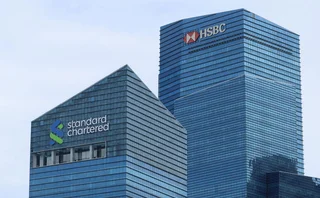
Banks fear fracturing of Asian trading desks by FRTB
Rules could produce “lots of little country desks”, warns StanChart market risk head


Global banks fear they will be forced to break up their emerging market trading desks to comply with new market risk capital rules, according to conference speakers.
Current structures – in which staff dotted across several offices may report in to a single line manager – may have to be replaced by small, country-specific desks, if each national regulator reacts to the Fundamental Review of the Trading Book (FRTB) by wanting to ring-fence trading operations in their jurisdiction.
“For any bank that has a lot of different locations and particularly a lot of subsidiaries, that is a big problem. Anything we can do to work with our regulators to avoid a complete fragmentation, creating lots of little country desks all over the place, would be fantastic,” Philippe Lintern, global head of market risk at Standard Chartered, told the FRTB Implementation Summit on May 23. “There is a balkanisation nightmare scenario.”
Finalised in January 2016, the FRTB requires banks to divide all their market risk operations into individual trading desks. Each desk must have a designated head, and each trader must belong only to one desk.
Other speakers said banks have a wide range of priorities when deciding their desk structure, including which products they see offering the best business opportunities, which risks need closest monitoring, as well as data availability, implementation cost and capital management requirements. The FRTB could trample on these priorities, banks fear, if different national regulators insist each desk has a local head.
“We are lead-regulated by the Prudential Regulation Authority [PRA] in the UK, so from a PRA and group capital perspective, we can take a cross-business and cross-country view quite easily. But we have large subsidiaries in Hong Kong, Korea and China, and I can imagine all of them are going to want their local versions of FRTB with local versions of the desk,” said Lintern.
Etienne Varloot, global head of market risk at French bank Natixis, told the conference the bank is already able to calculate a discrete risk number for expected shortfall under the current Basel 2.5 framework for all activities in a specific office such as Hong Kong, if requested to do so by the local regulator. This would not require creating a separate trading desk. “But it is to be expected that they will ask for an independent desk,” he warned.
We have large subsidiaries in Hong Kong, Korea and China, and I can imagine all of them are going to want their local versions of FRTB with local versions of the desk
Philippe Lintern, Standard Chartered
This could generate a number of difficulties, Varloot said. At the moment, Hong Kong is the head office for the Asia region and therefore currently aggregates risk for smaller offices such as Beijing, Singapore, South Korea and Taiwan. Varloot said he feared having to set up many very small FRTB desks to provide separate expected shortfall computations to each local supervisor.
Another problem is that the FRTB sets out a much brighter line dividing activities between trading and banking books. Where global banks run small Asian trading operations, teams of just a few staff normally work on both client and internal treasury trades – this might be prohibited by the requirement that any trader should only serve on a single desk.
“Can a trader doing FX trading in Singapore at the same time work for the treasury desk on the banking book? It isn’t clear; you can read the text in two different ways. For the time being, we are going for [the answer] ‘yes they can’, because if not, we are going to have to double the human resources in most of our local branches, which would be crazy – hiring people to do sometimes a couple of trades a month. I don’t think the regulator wants us to go out of business in Moscow or Dubai or wherever,” said Varloot.
The European Commission unveiled its proposal to implement FRTB in November 2016, while the US legislation is still pending.
コンテンツを印刷またはコピーできるのは、有料の購読契約を結んでいるユーザー、または法人購読契約の一員であるユーザーのみです。
これらのオプションやその他の購読特典を利用するには、info@risk.net にお問い合わせいただくか、こちらの購読オプションをご覧ください: http://subscriptions.risk.net/subscribe
現在、このコンテンツを印刷することはできません。詳しくはinfo@risk.netまでお問い合わせください。
現在、このコンテンツをコピーすることはできません。詳しくはinfo@risk.netまでお問い合わせください。
Copyright インフォプロ・デジタル・リミテッド.無断複写・転載を禁じます。
当社の利用規約、https://www.infopro-digital.com/terms-and-conditions/subscriptions/(ポイント2.4)に記載されているように、印刷は1部のみです。
追加の権利を購入したい場合は、info@risk.netまで電子メールでご連絡ください。
Copyright インフォプロ・デジタル・リミテッド.無断複写・転載を禁じます。
このコンテンツは、当社の記事ツールを使用して共有することができます。当社の利用規約、https://www.infopro-digital.com/terms-and-conditions/subscriptions/(第2.4項)に概説されているように、認定ユーザーは、個人的な使用のために資料のコピーを1部のみ作成することができます。また、2.5項の制限にも従わなければなりません。
追加権利の購入をご希望の場合は、info@risk.netまで電子メールでご連絡ください。
詳細はこちら 規制
CFTC accused of ‘double standards’ on compute futures
Duffy question ‘long review’ of CME’s contract when Kalshi already offers similar product
欧州の銀行は、アウトプット・フロアの是正策について合意に至っていない
市場リスクを除外すべきだと主張する人もいれば、クレジット・モデリングによるコスト削減をさらに進めるべきだと主張する人もいます

SECは2027年にCATを吸収合併することを目指している
SEC委員長が市場監視体制の直接的な管理権限を求めており、FINRAの権限を侵そうとしています

FCMたちは、CMEの監督からの離脱を認めるCFTCの提案を支持している
新たな規則は、垂直統合型取引所グループにおける利益相反に対処することを目的としています

銀行各社は、シンガポールに対し、暗号資産の保有限度額の緩和を求めている
トークン化やステーブルコインに対する資本要件の引き下げは歓迎されますが、上限の設定により、当面は銀行の参入が抑制されることになります
ESMAによると、EUの大手金融機関は清算業務の移転に関して動きが鈍いとのこと
「アクティブ・アカウント」の増加が中小企業の国内移転を後押ししています。立法府が望むならば、規制当局はより大きな役割を担う準備ができています。
イングランド銀行の危機対応融資計画が壁にぶつかる
規制当局が提案した「解放可能なレバレッジ資本バッファー」の引き上げ案に対し、懐疑的な見方が広がっています

BoEのレバレッジ比率の見直しが、HSBCとスタンダードチャータードに打撃を与えた
提案されている変更は、国内融資に有利な形でバランスを是正することを目的としています