
Quantitative analysis
Monthly snapshot
market data

Triple-B tie-up
technical
Detecting market abuse
Financial regulators need a way to detect market abuse in real time. Marcello Minenna has developed such a procedure that can detect, for each quoted stock and on a daily basis, the presence of market abuse phenomena by means of a set of tripwires that…
Maximum likelihood estimate of default correlations
Estimating asset correlations is difficult in practice since there is little available data andmany parameters have to be found. Paul Demey, Jean-Frédéric Jouanin, Céline Roget andThierry Roncalli present a tractable version of the multi-factor Merton…
Mixed default modelling
Structural and reduced-form models are two well-established approaches to modelling afirm’s default risk. Here, Li Chen, Damir Filipovic/ and Vincent Poor develop a new default riskmodelling strategy based on combining these two frameworks in order to…
Incorporating policyholder expectations into ALM
European life insurers have recently improved their asset/liability management (ALM) skills.However, those efforts have been limited to the matching of guaranteed policyholder benefits.While bringing considerable insight, they also leave management with…
Quant analysis by StructuredRetailProducts.com
Quant analysis
Premier Fund Managers
Quant analysis by StructuredRetailProducts.com
Caisse d’Epargne
Quant analysis by StructuredRetailProducts.com
Scottish Widows
Quant analysis by StructuredRetailProducts.com
Poste Italiane
Quant analysis by StructuredRetailProducts.com
Monthly snapshot
market data
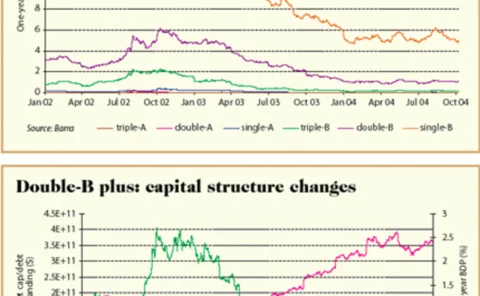
Default lines
market graphics

Counting on foreign cash
foreign investment
In the core of correlation
The single-factor Gaussian copula model has become a benchmark for the pricing and risk management of basket credit derivatives and synthetic CDO tranches. However, recent months have seen the development of a market for tranched synthetic indexes,…
Detecting market abuse
Financial regulators need a way to detect market abuse in real time. Marcello Minenna has developed such a procedure that can detect, for each quoted stock and on a daily basis, the presence of market abuse phenomena by means of a set of tripwires that…
Maximum drawdown
The maximum loss from a market peak to a market nadir, commonly called the maximum drawdown (MDD), measures how sustained one’s losses can be. Malik Magdon-Ismail and Amir Atiya present analytical results relating the MDD to the mean return and the…
HSBC
Quant analysis by Arete Consulting
CIC
Quant analysis by Arete Consulting
Nvesta
Quant analysis by Arete Consulting
CNP
Quant analysis by Arete Consulting
Smile dynamics
Traditionally, smile models have been assessed according to how well they fit market option prices across strikes and maturities. However, the pricing of most recent exotic structures, such as reverse cliquets or Napoleons, is more dependent on the…
Correlating market models
While swaption prices theoretically contain information on interest rate correlation, Bruce Choy, Tim Dun and Erik Schlögl argue that, for any practical purpose, this information cannot be extracted. Care must therefore be taken when pricing correlation…