
Model validation
From Navier-Stokes to manuscripts by the kilo: AI’s impact on quant research
As AI produces results in bulk, finance needs trusted ways to assess provenance, reliability and significance



The application of a corporate bond default risk-identification model to digital economic security
This paper proposes a CatBoost-based model incorporating corporate revenue performance and governance metrics to assess the likelihood of bond default and improve prediction accuracy.

Banks building GenAI governance in parallel to model risk
Risk Benchmarking: Majority have established AI governance committees, but ownership is fragmented

Agentic AI set to drive end-to-end automation of MRM workflows
Risk Live: Validator role likely to shift towards oversight and expert judgement

Bowman shuns CECL. Friends say it just needs a little help
How far should FASB go in reforming credit-loss accounting rules?

From gatekeeper to coach: model risk bids to reinvent itself
Model Risk Benchmarking data reveals a function in flux, grappling with resource cuts, AI models, regulatory divergence

Treat AI models as would-be hackers, says quant
Risk Live: Models capable of “strategic deception” require different risk management, says former Risk.net quant of the year

Managing AI models is reshaping three lines of defence, say banks
Risk Live: Model managers want seat at table during development, and expect first line to take charge of AI model testing
How banks are using AI assistants for credit risk model validation
Model validation has become a structural bottleneck for European banks. AI-based assistants can offer a credible response and early production deployments are having an operational impact

Regulators question human-in-the-loop as AI governance tool
Bank of England and FSB executives suggest it’s more important to retain overall accountability

Do banks still need to validate GenAI models?
Regulators carved out GenAI models from new risk guidance. Banks shouldn’t see this as a reason to stop validating them.

Hopes, fears and ‘mass confusion’: the sudden end of SR 11-7
Banks welcome chance to prioritise model reviews, but fret over future policy changes and AI
Graph neural networks for credit default prediction: robustness and model evaluation
The authors evaluate the robustness and performance of graph-based models in credit default prediction.

AI risk management and the shift to capability control
By reframing validation, banks can align innovation with regulatory demands and maintain robust risk discipline, argues risk manager
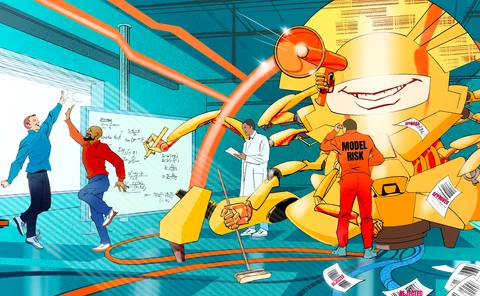
The do-it-all machine: model risk in the age of generative AI
Banks race to understand risks posed by new breed of multi-purpose bots

Model validation of a generative-artificial-intelligence-based avatar for customer support in banking
The authors put forward a validation method for a gen-AI-based avatar designed to deal with customer inquiries in the banking sector.

Rising reliance on internal auditors spooks regulators and industry
Risk managers warn US is substituting supervisors with auditors; could compromise independence
Generative artificial intelligence in model risk management: emerging opportunities, supervisory challenges and validation frameworks
The author proposes a structured approach to validating generative AI models in line with the principles of current regulatory standards.

The loneliness of the model risk manager
Boards may see them as a drag on innovation; risk functions need to show they embrace efficiency
A dual backtesting framework for quantifying nested model error and unlocking capital efficiency
The author puts forward a framework for dual backtesting, in which single-blind backtesting assesses core models and double-blind backtesting evaluates the whole system.

FHLB Cincinnati explores AI to spot failing banks
Agentic model detects anomalies, monitors sentiment and drafts credit reports for analyst review