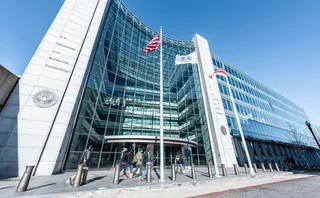
SEC finalises rules on hedge fund registration
The much anticipated SEC decision regarding US-domiciled hedge fund registration raised few eyebrows when it was announced late last month. It was clear, therefore, that hedge fund registration was only a matter of time, but what is less clear is the level of impact this may have on the US alternative asset management industry. By Stewart Eisenhart and Victor Anderson.
To little surprise but some chagrin, the US Securities and Exchange Commission (SEC) voted on October 26 to finalise rules proposed earlier this year to require hedge funds to register as investment advisors and establish compliance policies and procedures.
According to the Commission, the rule will enable more thorough collection of information on hedge fund advisors and examination of their operations in order to root out compliance problems earlier and deter fraudulent activities. Hedge funds will have until February 2006 to comply with the rule. Prior to that date, the Commission has indicated intentions to form a task force to determine how to implement the rule and ensure its efficacy.
The Mutual Funds Association (MFA), a hedge fund trade association and one of the staunchest opponents of the registration rule, decried the SEC's move to finalise the regulation, noting considerable numbers of industry sources coming out against it during the recent comment period.
In a statement made during final deliberations on the rule, however, SEC Chairman William Donaldson questioned assertions that registration would impose undue burdens upon hedge fund managers and threaten their markets.
"If more than 40% of all existing hedge fund managers have already registered voluntarily and have testified to its being a minimal burden, why is it that others resist?" Donaldson argued.
Donaldson's sentiments will no doubt strike a chord with the general US public, especially in the wake of last year's mutual fund scandal. But even though the latest measures are designed to bolster investor confidence, quite whether they will have the desired effect from the regulator's perspective – mitigating potential hedge fund fraud – is a moot point. Indeed, even prominent members of the US regulator, have voiced concerns regarding the practicalities of an under-staffed and under-funded regulatory body attempting to regulate an industry where, if any malfeasance is going to take place, it'll be accompanied by a trail of deception trying to hide the evidence of wrong doing. After all, last year's mutual fund scandal kicked off by the chance discovery during a routine SEC audit that Canary Capital, a New York-based hedge fund, had engaged in late trading practices with Bank of America's Nations Funds – hardly evidence that the SEC is 'on top of things'.
Mixed legal reaction
Although the final rule and its specific provisions have yet to be published – as of press date the SEC website (www.sec.gov) still hadn't published details of the rule – all parties involved have a good idea of what the regulation will entail.
David Goldstein, a partner in the securities practice of New York law firm White & Case who represents domestic and international hedge fund and private equity managers, opposes the SEC's move, and suggests the Commission has finalised the rule without knowing how to implement it.
"We understand that the SEC takes this seriously, but they're not executing it properly – I think they'd have more credibility if they'd taken more time to reflect on the comments," Goldstein argues. "What they're going to do is figure out in the next 15 months how to cope with all the comments after announcing that the rules will be final."
Goldstein claims that although the Commission aims to protect both investors and financial markets with the regulation, the rule misses the mark on both counts. "The mutual fund industry is a perfect example of how supervision has not protected the markets," he says. "People say the mutual fund industry would be worse without supervision, maybe. But that has not prevented fraud and illegal activity in that industry, so to think SEC oversight of hedge funds is going to have any positive effect on markets generally is just illusory.
"In terms of investor protection, it's totally wrong-headed," Goldstein continues. "In terms of 'retailisation', pension funds are the savviest, smartest investors on the market. To say that pension funds need this protection – nobody respects that, except the Investment Company Institute (a US mutual fund trade association)."
Adverse effects
According to Goldstein, the adverse effects of the registration rule for hedge fund investors will be particularly acute in emerging and international markets, where fund managers may shut out US capital to avoid regulation.
"One of the biggest gaps in all this is how non-US investment managers of offshore funds are going to be treated," says Goldstein. "Offshore advisors are not going to be able to make heads or tails of it, and the group I would call emerging market managers – middle market managers – have told me they are going to exclude US money. They don't need US money to drive up their asset size because they're looking globally for investors. "Until these funds reach extremely large sizes where they won't necessarily fear SEC oversight, they're going to shut US investors out," Goldstein warns. "The middle-tier managers are very often the ones with the best performance, so US investors are going to be cut out of a broad swath of investment opportunities."
Much ado about nothing?
David Barnett, senior counsel at Morrison Cohen Singer & Weinstein, another New York law firm representing hedge fund clients, sees neither alarms nor any surprises in the SEC's action.
Barnett says the commission's plans to form a task force prior to the compliance date shows a willingness on its part to ensure effective implementation.
"They want examiners to understand what the risks are for hedge funds, and what they should be asking and looking at when they go to visit these firms," Barnett says. "That's part of the reason why the compliance date is so far out."
Barnett also argues that the compliance section of the rule does not necessarily require the hiring of a chief compliance officer at a hedge fund – only the appointment of one.
"That rule does not say that you have to go out and hire someone to be the chief compliance officer, so most firms will probably designate a controller or a chief financial officer (CFO) to be the compliance officer," Barnett says. "If you're managing $50 million, you're not required to go out and hire a lawyer or someone from an investment bank to be a compliance officer. If you're a large hedge fund managing $2 billion, you probably already have a general counsel or chief compliance officer. A good CFO with help from a law firm can really get it done."
Barnett notes that many of his firm's hedge fund clients have already sought guidance on getting in place policies and procedures addressing such things as personal securities trading, insider information, and advertising required in the rule.
While acknowledging that costs associated with SEC registration and compliance won't be painless for many small and mid-tier funds, Barnett doesn't expect them to prove crippling based on the experiences of fund managers who've already registered as investment advisors.
"The start-up and ongoing costs are not so great, but a lot depends upon the size of the firm – a $70 million fund may be hurt by a $50,000 cost to get things up and running, but for a $2 billion fund, not so much," Barnett says. "The SEC said that no onereally complained to them before about the costs. All these hedge funds that have already registered voluntarily haven't complained, so they can't believe there would be complaints about this."
Hedge Fund & Investment TechnologyOnly users who have a paid subscription or are part of a corporate subscription are able to print or copy content.
To access these options, along with all other subscription benefits, please contact info@risk.net or view our subscription options here: http://subscriptions.risk.net/subscribe
You are currently unable to print this content. Please contact info@risk.net to find out more.
You are currently unable to copy this content. Please contact info@risk.net to find out more.
Copyright Infopro Digital Limited. All rights reserved.
As outlined in our terms and conditions, https://www.infopro-digital.com/terms-and-conditions/subscriptions/ (point 2.4), printing is limited to a single copy.
If you would like to purchase additional rights please email info@risk.net
Copyright Infopro Digital Limited. All rights reserved.
You may share this content using our article tools. As outlined in our terms and conditions, https://www.infopro-digital.com/terms-and-conditions/subscriptions/ (clause 2.4), an Authorised User may only make one copy of the materials for their own personal use. You must also comply with the restrictions in clause 2.5.
If you would like to purchase additional rights please email info@risk.net
More on Regulation
Bowman’s Fed may limp on by after cuts
New vice-chair seeks efficiency, but staff clear-out could hamper functions, say former regulators
Review of 2025: It’s the end of the world, and it feels fine
Markets proved resilient as Trump redefined US policies – but questions are piling up about 2026 and beyond
Hong Kong derivatives regime could drive more offshore booking
Industry warns new capital requirements for securities firms are higher than other jurisdictions
Will Iosco’s guidance solve pre-hedging puzzle?
Buy-siders doubt consent requirement will remove long-standing concerns
Responsible AI is about payoffs as much as principles
How one firm cut loan processing times and improved fraud detection without compromising on governance
Could one-off loan losses at US regional banks become systemic?
Investors bet Zions, Western Alliance are isolated problems, but credit risk managers are nervous
SEC poised to approve expansion of CME-FICC cross-margining
Agency’s new division heads moving swiftly on applications related to US Treasury clearing
ECB bank supervisors want top-down stress test that bites
Proposal would simplify capital structure with something similar to US stress capital buffer