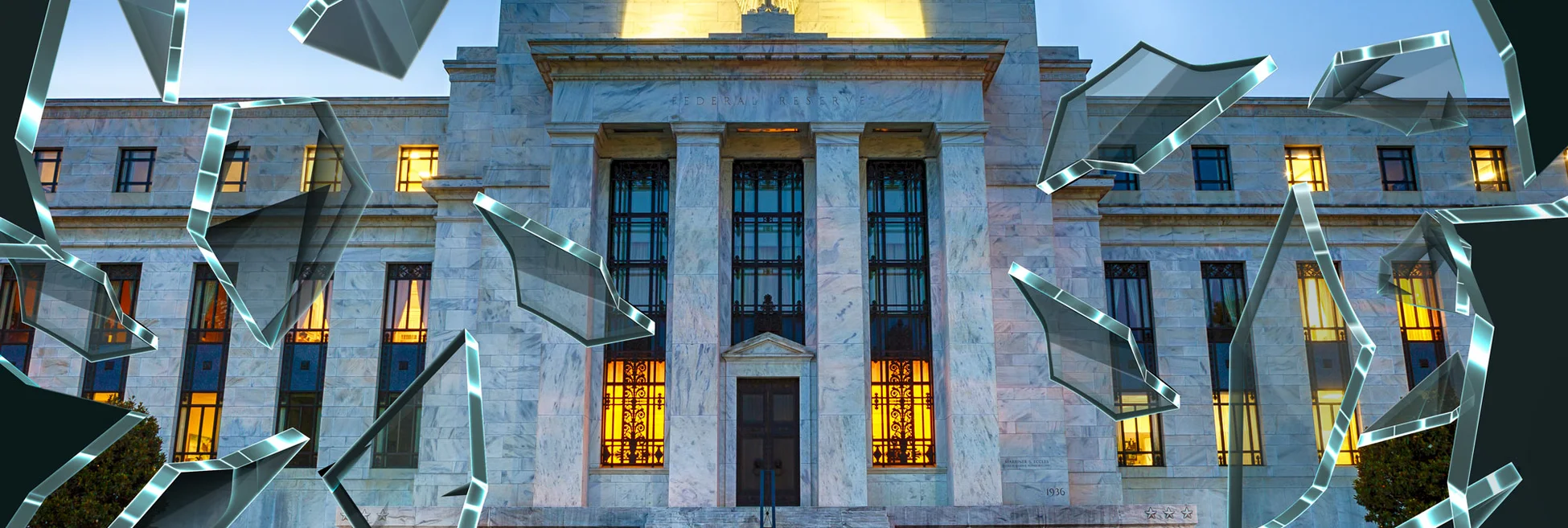

Federal Reserve building with shards of shattered glass around it

Fed fractures post-SVB consensus on emergency liquidity

New supervisory principles support FHLB funding over discount window preparedness

It was as close to a regulatory consensus as seems possible these days.

After the collapse of Silicon Valley Bank in 2023, regulators generally agreed that US banks had become too dependent on the Federal Home Loan Bank (FHLB) system for funding, and that they needed to be better prepared to use the Federal Reserve’s discount window in an emergency.

At the end of October 2025, the Fed issued a new statement of supervisory operating principles explicitly setting out the changes Michelle Bowman, vice-chair for supervision, “expects us to take”. On emergency liquidity, it shatters that post-SVB consensus.

Bank examiners are now told they “should not prohibit or discourage firms” from relying on FHLB funding when performing internal liquidity stress tests, or pressure them to preposition assets at the discount window as a condition of future borrowing.

The memo describes the changes as “a significant shift from past operating practices” that reflect Bowman’s “priorities and principles”.

To some regulators who were in office during the SVB crisis, the change in liquidity guidance seems perplexing – even reckless.

I basically feel like the FHLBs and the Fed need to come to a more workable regime than what we saw in 2023
Bill Dudley, former Fed president

“These are bad ideas,” says Michael Hsu, former head of the Office of the Comptroller of the Currency. “I’m astounded they’re making this rule.”     

Graham Steele, former Treasury assistant secretary for financial institutions in the Biden administration, is equally baffled.

“I thought everyone agreed that [reliance on FHLB funding] was a problem, and it seemed like there was some degree of bipartisan industry consensus that something needed to change,” he says. “This feels like moving in the opposite direction.”

Others take a more nuanced view. Randal Quarles, Fed vice-chair of supervision during the first Trump administration, argues the discount window has “atrophied” due to a lack of regular use and that the Fed needs to “seriously rethink” its role as the lender of last resort.

“What the SVB event showed was that the liquidity needs of certainly many banks in the system, and maybe the system as whole, are much higher in the modern world than we had thought, because of advances in technology that allow runs to accelerate and develop at a faster rate and to a much greater degree than was physically possible before,” says Quarles.

Michelle Bowman
Photo: Federal Reserve/Flickr
Michelle Bowman: modernising capabilities

That means regulators should be open-minded about how to deal with bank runs, Quarles says. And while he stops short of explicitly endorsing the recent changes to supervisory principles, he says he is sympathetic to the Fed’s direction of travel.

One prominent advocate of prepositioning collateral at the discount window seems surprisingly unperturbed by the change in Fed policy. Bill Dudley, former president of the New York Fed, chaired a working group that published a report in January 2024 on ways to improve the Fed’s lender of last resort mechanisms, including requiring banks to preposition enough collateral at the discount window to meet all runnable liabilities. Asked about the Fed’s recent guidance, Dudley says he is “not wed to the idea that FHLB advances have to be somehow outlawed or trimmed back”, and goes on to highlight a different issue – the difficulty of moving collateral between the FHLBs and the Fed.     

“My understanding is the FHLBs sometimes have a claim on the entire pool of collateral, and then the question is, how does that work if I need to move to the Fed,” he says. “I basically feel like the FHLBs and the Fed need to come to a more workable regime than what we saw in 2023.”

On this, Bowman seems to agree. In Congressional testimony last month, she emphasised “the importance of being able to quickly move collateral from the FHLB system to the discount window system”.

“We’re doing a lot of work to modernise our capabilities and our operations in that space,” Bowman said.

The larger question for some is how banks will respond to the recent guidance while the Fed upgrades its systems and rethinks its role as lender of last resort.

“There may be a risk that some banks or even their regulators take a more lenient position on readiness for pledging and for accessing funding during crises,” says Joan Cheney, who was until earlier this month chief risk officer at Customers Bank in New York.

Who doesn’t love a discount?

One of the more striking findings of the Fed’s post-mortem report on SVB’s collapse was that the California lender was unprepared to borrow from the Fed in an emergency. In theory, SVB had plenty of eligible collateral for the discount window. But only a small amount was pre-pledged, the bank had not conducted test transactions, and it was unable to move assets quickly enough from its custody bank or the FHLB to the Fed. 

The problem was not limited to SVB. A Fed study on discount window preparedness published in April 2024 found that nearly 20% of supervised banks – 924 out of a total of 4,824 – had not signed up to use the discount window, while only around 40% had pre-pledged collateral for future borrowing.

The findings sparked a debate over how to get banks to be better prepared to tap the Fed’s lender-of-last-resort facility in a crisis.

One of the most concrete ideas came from Hsu, who proposed a new, targeted liquidity requirement for fast-moving outflows in January 2024. The existing liquidity coverage ratio requires banks to hold sufficient liquid assets to cover 30 days of stressed outflows. Under Hsu’s new proposal, banks would have to prove they could survive five days of stress. Crucially, banks would only be allowed to assume discount window borrowing to meet the requirement if collateral is pre-positioned and operational access tested in advance.

Others backed a simpler requirement for banks to preposition collateral equivalent to a portion of their uninsured deposits – perhaps up to 50% – and conduct a set number of test transactions each year.

I personally would like us to go even further and have the expectation that each institution must be set up to at least be able to tap the window
Lisa White, Richmond Fed

While the exact mechanism proved elusive, there was general agreement among banking regulators that prepositioning collateral at the discount window was the way to go. “Everyone was in agreement after SVB that banks should really preposition collateral and get it ready,” Hsu says. 

A former senior Fed official who was privy to the discussions concurs: “The safest [option] has to be the discount window,” they say. “Holding collateral at the Fed is not free, and it carries with it opportunity costs. But purely from a risk perspective, I think [regulators] would prefer to have knowledge of what’s there and how much.”

Dudley gives two other reasons for wanting banks to preposition collateral at the discount window: “One, I think it’s a way of constraining banks from doing crazy things with their uninsured deposits, and two, it’s basically reassuring to depositors that they’re always going to get paid,” he says.

Regulators ultimately decided to use more carrot than stick to achieve their policy objectives. They recognised policymakers had themselves given the impression the discount window was a form of bailout, creating a stigma that was difficult for banks to overcome.

“The Fed has tried lots of different ways to reduce the stigma and make [the discount window] more business as usual,” says the former Fed official, “but it’s really challenging when it’s not your first resort from a funding perspective”.

Rather than adopting a formal rule, the Fed instructed examiners to change their messaging on discount window use and encourage banks to preposition collateral for future borrowing.

Lisa White, executive vice-president for supervision, regulation and credit at the Richmond Fed, spelled out the new approach at a Risk.net conference in March 2024, a year after the collapse of SVB.

“We are trying to shift the perspective that I know many institutions will have about the discount window stigma and shift the narrative to it being a good thing that financial institutions are set up and have this as an option,” she said. “We’d love to see all the financial institutions that we supervise have the paperwork done and also have collateral that is pledged and ready to go.”

She also hinted there was more to come. “I personally would like us to go even further and have the expectation that each institution must be set up to at least be able to tap the window,” White said.

Efforts were also made to improve access to the discount window. A new portal created in 2024 allowed banks to make enquiries at any time about accessing the facility. Fed officials indicated further upgrades were in the works, including modernising the process of transferring collateral from the FHLBs. There was even talk of eventually opening the discount window 24 hours a day, seven days a week.

Also in 2024, the Federal Housing Finance Agency issued an advisory bulletin to the FHLBs setting out new expectations for assessing a bank’s creditworthiness when providing liquidity – which some feared would restrict lending to smaller banks – and directing them to work more closely with prudential regulators.

The message to banks seemed clear enough: reduce reliance on FHLB funding and borrow more from the discount window when needed. 

Changing course

For some, the Fed’s October statement has conjured confusion out of clarity.

While there is no formal regulation requiring banks to preposition collateral and test their ability to access the discount window, the Fed’s examiners made it clear it was “strongly recommended”, says Cheney, whose tenure as CRO at Customers Bank included the US regional banking crisis.  

The new guidance sends the opposite signal, she says: “They’re telling their regulators on site to take a step back.”

When Risk.net asked for clarification on the updated supervisory principles, the Fed said its current position is that if banks can access FHLB liquidity, they should be able to take that into account in managing their liquidity or performing internal liquidity stress tests. That does not mean the Fed wants them to become overly dependent on FHLBs. Similarly, if banks otherwise qualify for access to the discount window under applicable rules, supervisory staff should not be applying pre-positioning conditions that are not in the rules.

Risk.net understands the new supervisory principles should not be taken to mean the Fed doesn’t want banks to be better prepared to use the discount window than SVB was in 2023. 

Some see sense in the new supervisory principles. An industry source notes the FHLBs advanced more than $1 trillion to US banks in April 2023, while the Fed lent $329 billion via the discount window. Ignoring the availability of FHLB funding in a crisis would be naive, they say.

Randal Quarles
I would have been very open to lending to Silicon Valley Bank without a haircut on those securities and without necessarily having it collateralised in the first instance
Randal Quarles

Others see more ideology than pragmatism at work. Cheney feels “they’re taking a really strong stance in the opposite direction” to any measures enacted under the Biden administration. According to this interpretation, Bowman’s nomination as vice-chair chimes with an overall regulatory approach that is “much more lenient towards banks since there have been some changes in the executive and other branches of government”.

Steele also interprets the change in policy as a nakedly political attempt to renounce the work of Michael Barr, the Biden-appointed former Fed vice-chair for supervision, who stood down from the post in February 2025 but remained on the Fed Board. “I’m not clear on the benefits of doing this other than to make a break from the Barr era,” he says.  

At least one former Fed vice-chair is withholding judgment. Quarles says the latest supervisory statement should not be the last word on how the Fed fulfils its role as the lender of last resort to troubled banks. The big lesson of SVB, he argues, is that the Fed could have saved the bank despite its lack of preparation to borrow from the discount window.

“It was very clear from looking at the balance sheet that if SVB could have held onto these securities, it was solvent,” Quarles says.

SVB’s assets were mostly Treasuries or agency bonds with no credit risk, he says. The bank had plenty of capital, provided it could hold those assets to maturity. The run on deposits meant it couldn’t, but the Fed could, he argues. And if the Fed knows a bank has suitable collateral available and unencumbered on its balance sheet, pledging it in advance of accessing the discount window shouldn’t be necessary either.

“If I had been at the Fed, I don’t know whether the regulations would have allowed it, but I would have been very open to lending to Silicon Valley Bank without a haircut on those securities and without necessarily having it collateralised in the first instance,” says Quarles.

Whether Bowman would back such a radical approach – and what happens in the meantime – remains to be seen.

Editing by Kris Devasabai and Philip Alexander

Only users who have a paid subscription or are part of a corporate subscription are able to print or copy content.

To access these options, along with all other subscription benefits, please contact info@risk.net or view our subscription options here: http://subscriptions.risk.net/subscribe

You are currently unable to copy this content. Please contact info@risk.net to find out more.

Most read articles loading...

You need to sign in to use this feature. If you don’t have a Risk.net account, please register for a trial.

Sign in
You are currently on corporate access.

To use this feature you will need an individual account. If you have one already please sign in.

Sign in.

Alternatively you can request an individual account here