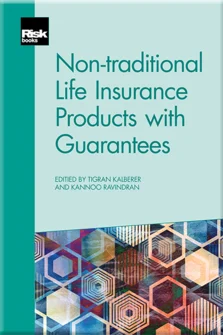
Non-traditional Life Insurance Products with Guarantees
First published:
ISBN: 9781782722038
If you are a Risk.net subscriber you are entitled to 20% off your Risk books purchases. Please email enquiries@riskbooks.com for more information.
As part of your Risk.net subscription you are entitled to 20% off all of your Risk Books purchases. If you would like to place an order please email enquiries@riskbooks.com
Economic Scenario Generators and Variable Annuities
Alexey Botvinnik
Low Interest Rate Environments and Consequences
Risks Faced by Writers of Investment Guarantees
Variable Annuity in Asia post-2008
How did Variable Annuities Fare in the Crisis?
Traditional Life Insurance Products are Under Pressure
An Overview of Regulatory Requirements
Simulations
Economic Scenario Generators and Variable Annuities
Modelling and Managing Policyholder Behavioural Risks
Modelling and Managing Mortality and Longevity Risks
Valuation of Variable Annuity Guarantees
Understanding and Using Reinsurance Treaties for Guaranteed Products
Hedging of Long-term Fund-linked Exotic Options
Overview of Commonly Used Risk Management Strategies
Taxonomy of Equity, Interest Rate, Hybrid and Customised Derivatives Used for Risk Management
Managing Risks Underlying Variable Annuity Liabilities
Basis Risk
Measuring Hedge Effectiveness
Measuring and Reporting Hedge Efficiency
Eight Important Questions Practitioners Should Ask When Managing Equity-linked Insurance Guarantee Risks
Variable annuities (VAs) are typically more sophisticated than traditional insurance products, and thus require a more elaborate product management approach. As market risk factors play a critical role in VA products, it is important to account for such risk factors when developing and managing VA products. This is where economic scenario generators (ESGs) come into play, to model future distributions of relevant market risk factors and the resulting profit and loss for the insurance company. The results of such models can be used for pricing, product development, hedging, risk management, etc.
ESGs create scenarios of economic variables that are subsequently processed by the corresponding modelling system. ESG applications are generally based on the Monte Carlo approach, using the law of large numbers and allowing determining expected values by estimation of the mean. The size of a scenario set can be quite large, and is usually a trade-off between the computing power available to the user and the desired degree of convergence for the estimate.
There are two types of ESGs, those for real-world modelling and those for valuation. This chapter will examine both, including which
Copyright Infopro Digital Limited. All rights reserved.
As outlined in our terms and conditions, https://www.infopro-digital.com/terms-and-conditions/subscriptions/ (point 2.4), printing is limited to a single copy.
If you would like to purchase additional rights please email info@risk.net
Copyright Infopro Digital Limited. All rights reserved.
You may share this content using our article tools. As outlined in our terms and conditions, https://www.infopro-digital.com/terms-and-conditions/subscriptions/ (clause 2.4), an Authorised User may only make one copy of the materials for their own personal use. You must also comply with the restrictions in clause 2.5.
If you would like to purchase additional rights please email info@risk.net