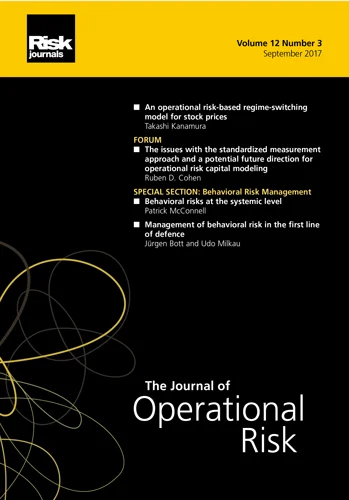
Journal of Operational Risk
ISSN:
1755-2710 (online)
Editor-in-chief: Marcelo Cruz
About this journal
Of the main areas of risk management, operational risk has the shortest history, with the industry beginning to give it serious consideration only 25 years ago. In that time, the industry has made great strides in both the definition and quantification of operational risk. The Journal of Operational Risk has been publishing papers at the forefront of this development since its inception.
On the quantification side, significant progress has been made, with major banks disclosing their operational risk exposures on a yearly basis. For many financial institutions their operational risk exposure is higher than that of market and credit risks. One large operational risk event can be lethal to a financial firm. Operational risk is thus a key concern for the industry as well as for the regulators that supervise financial institutions.
On the definition side, the industry has recently introduced the concept of “Non-Financial Risk” encompassing not just the early definition of operational risk but other risks like strategic, people, cyber, IT, etc. A broader view of operational risk would also consider Enterprise Risk Management, Cyber Risk Management, Information Technology Risks, Data Quality Risks amongst others. The introduction of new technologies like machine learning, artificial intelligence alongside new quantification ideas makes operational risk an intriguing risk domain with a green field for development and implementation of new ideas and theories.
With that in mind, The Journal of Operational Risk welcomes papers on non-financial risks as well as topics including, but not limited to, the following.
- The modeling and management of operational risk;
- Recent advances in techniques used to model operational risk, e.g., copulas, correlation, aggregate loss distributions, Bayesian methods and extreme value theory;
- The pricing and hedging of operational risk and/or any risk transfer techniques;
- Data modeling external loss data, business control factors and scenario analysis;
- Models used to aggregate different types of data;
- Causal models that link key risk indicators and macroeconomic factors to operational losses;
- Regulatory issues, such as Basel II or any other local regulatory issue;
- Enterprise risk management;
- Cyber risk management;
- IT risk management (how systems errors/fails impact an organization and change their risk profile);
- Big data applications to non-financial risk;
- Artificial intelligence and machine learning applications to risk management;
- Qualitative analysis of non-financial risks.
Journal Metrics:
Journal Impact Factor: 0.8
5-Year Impact Factor: 0.7
CiteScore: 1.3
Latest papers
Estimation of value-at-risk for conduct risk losses using pseudo-marginal Markov chain Monte Carlo
The authors propose a model for conduct risk losses, in which conduct risk losses are characterized by having a small number of extremely large losses (perhaps only one) with more numerous smaller losses.
Cyber risk management: an actuarial point of view
This paper points out the peculiarities of cyber insurance contracts compared with the classical nonlife insurance contracts from both the insurer’s and the insured’s perspectives. The main actuarial principles that are fundamental to any valuation in a…
Measuring expected shortfall under semi-parametric expected shortfall approaches: a case study of selected Southern European/Mediterranean countries
In this paper, the authors investigate the applicability of semi-parametric approaches for estimating expected shortfall.
The impact of enterprise risk management on the performance of companies in transition countries: Serbia case study
In this paper, seven hypotheses are defined, on the basis of which a theoretical model is developed to examine how different sources of enterprise risk affect the operational performance of Serbian companies and their risk of losing market position.
Applying existing scenario techniques to the quantification of emerging operational risks
This paper sets out techniques for: (a) identifying systematically emerging threats, their timescales, and interrelationships (eg, feedback loops and domino effects); (b) quantifying operational risks through structured scenario analysis processes that…
An investigation of cyber loss data and its links to operational risk
This paper investigates cyber loss data and focuses on quantifying the direct financial and compensatory losses emanating from cyber risks.
On the selection of loss severity distributions to model operational risk
This paper presents truncation probability estimates for loss severity data and a consistent quantile scoring function on annual loss data as useful severity distribution selection criteria that may stabilize regulatory capital.
The use of business intelligence and predictive analytics in detecting and managing occupational fraud in Nigerian banks
The goal of this paper is to illustrate how Nigerian banks, and indeed banks elsewhere, can develop solutions that incorporate both BI and predictive analytics techniques in detecting, predicting, preventing and managing occupational fraud.
Quantification of operational risk: statistical insights on coherent risk measures
In this paper, the authors review some of the existing methods used to quantify operational risks in the banking and insurance industries.
The operational risk disclosure practices of banks: evidence from India and Romania
This paper compares the levels of operational risk disclosure in the banking industries of India and Romania.
Sample dependence of risk premiums
This paper discusses the framework within which to study how sample dependence is transferred from the data to the premiums via the density.
Estimation of losses due to cyber risk for financial institutions
The objective of this paper is to analyze cyber risk from an operational risk perspective and to measure cyber risk empirically.
Introducing a novel system-of-systems axiomatic risk management technique for production systems
This paper focuses on conceptual and modeling frameworks in an attempt to explore qualitative and quantitative risk management techniques for hierarchical SoS risks, exemplifying the production systems for demonstration.
Maximum likelihood estimation error and operational value-at-risk stability
The aim of this paper is to systematically investigate the stability of operational value-at-risk (OpVaR) models when fitting heavy-tailed distributions to the relatively small sample sizes found in operational loss data.
An alternative approach for the operational risk assessment of a new product
The aim of this paper is to provide a new operational risk management framework to identify and mitigate the operational risk exposure arising from a new product.
Operational risk measurement: a loss distribution approach with segmented dependence
This paper proposes an approach, called the loss distribution approach with segmented dependence (LDA-SD), which can model the different dependencies of HFLI and LFHI losses in the framework of LDA.
A review of the state of the art in quantifying operational risk
In this paper, the authors provide a comprehensive review of the different approaches developed to model operational risk, specifically focusing on the actuarial approach.
Global perspectives on operational risk management and practice: a survey by the Institute of Operational Risk (IOR) and the Center for Financial Professionals (CeFPro)
This paper presents survey results which represent comprehensive perspectives on operational risk practice, obtained from practitioners in a wide range of countries and sectors.
Is operational risk regulation forward looking and sensitive to current risks?
This paper evaluates the operational risk capital requirements of large US banks to determine whether they are forward looking, sensitive to banks’ current exposures and designed to allow for risk mitigation.
Predictive fraud analytics: B-tests
In this paper, the authors look at B-tests: methods by which it is possible to identify internal fraud among employees and partners of the bank at an early stage.