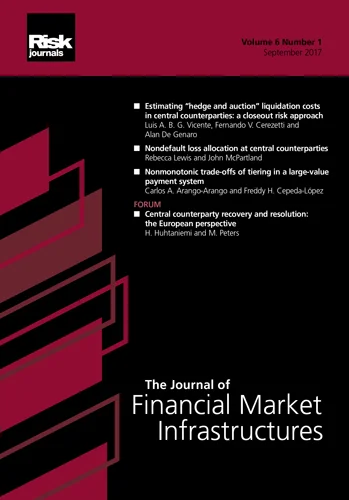
Journal of Financial Market Infrastructures
ISSN:
2049-5412 (online)
Editor-in-chief: Manmohan Singh
Volume 13, Number 1 (December 2025)
Editor's Letter
Manmohan Singh
This first issue of Volume 13 of The Journal of Financial Market Infrastructures offers three papers, which respectively provide a broader view on the singleness of money and discuss recent regional developments, including remittances in Latin America and digital payments in sub-Saharan Africa. The journal strives to provide its readership with a selection of cutting-edge papers, particularly those on “out of the box” ideas and analytics that underpin research in stablecoins and tokenized deposits; nonbank payment service providers and access to central bank payment rails; distributed ledger technologies, machine learning and artificial intelligence and their impact on financial market infrastructures; payments, netting and settlement time (T0), and clearing systems; and digital money (both private and public) and its impact on central bank operations and central bank balance sheets, including seigniorage.
In the first paper in the issue, Charles-Enguerrand Coste and George Pantelopoulos from the European Central Bank and the University of Newcastle, New South Wales, respectively, ask “Are stablecoins fungible money?”. Their paper rejects the “narrow” perspective whereby means of payments are merely tradable at par to maintain the so-called singleness of money, and argues that stablecoins issued by different issuers on different blockchains can be fungible to the same extent as commercial bank deposits from different banks, provided that payment and settlement technologies are interoperable, payments are transacted on ledgers that offer settlement finality, and central bank money acts as the monetary anchor.
The issue’s second paper – “Central bank digital currency and other digital payments in sub-Saharan Africa: a regional survey” by Luca Antonio Ricci, Calixte Ahokpossi, Anna Belianska, Khushboo Khandelwal, Sunwoo Lee, Grace Li, Yibin Mu, Saad Noor Quayyum, Silvia Nunez, Jack Ree, Marcos Rietti Souto and Felix Simione – reports key findings from the International Monetary Fund’s “Sub-Saharan Africa central bank digital currency and digital payments survey”. This paper sheds light on the motivations, benefits and challenges of central bank digital currency adoption, as well as the developments of digital private money and crypto assets in sub-Saharan Africa. The authors emphasize the pivotal role of collaboration and shared knowledge in navigating the intricate landscape of digital currencies and assets in the region.
Finally, “Rethinking remittances in the US–Mexico corridor: innovation, cost and policy implications” by Seth Dunbar, Christine Kirby, Pon Sagnanert, Alessio Saretto and Cynthia Silva, a team from the Federal Reserve Bank of Dallas, evaluates how online platforms and crypto-based technologies have reshaped the remittances landscape using the US–Mexico corridor as a case study. The authors suggest that the full benefits of such technological advances can be realized only if foundational constraints are addressed, but they also question whether such crypto-based solutions can maintain such advantages once they have been brought fully within the regulatory framework.
The editorial board encourages regular submissions, and for selected papers we find opportunities for seminars to disseminate the key messages. Recent papers were presented at a joint seminar by the Bank for International Settlements Innovation Hub Hong Kong Centre and The Journal of Financial Market Infrastructures, and at the International Monetary Fund. Forthcoming special issues of our journal will include papers presented at the 23rd Simulator Seminar hosted by the Bank of Finland, and at the Central Bank of Peru’s annual conference, which focused heavily on digital transformation and macroeconomic resilience.
We welcome suggestions for topics that would be of particular interest to our readers as the landscape of money, collateral and financial market infrastructures continues to change rapidly in the digital era.
Papers in this issue
Are stablecoins fungible money?
The authors assess the fungibility of stablecoins, arguing that this can be equivalent to that of traditional bank deposits if payment and settlement technologies are interoperable.
Central bank digital currency and other digital payments in sub-Saharan Africa: a regional survey
The authors highlight the motivations, benefits and challenges of central bank digital currency adoption in sub-Saharan Africa.
Rethinking remittances in the US–Mexico corridor: innovation, cost and policy implications
With a focus on the US-Mexico corridor, the authors investigate how online platforms and crypto-based technologies have reshaped the dynamics of cross-border payments.