
Swaps data: forex options – candidate for a clearing mandate?
Volume stats reveal a large vanilla market and much smaller trade in barriers

Foreign exchange options have so far been less affected than other products by changes to the structure of over-the-counter derivatives markets. There is no clearing mandate. This is a result of insistence from regulators that any clearing service should cover the potentially huge settlement risks that arise in physically settled options, when the trade notional in different currencies have to be exchanged. The need to solve that challenge has held back the launch of voluntary services.
As a result, there is also no requirement to use swap execution facilities (Sefs) in the US; only products that are subject to mandatory clearing can be considered for a Sef mandate.
But next year the picture is set to change, with both CME Group and LCH working on forex options clearing services. Trading in the product has also been switching steadily to electronic platforms.
The market is a potential candidate for both a clearing and execution mandate at some point in the not-too-distant future. So, how does it look today?
Vanilla forex options
Data from swap data repositories in the US is used here to aggregate trade counts for vanilla forex options, which are traded by US firms in five major currency pairs in each of the past four months.
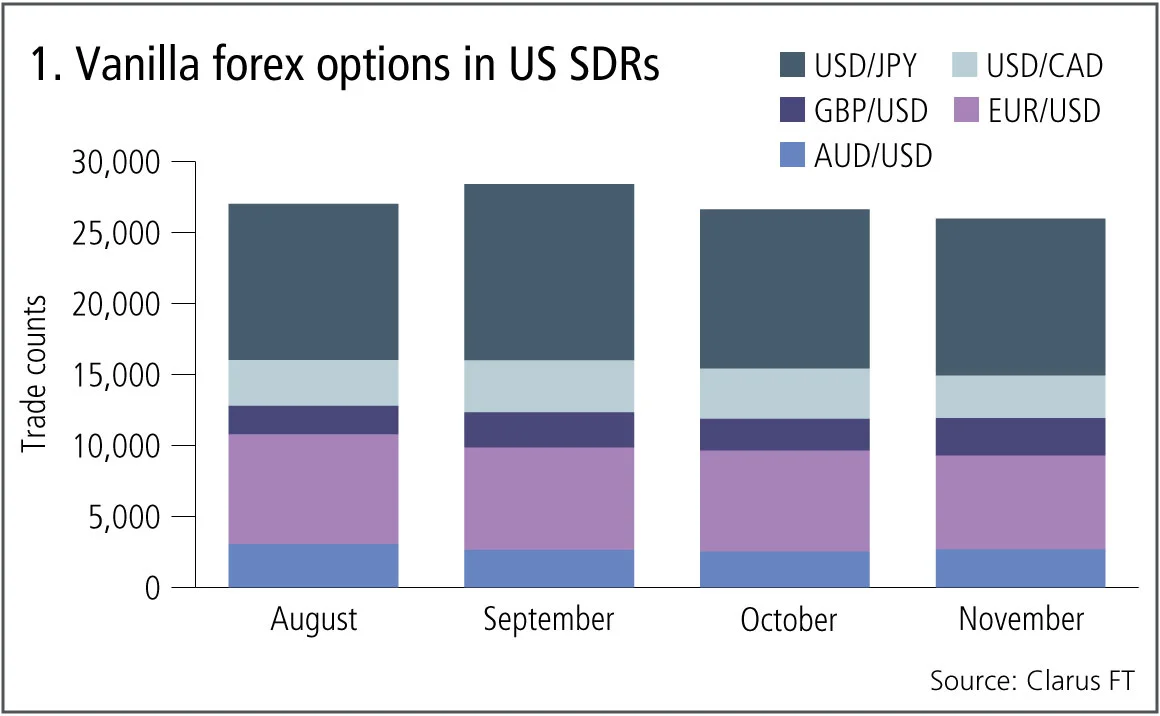
Figure 1 shows:
- Each month, around 27,000 trades are reported in these five major pairs.
- An average of 1,350 each day.
- USD/JPY has the most trades, averaging 11,400 per month.
- EUR/USD is next, averaging 7,100 trades per month.
- USD/CAD follows with 3,350 trades per month.
- AUD/USD and GBP/USD are 2,700 and 2,300 respectively.
Gross notional
Let’s look at the same trades in gross notional terms.
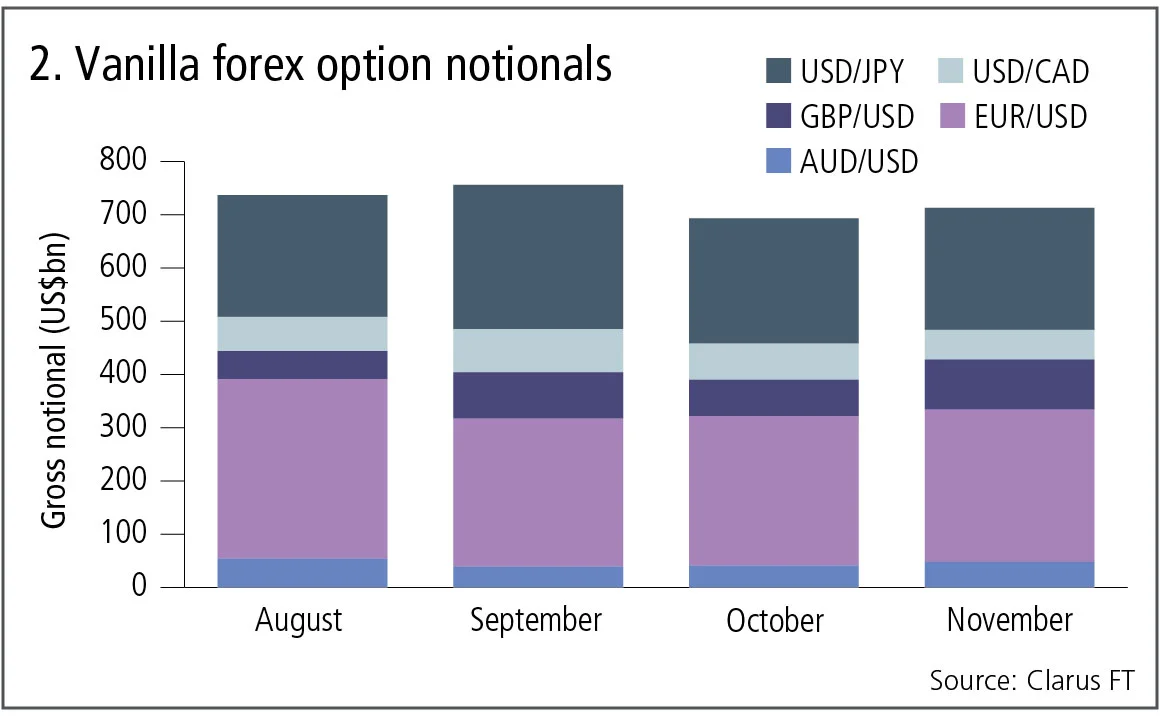
Figure 2 shows:
- An average of $725 billion is traded each month in these currency pairs.
- EUR/USD is the largest, with $300 billion per month, or $15 billion per day.
- USD/JPY is next, with $240 billion.
- GBP/USD follows with $75 billion.
- USD/CAD and AUD/USD have $67 billion and $46 -billion, -respectively.
- The average trade size of EUR/USD forex options is $40 million, while for USD/JPY it is half that at $20 million.
Swap execution facilities
While it is not mandatory to trade forex options on swap execution facilities, some trading takes place voluntarily.
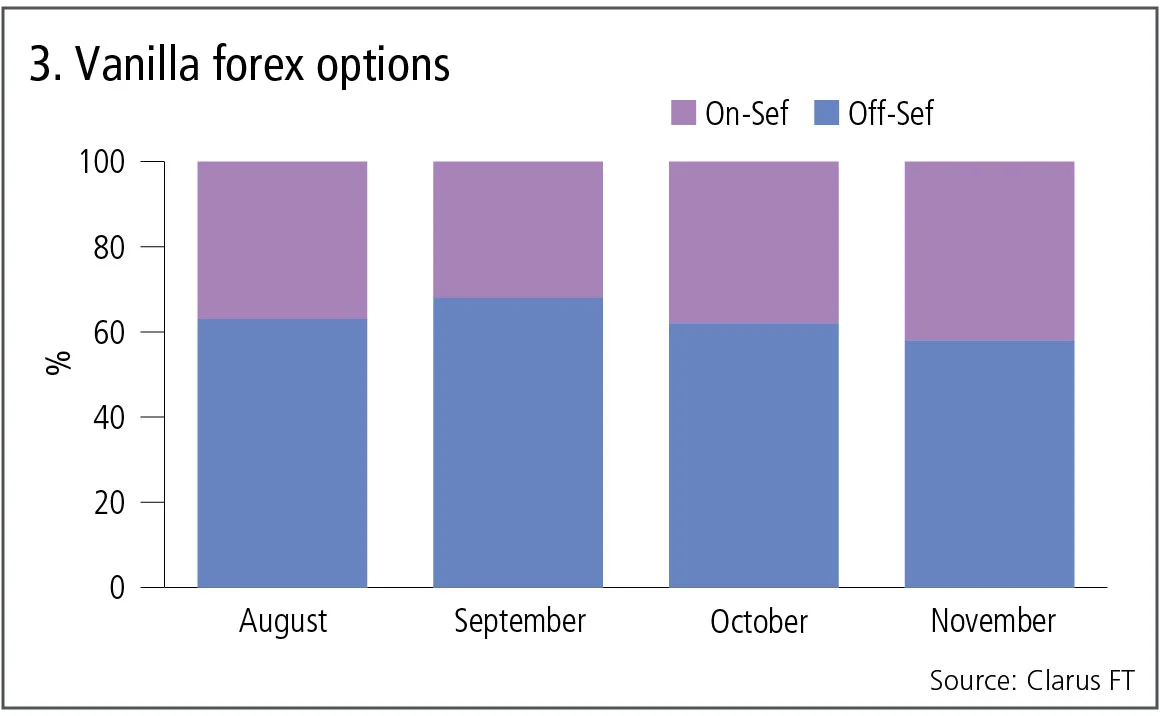
Figure 3 shows:
- About 70% of volume by trade count is off-Sef and 30% on-Sef.
- In gross notional terms, it is 63% off-Sef, and 37% on-Sef.
The vast majority of on-Sef volumes takes place on dealer-to-dealer Sefs run by BGC, GFI, Tradition and TP Icap.

Figure 4 shows:
- Tradition is the largest each month, with a 40% market share.BGC is next, with a 28% share.
- GFI follows with a 16% share.
- TP Icap has 15%.
- November 2017 was the highest-volume month.
Barrier forex options
Forex options with a barrier level that triggers the option to kick in or knock out are another common product. Repository data is used here to generate trade counts for the same five currency pairs.
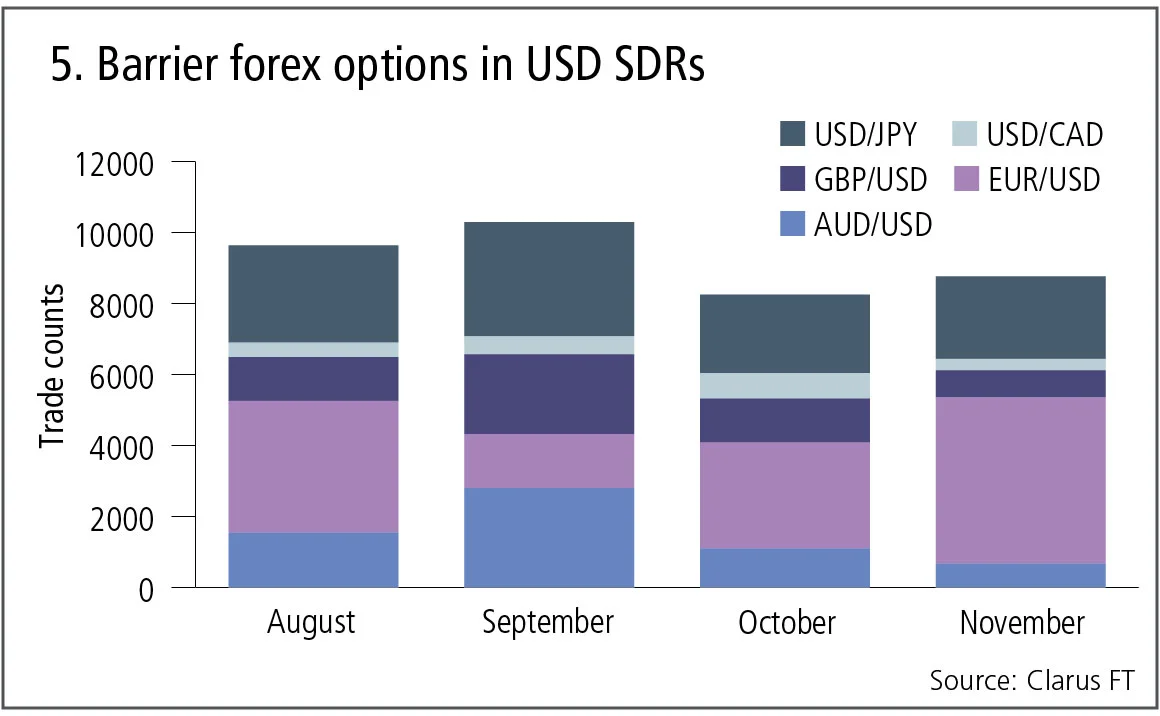
Figure 5 shows:
- Each month, around 9,000 trades are reported in these five major currency pairs – so, one-third the levels for vanilla options.
- EUR/USD has the most trades, averaging 3,200 per month.
- USD/JPY is next, averaging 2,600 trades per month.
- AUD/USD follows with 1,500 trades per month.
- GBP/USD and USD/CAD are at 1,350 and 500 respectively.
Gross notional
Again, the shares change when the market is looked at in gross notional terms.
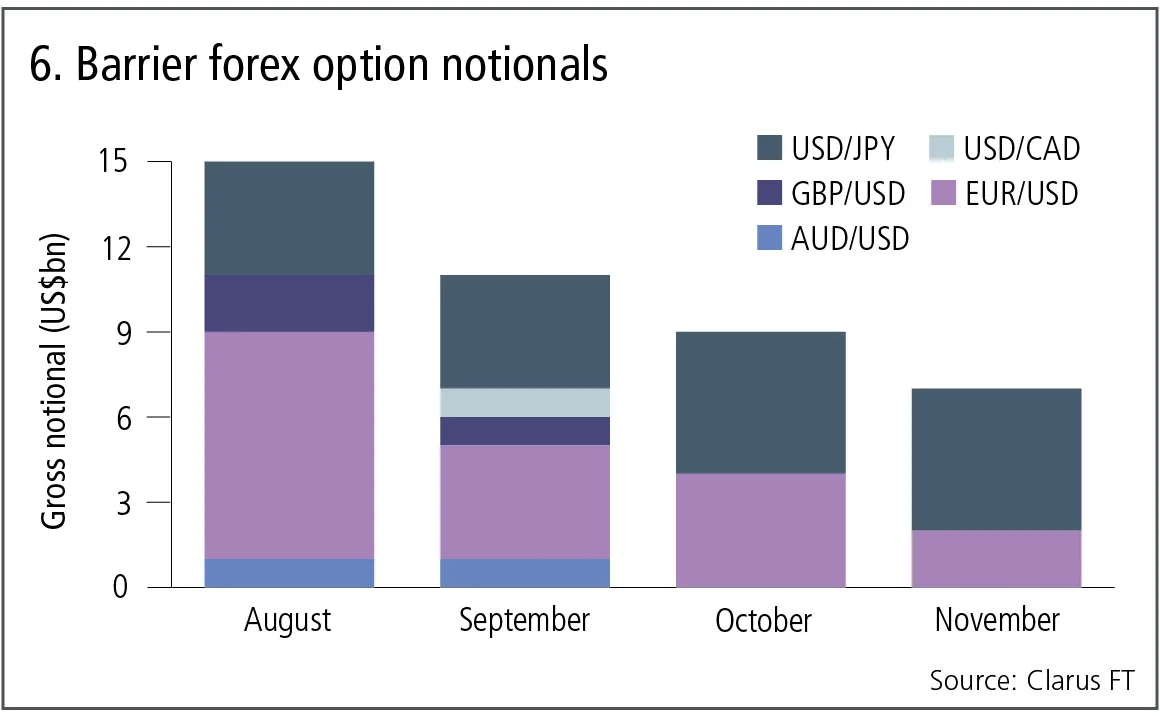
Figure 6 shows:
- An average of $11 billion is traded each month in these currency pairs.
- That is just 1.5% of the $725 billion in vanilla options.
- EUR/USD is the largest, with $4 billion per month.
- USD/JPY is similar, also with $4 billion.
- The chart shows lower month-on-month volume.
- So, while in trade-count terms barriers are equal to 30% of the vanilla options market, in gross notional terms they are far less significant at 1.5%.
The average trade size of EUR/USD barrier trades reported to US swap data repositories is $1.4 million, significantly lower than the $40 million average for vanilla options. Such small notionals are not indicative of client activity.
Amir Khwaja is chief executive of Clarus Financial Technology.
コンテンツを印刷またはコピーできるのは、有料の購読契約を結んでいるユーザー、または法人購読契約の一員であるユーザーのみです。
これらのオプションやその他の購読特典を利用するには、info@risk.net にお問い合わせいただくか、こちらの購読オプションをご覧ください: http://subscriptions.risk.net/subscribe
現在、このコンテンツを印刷することはできません。詳しくはinfo@risk.netまでお問い合わせください。
現在、このコンテンツをコピーすることはできません。詳しくはinfo@risk.netまでお問い合わせください。
Copyright インフォプロ・デジタル・リミテッド.無断複写・転載を禁じます。
当社の利用規約、https://www.infopro-digital.com/terms-and-conditions/subscriptions/(ポイント2.4)に記載されているように、印刷は1部のみです。
追加の権利を購入したい場合は、info@risk.netまで電子メールでご連絡ください。
Copyright インフォプロ・デジタル・リミテッド.無断複写・転載を禁じます。
このコンテンツは、当社の記事ツールを使用して共有することができます。当社の利用規約、https://www.infopro-digital.com/terms-and-conditions/subscriptions/(第2.4項)に概説されているように、認定ユーザーは、個人的な使用のために資料のコピーを1部のみ作成することができます。また、2.5項の制限にも従わなければなりません。
追加権利の購入をご希望の場合は、info@risk.netまで電子メールでご連絡ください。
詳細はこちら コメント
オペリスク・データ:バイナンスの大規模ハッキングを受け、損失が急増
また、米国の銀行はAMLに関する新たな罰金の波に直面しており、トルコの銀行は労働市場を操作しています。データ提供:ORX News

予測市場は、制度的な信頼性テストに合格できるのか?
専門家によると、規制対象の企業は、利用を可能にするために、信頼性の高い事象判定手法と商品横断的な証拠金管理が必要だとのことです

信用リスクモデリングにおけるAIには、なぜハイブリッドのアプローチが最も適しているのか
AIはモデルが四半期報告書以上の情報を把握するのを支援していますが、CROによると、ガバナンスが完全な自動化を妨げているとのことです

ポッドキャスト:アリエ・シェーター氏とハリオム・タツァット氏によるAIの説明可能性に関する対談
バークレイズのクオンツたちが、メカニスティックな解釈可能性を用いたAIの監視手法について語ります
スイスフラン建てローンの損失は、EUの消費者金融業界にとっての灰色のサイである
mBankのCROであるマレク・ルシュティン氏は、ポーランドの銀行への影響が、法的リスクのモデリングにおける盲点を浮き彫りにし、それがより広範な影響を及ぼしていると述べています。

オペリスクデータ:EFG、20年にわたるマネーロンダリングで巨額の損失を被る
また、ディープフェイクによる音声クローンがインテサの部門を騙し、仮想通貨関連のハッキング事件が相次いでいます。データ提供:ORX News

ナビエ・ストークス方程式からキロ単位の論文まで:AIがクオンツ研究に与える影響
AIが大量の成果を生み出す中、金融業界では、その出所、信頼性、重要性を評価するための信頼できる手段が必要とされています

AIを正しい軌道に乗せ続けるには、継続的な検証が鍵となる
意思決定ごとの検証を行うことで、ユーザーがAIの判断を信頼できるようになります