
Feature

US cap-and-trade offsets clouded by uncertainty
As US firms await climate change legislation, it looks inevitable that heavy emitters will need to invest in carbon offset projects – some of them overseas – in order to meet targets. However, the outlook for offsets is clouded by regulatory uncertainty…

Lessons learnt in 2009
For risk managers, 2009 was about dealing with the aftermath of the financial crisis, revisiting models and putting greater emphasis on liquidity and cashflow risk. Katie Holliday talks to experts about the major lessons learnt this year

Energy Risk Environmental Rankings 2009
Energy Risk carried out its second annual Environmental Rankings survey this year in which respondents voted for their preferred players in emissions & renewables markets. Katie Holliday analyses the results and talks to market participants about their…

Oil ETF/commodities indexes
Investment in oil-based commodities indexes and ETFs has grown this year, but how will potential regulatory changes impact their development? Katie Holliday looks at what products are being offered and to what extent regulatory uncertainty is impacting…

Oil project economics
As oil companies look beyond current concerns over credit and costs, Pauline McCallion finds out how project economics are changing future plans

Oil price outlook 2010
Oil prices – which have been rangebound between $65–75 per barrel for most of the second half of the year, averaging just under $61/bbl for 2009 – are forecast to average more than $15 higher next year on expectations of a steady recovery in the global…

Consequences of the cleanup
The UK Financial Services Authority must bolster laws designed to protect investors while ensuring that it takes these actions in sympathy with regulations being introduced at a European level. Richard Jory reports on the actions of the regulator and the…
Breaking the chains
The need to diversify customer credit risk and the rising importance of fiduciary standards make open architecture distribution vital to structured products’ future. As advisers become concentrated in bigger institutions and market volumes remain static,…

India finds some forward momentum
The global financial crisis could easily have sounded the death knell for India’s nascent structured products market. But as the country’s equity markets have resumed their upward trend, dealers say equity-linked structures are catching on fast.

Unwrapping Russian structures
Since the 1998 stock market crash, Russia’s financial sector has evolved to play host to a derivatives industry sophisticated enough to support the development of retail structured products. As well as introducing offshore products to the local market,…
Lessons in simplicity
The mood at the fifth Structured Products Europe conference in London was distinctly retrospective, as speakers and delegates spent two days dissecting their business practice with a readiness that suggests the industry has learnt from its mistakes and…
The cream of the crop
The Structured Products Awards for Europe 2009 were presented on November 18 at the Park Plaza Victoria in London by celebrity guest speaker, the comedian Sean Lock. Barclays Capital was named house of the year and Credit Suisse took the award for equity…
The index artists
The past 12 months have posed a new set of challenges for the indexing and exchange-traded fund markets. But as delegates to the Art of Indexing Summit USA in New York heard on October 28, providers are adapting to the changed landscape. Now it is simply…
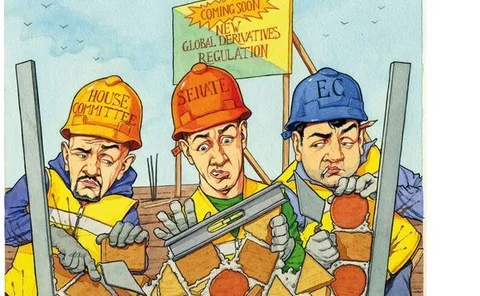
OTC reforms built to last?
Reform of derivatives markets is gathering pace in the US ahead of a crucial debate in the House of Representatives. But questions remain over exemptions for corporate hedgers and foreign exchange swaps and forwards, meaning the final architecture of the…

Scaling the peaks on 3s/6s basis
Some banks are drawing attention to a widening in the basis between three-month and six-month Euribor, as financial institutions are forced to use longer-term funding to eliminate mismatches on their balance sheets. How are banks responding? By Duncan…

Loan loss dynamics
The International Accounting Standards Board unveiled a new expected loss approach in November, following criticisms of the current incurred loss model. But European regulators have declared their preference for dynamic provisioning – and have even…

Capital punishment?
At a landmark meeting early this month, the Basel Committee will finalise its proposals for a host of measures, including counter-cyclical capital buffers and a leverage ratio. The consultation in early 2010 will be the industry’s last chance to fight…

CDS tested to the limit
Auctions to settle credit default swaps on media firm Thomson in October tested both the small bang protocol and the nerves of dealers. The outcome puzzled some market participants, while others have called for the removal of restructuring as a credit…

ABS retention tension
A report by the Committee of European Banking Supervisors last month criticised aspects of a proposal to require securitisation originators to retain 5% of exposures from 2011, while practitioners maintain the move will do little to align incentives…

Index clampdown
The growth of commodity index investments has lured an increasingly diverse investor base into commodities in recent years. But with new regulations due to be announced in December, could this process be thrown into reverse? Mark Pengelly reports

Independent variable
A paper detailing alternative approaches to posting independent amount is expected to be jointly published by the International Swaps and Derivatives Association, the Managed Funds Association and the Securities Industry and Financial Markets Association…

Positioning repositories
Regulators on both sides of the Atlantic agree on the need for trade repositories to aid the monitoring of systemic risk. But there is a difference of opinion on where these repositories should be based, leading to the possibility that multiple trade…

Knock-on FX
Many banks are now including a credit charge in swap and forward transactions, while increased volatility has upped the cost of options. At the same time, the financial crisis has sparked a suspicion of complex products. How are corporate hedgers and…