

Lifetime achievement award: Dennis McLaughlin
Risk Awards 2026: When the stakes are systemic, ex-Princeton prof is never far away
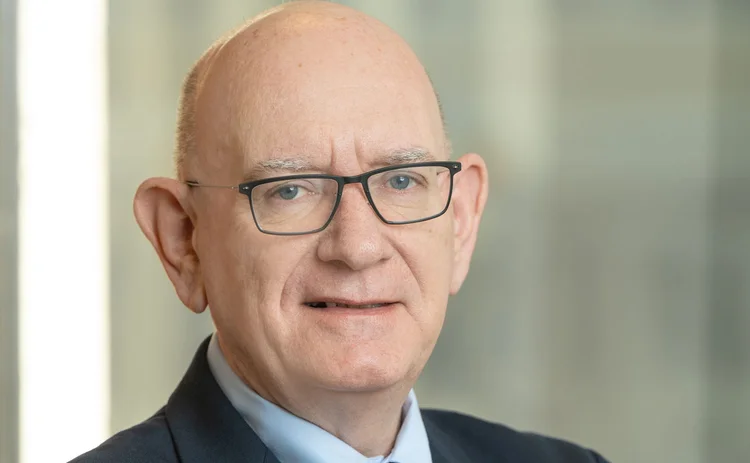

Things that are interesting; things that are new. These twin attractions are how Dennis McLaughlin explains the unique, high-wire career that took him from a maths professorship at Princeton, to McKinsey, Citi and Merrill Lynch, then to a trio of chief risk officer roles at LSEG, Fnality and – since January – the World Bank.
He seems to mean it. In the course of this interview, McLaughlin uses the word “interesting” almost three-dozen times – first, when explaining how he came to study mathematics at university.
“It was interesting, and that’s a theme. I do what I find interesting. It’s never really been about chasing after money or a big job title. If it’s interesting, I’ll do it – I’ll do it for nothing, just for the intellectual enjoyment of it. I like that kind of stuff. It’s about puzzling. It’s about understanding things. That’s what keeps me going,” he says.
It’s not the whole story, though. Many of the things McLaughlin describes as interesting could equally be described as intimidating, terrifying, or overwhelming. That doesn’t seem to be an accident.
McLaughlin has been drawn to situations and roles where the stakes are systemic – like some indefatigable, ironclad moth
At Merrill Lynch, his job was to lead the bank’s Basel II programme, but as the subprime crisis erupted, the role morphed into something very different, after McLaughlin’s repeated questions about the bank’s pile of securitised mortgages resulted in him being asked to anticipate the bank’s liquidity needs, reporting to the group treasurer.
At LCH, McLaughlin arrived in 2012, amid a sovereign debt crisis the clearing house was plugged into, thanks to its dominant position in European repo markets: “It was the attraction of, you know – God, this is really important. The headlines were full every day of Italy blowing up, and Greece. Ireland was going through hell. It looked like the world was crumbling. And that was the place I wanted to be – to try and get into the middle of that,” he says.
His current role began after US conservative groups had published their Project 2025 wishlist for the second Trump presidency – which included a call for the country to withdraw itself from the World Bank – and just weeks before Trump signed an order calling for US involvement in all intergovernmental organisations to be reviewed. (This is not something McLaughlin is willing to talk about – or not much, anyway).
“A huge piece of this role is about preserving the trust that our shareholders have in us. And we have seen examples recently – for example, in the USA – where that trust was lost, where it evaporated. In some sense, my most important role is to not jeopardise that trust,” he says.
Again and again, McLaughlin has been drawn to situations and roles where the stakes are systemic – like some indefatigable, ironclad moth.
One of the main reasons I was comfortable joining [LCH] was because I knew [Dennis] was there
Suneel Bakhshi

In the case of LCH, those stakes were made very clear to Suneel Bakhshi when he was interviewing for the firm’s chief executive role in 2013. The sovereign debt crisis had blown over by that point, and the clearing house had a new role to get to grips with, thanks to the swaps clearing mandate that would ultimately see it hoovering up quadrillions of dollars of notional, and become – arguably – the world’s biggest single locus of counterparty risk.
One of Bakhski’s interviews was with Paul Tucker, the then-deputy governor of the Bank of England. Tucker sought to test the prospective CEO’s mettle – he asked Bakhshi if he was sure he wanted the job. As Bakhshi tells it, the question was phrased like this:
“Do you realise that if the London Stock Exchange ever went down, we could reopen the market in one or another venue. However, if LCH ever went down on your watch, it would result in a call involving David Cameron, Angela Merkel, Barack Obama, and the Chinese premier. And you.”
After a pause, Bakhshi adds: “I remember that so well. I never forgot it.”
Bakhshi did want the job – and he got it – taking up the post in 2014. In 2019, he moved to Mizuho Financial, where he is now deputy group CEO.
One of the reasons he took the role at LCH – despite Tucker’s dire warning – was because he believed the central counterparty could manage the new risks it was acquiring.
“My defence against that scenario was my chief risk officer, Dennis,” says Bakhshi. “He’s brilliant. One of the main reasons I was comfortable joining was because I knew he was there.”
Hieland Laddie
McLaughlin’s willingness to stand, cold and alone, while buffeted by swirling, discordant airs, was honed before his career in finance began. He was a bagpiper.
More than that – he became a world champion at the age of 15, having travelled from his home in the southeast of Ireland to compete in the Scottish highlands. He still owns a set of pipes, and plays them when he is able to find some solitude, most recently a month ago.
“You have to really plan. You have to go somewhere where there’s nobody else around. For the championships, I went to Scotland and spent a week practicing all around the highlands – I’d make my way up a mountain or a hill and just play for hours, surrounded by the heather,” he says.
I got both the analytics and the business understanding – and the communication skills
Dennis McLaughlin
McLaughlin also went his own way academically. He was the first member of his family to go to university and, when he did so, he studied maths – “I saw maths in everything,” he says – with the goal of pursuing an academic career.
After completing his master’s degree in mathematical science at University College Dublin, he left Ireland to tackle a PhD at Brown University. At the time, one of the new, interesting things in mathematical physics was string theory. McLaughlin’s dissertation explained what a string was – at 14 pages, it was a slender piece of work, but it was sufficiently novel that it landed him a professor’s role at Princeton, then home to maths legends John Nash and Andrew Wiles. McLaughlin spent almost a decade in these exalted circles – most of the 1990s – before a chance conversation with an economist revealed that the partial-differential equations McLaughlin had been working on were used routinely in finance. It changed the course of his career.
“After that, I realised there was something missing. Everything wasn’t a pure mathematical model. There’s a whole business side, which really mathematics was a representation of, and I had to learn about the business side. I took that seriously, so went and got an MBA at Wharton, which meant I could round out both sides of the equation. So, I got both the analytics and the business understanding – and the communication skills,” he says.
This is unusual. Darrell Duffie, professor of finance at Stanford University’s Graduate School of Business, describes McLaughlin as “one of very few that have made this transition from mathematics to practicing finance. And not the kind of finance person who is hanging on at the edges, throwing theorems in – but actually running stuff as a mathematician. That’s extremely rare.”
Bakhshi puts it slightly differently: “He’s not a nerd.”
Where the flak is heaviest
The second decade of McLaughlin’s career included four years at McKinsey, one at Citi, and five at Merrill Lynch, allowing him to apply his maths skills to a wide range of practical challenges. He helped power companies understand the risks that forward sales exposed them to in the newly deregulated US market, and developed an automated market-making engine, as soaring turnover on Nasdaq left human traders – and screens – unable to keep up with flickering prices. He then started to tackle the challenge of the incoming bank capital framework by building a system that allowed users to “double-click on any line in the balance sheet, and see the risk underneath it”.
When he started to implement this approach at Merrills, things really got interesting. It was sometime in 2006 – the peak of the decade-long boom in credit structuring, and the start of a precipitous descent.
“I remember double clicking on a line one day. It was an $87 billion position, and there was no risk – which I didn’t believe. So, where’s the risk? I was told, ‘Oh, these are triple-A rated. You don’t need to worry’.”
There is a saying that may – or may not – have originated from bomber crews in the second world war: the flak is always heaviest when you’re over the target. McLaughlin uses it to describe what happened as he tried to find out what lay underneath this big pile of tranched mortgage exposure – the securities that would eventually cost Merrill Lynch its independence.
We were just trying to stay alive long enough to land on an aircraft carrier, which turned out to be Bank of America
Dennis McLaughlin
“As I probed, people came out of the woodwork, telling me there was no point going further, I didn’t need to look at it,” he says.
Who were these people, and did anyone try to prevent him getting involved?
“There were no medals for continuing to raise these issues – but that’s as far as I’ll go,” he says. Characteristically, McLaughlin describes this episode as ‘fascinating’.
It may not have brought him any medals, but as subprime mortgage defaults surged and those coveted triple-A ratings were incinerated, it did result in a change of role. McLaughlin was asked to model the margin calls that would result from the collapsing value of Merrill Lynch’s mortgage debt: “You just had this steady stream of billions coming out of the bank. And my role very quickly evolved into trying to protect the integrity of the bank against this massive drain that was likely to come, were the market to deteriorate further. We were just trying to stay alive long enough to land on an aircraft carrier, which turned out to be Bank of America,” he says.
Of course, it wasn’t initially clear where the bank would land – or whether there would be a landing at all. McLaughlin recalls getting a call from his boss at around 3am on September 13 – a Saturday – summoning him to a mysterious, Federal Reserve-sponsored meeting at the offices of a law firm in midtown Manhattan. When he arrived, he discovered that each of three separate floors had been set aside for teams who were trying to work out what would happen if a trio of tottering firms was allowed to fail – one floor for AIG, one for Lehman Brothers, one for Merrill Lynch.
“I had my laptop, and was basically doing what-ifs. You’d do it for one firm, and then you’d go to the next floor, trying to get a sense for what the world would look like if this firm or that firm went down,” he says.
In the end, of course, there was a different outcome for each of the trio: AIG was given a credit line by the Fed, so it could meet the margin demands of its credit default swap counterparties; Merrill landed on the aircraft carrier; and Lehman Brothers filed for bankruptcy after no acquirer could be found. These announcements were all made in a dizzying, 48-hour period.
McLaughlin was able to draw on the experience a few years later: “Looking back on it, the interesting thing was: AIG was the closest thing to a clearing house I’d ever seen. That was the function it was performing. It was basically standing in between all of these credit traders and guaranteeing the portfolios, which is kind of what a clearing house does – so that was like live-fire training for what was to come.”
It didn’t come straight away. After Merrills touched down at Bank of America, McLaughlin took off. He was asked to stick around and help work through the portfolio, but it didn’t appeal: “I had just been through the mill for two years doing this stuff, so I decided maybe it was time for a break”.
Twenty-two pages of risk
After three years as chief executive for a new Aon venture in Dublin, LCH came calling. At the time, LSEG was negotiating to acquire a majority stake in the business, hoping to capitalise on an expected boom in derivatives clearing – in 2009, the G20 nations mandated exchange-style trading, clearing and reporting for over-the-counter derivatives “where appropriate”, as part of a package of responses to the subprime crisis. The first clearing rules would take effect in the US during 2013, with Europe following in 2016. But the expected step-change in volume – and risk – was only one of the forces then acting on LCH.
Shareholders in LSEG were given a run-down of those forces when they were urged to approve the exchange group’s €463 million bid for 60% of the clearing house. The first line of that letter reads: “The whole document should be read. Your attention, in particular, is drawn to the risk factors set out in Part 2.”
Risk factors occupied fully 22 pages of the document. Some of them were bog-standard M&A warnings: it might take time for the merger to be approved, LSEG might be overpaying, the acquisition might not deliver on its goals. But many more sketched a wild landscape of unknowable, untameable dangers.
Shareholders were warned that the firm’s post-trade revenues would be “substantially dependent” on clearing volumes, and that the factors determining these volumes would be beyond the control of the company. They were warned that the group could be impacted by the then-raging eurozone debt crisis, which increased the threat of a new bank default. And they were alerted to the fact that the European Central Bank had recently staked out its position that euro-denominated clearing should be located within the eurozone – a policy that was being challenged by the UK government because of the threat to London-based clearing houses.
On it went: LCH might end up in a dispute with its own clearing members if a default was deemed to be badly managed; there were technology risks and cyber threats; misfiring models that could leave LCH under-margined; the fear that markets might dry up just when a CCP was trying to liquidate collateral; and many more risk management bugbears.
He developed a lot of the policies [at LCH], and many are still adhered to today – a decade or more on. I think that says something about the quality of his work
Ron Berndsen Tilburg University
Facing this gaggle of threats – and a huge opportunity to expand – LCH recognised it would need a risk management upgrade. The business had been acquired by a consortium of six banks in 1988, and although that consortium had grown (and pushed through a merger of its own with Clearnet, a Parisian CCP), it still had the feel of a service owned by – and run for – the benefit of those banks. In 2009, a press release boasted that LCH was handling 50% of the interdealer market for interest rate swaps – many banks were still sitting on the sidelines, and the CCP had not opened its door to their clients.
“The G20 mandate hadn’t yet taken effect, and the philosophy was that this was kind of a utility – keep the lights on, keep the engine churning, put some boundaries around the risk. But LCH was tiny back then. The path it was on required a completely different mindset from a risk point of view,” says McLaughlin.
Looking back, he breaks the work into four principal buckets. Margin modelling needed to be upgraded (“Those models weren’t very advanced at the time”). The default fund needed to be correctly sized, because the per-basis point sensitivity of LCH’s portfolio reached $100 million while McLaughlin was there – and the relevant markets could easily swing by 10 basis points (“If you have big numbers like that and you’re trying to ensure everybody is OK, then the calculation of the guarantee fund becomes a really big deal, because that’s the backstop. That was a difficult challenge.”). Operational risk was another challenge, because non-default losses had to be covered by LCH’s own financial resources – not those of the member firms (“We weren’t very good at that at the time. We had to build that option.”). And he had to ensure each CCP’s rulebook gave it the ability to recover from spillover losses (“There’s a lot of emphasis, obviously, on margin models. But don’t forget all this other stuff – the ability to reallocate losses – which is in many ways much more important than the margin model, because it gives you the power to recover”.).
Layered over the top of this was evolving regulation – which set minimum expectations and gave some direction across each of these four buckets – plus redoubled, more intrusive supervision, and the commercial imperative to compete, to grow, to add new members and products.
It went well – visibly so. When McLaughlin joined LCH, the amount of derivatives notional at SwapClear – its interest rate swap CCP, and the biggest potential beneficiary of the clearing mandate – was $386 trillion. By 2019, it was $1,229 trillion, cementing its status as the market’s dominant OTC clearing house.
One of the specific achievements McLaughlin picks out is his attempt to address the dangers of procyclicality in clearing – the threat that a CCP might add fuel to a market conflagration rather than dousing it, by hiking margin and tipping users into default.
When Dennis reports to the board, he is on top of things. You know you can trust him
Rob Berndsen
“I made the margin models pass a rigorous test – so, if you evolved the market into a hypothetical future that sort of mirrored what had happened over the prior 30 years, then we should never be in a situation where, on any given day, we’d need to raise margins by over 25%. Maybe that sounds easy – it’s not,” he says.
Models that failed the test had to be recalibrated. As evidence that it did the trick, McLaughlin points to the cross-market meltdown that followed the imposition of Covid lockdowns in 2020. For users of LCH, this period was “business as usual; there was no dislocation, nothing changed”. Other clearing houses were forced into what McLaughlin calls “emergency margin recalibrations, because they had not appreciated the potential moves that could occur, and how weak their models were”.
Ron Berndsen is an economics professor at Tilburg University, who started chairing the LCH risk committees in 2018 and is still there today – as are many of the ideas that McLaughlin introduced during the CCP’s boom years.
“He developed a lot of the policies, and many are still adhered to today – a decade or more on. I think that says something about the quality of his work,” says Berndsen.
Bakhshi, the former LCH chief exec, prized McLaughlin’s ability to enable the CCP to pursue its commercial targets without sacrificing risk management standards – a balancing act that was scrutinised not just by senior management, but also by the risk committee, and the bank representatives whose institutions were in the firing line if anything went wrong.
“Dennis was instrumental in finding that balance,” he says.
He was also good at holding the line when needed, Berndsen adds.
“Sometimes we would say internally that Dennis must be the loneliest man on the planet sometimes, because on occasion he was the only one opposed to a certain business initiative. It was very much one of his achievements that he was able to keep one eye on the business needs, but to augment it in such a way that the risks – the residual risk – became manageable and acceptable,” he says.
In their own roles, Berndsen and Bakhshi both relied on McLaughlin.
Berndsen says: “When Dennis reports to the board, he is on top of things. You know you can trust him.”
And Bakhshi: “I always felt I could depend on him.”
And in one very important respect, McLaughlin didn’t let them down: Bakhshi was never summoned to explain a clearing house meltdown to a jury of world leaders.
Mother Teresa risk
In 2021, McLaughlin was promoted to lead financial risk across LSEG, with the LCH CRO role being split to cover its clearing houses in London and Paris, but he concluded he had taken the role as far as he could. When he left later that year, he was briefly stumped.
“When I finished, I couldn’t think of anything else to do. At that point, across the clearing businesses, we had grown to north of two quadrillion dollars in notional – so, it was enormous. And it was a good time to leave, but I almost thought of retiring at that point, because it was a difficult one to top. From a risk perspective, it was the biggest market on the planet,” he says.
He spent some time as a non-exec director at the Canadian Derivatives Clearing Corporation, then took another CRO role – this time at Fnality, which started life in 2015 as a tokenised settlement project at UBS, before broadening to become a consortium that now includes 24 banks and market infrastructure firms. It was an interim position, but it allowed McLaughlin to explore something else that was new and interesting – the promise of near-instantaneous digital settlement, and what this might mean in practice.
“The PR is wonderful: you wouldn’t need any capital, because everything settles instantaneously. I mean, great – but it’s not true. At some point, you’re stopped by the business considerations of what you’re actually doing,” he says.
He is alluding to the fact that reducing settlement times also limits the number of trades settling during the same window – and therefore, the ability to net. There is a trade-off between settlement speeds and the funds a market-maker would need to have available at any point in time. This trade-off – different for every market, because each market has different trading volumes – creates a tipping-point beyond which faster settlement becomes self-defeating. Trying to describe this trade-off gave McLaughlin a chance to flex his mathematical muscles again.

“Market-makers today basically work on a ‘float’ of operating capital: if you look at a certain settlement window, within that period, you’ll be buying and selling, going back and forth. But as you reduce the settlement window, suddenly you don’t get the benefit of those offsetting trades anymore – you don’t get the benefit of the float – and you have to be able to fund each transaction individually. I was able to calculate where that trade-off lies, which I thought was very interesting, because it drives at the heart of a lot of these business propositions,” he says.
Moving from the current system of deferred net settlement to the vision of real-time gross settlement can be done, McLaughlin argues, but it will require a host of other, supporting changes – such as a new trade-financing mechanism.
But McLaughlin wasn’t sticking around to help drive those changes – Fnality was a temporary home. In the end, the question of where to go after managing risk for the biggest market on the planet, was to manage risk at one of the planet’s biggest, best-known, and least-understood institutions.
“When the World Bank came along, it was a very different animal – I’d never worked anywhere like this. Of course, it’s a bank, so it does all the things that banks do – it has functions for market risk, credit risk, asset/liability management and all the rest – but it’s lending to countries that are at war, or enduring famine, or have suffered earthquakes. So, normal banks don’t go there. It’s very, very risky. I thought that was fascinating – so, again, it goes in the bucket of new and interesting things I’ve been attracted to,” he says.
It is able to make this risky business model work because – generally – countries don’t default on loans from one of the World Bank’s units. The bigger danger, McLaughlin says, is that the organisation loses the support of its 189 shareholders, of which the US is the biggest.
That’s one of the reasons I like working at the World Bank – I can have a conversation about it with my kids
Dennis McLaughlin
“We’re not taxed, we’re not regulated – we’re given the benefit of the doubt – so it really boils down to the trust those shareholders have in us,” he says.
At that level, it might sound a little like liquidity risk for a deposit-taking institution – if a bank loses the trust of its depositors, then it will be choked out of business regardless of how profitable or well-capitalised it is. Similarly, the World Bank would be unable to pursue its mission if its shareholders withdrew their support. But shareholder trust in the World Bank has a very different dynamic than the one governing depositor trust in a normal bank.
“We say ‘We’re here to save the world’, and others say ‘No, you’re not – you’re killing people.’ You get accusations like that, and they can destroy the trust people have in you. Trying to preserve that trust is the number one thing on my radar,” McLaughlin says.
“There’s no rulebook for this – it’s not something I’ve seen in any other financial institution. Sometimes, I call it ‘Mother Teresa’ risk,” he adds, of the canonised Catholic nun whose poverty-fighting work also sparked a range of criticisms.
McLaughlin reports to Ajay Banga. The current president of the World Bank began his five-year term in mid-2023, but had earlier spent a decade at Citi, running the bank’s international consumer businesses, where the two men first met. They have some foundational work to do – including the creation of a wider second-line risk function. As things stand, the second line has responsibility for market, credit and operational risks – the plan is for it to take on all enterprise risks, including political, strategic and reputational risks.
“Ajay is pushing this idea that, if you’re implementing something, then you can’t grade your own homework. If a business owner also has control of the risk function, then you’re going to have problems, ultimately, so he’s breaking that up slowly. Here, it’s quite difficult, because it’s a sea-change. And you’ll remember that it didn’t happen easily in the financial markets either,” he says.
He could boil complex things down in a way that enabled a range of different stakeholders to understand
Suneel Bhakshi
In this respect, risk management at the World Bank has a path to follow. But in many others, it has to blaze its own trail. Ten months into the role, McLaughlin is doing just that. One of his big ideas is to use semantic analysis to unearth lurking problems in the thousands of projects financed by the World Bank.
“When you build a dam, you’ll be taking 7,000 people from point A and relocating them to point B – and you have to somehow compensate them at a market rate. We do a lot of that, so of course there are going to be complaints,” he says.
He doesn’t say how many complaints, exactly, but it’s this background drumbeat of resentment, discrimination, disenfranchisement that occasionally reaches a crescendo, jeopardising trust in the World Bank and its work. Depending on how you count them, McLaughlin says the bank is engaged in around 5,000 live projects at any one time – each one of them with its own cast of construction companies and other suppliers.
The projects all generate sheaves of documentation, so McLaughlin hopes to tease out potential problems by scouring the documents at scale for suspect language – things that might be clues to a future firefight.
“If I use semantic AI to mine the text, can I get some hints that there may be hidden problems with some of these projects? It’s not easy, because sometimes the language is not clear, so you’ve got to design an algorithm that can penetrate that. It’s not spell-check,” he says.
Currently, McLaughlin has a team in Chennai working on this project, and he expects to hire more in the US – “probably here in DC, because I think it’s going to require a lot of training. It’s baby steps right now, because nothing like this has been built before, but it could lead us to a very exciting place. And that’s what I live for.”
There’s another thing about the World Bank job that is new and exciting, McLaughlin notes: his children are, for the first time, interested in his work.
“When you work for a bank, the response is – you know – go away, you evil banker. But when you’re working for the World Bank, they get interested: ‘Oh my God, you’re doing something that might actually help people.’ And that’s one of the reasons I like it – I can have a conversation about it with my kids,” he says.
Other conversations may be less pleasant. It’s still early days for the second Trump administration, and it remains to be seen how the White House will handle calls to disengage from multilateral financial institutions. That topic – and, generally, the whole area of geopolitics – is marked a no-go area for the purposes of this interview.
But those who know McLaughlin believe he’ll be an asset if push comes to shove.
As Bakhshi puts it: “As CRO, he was not only incredibly competent in risk management, but he could also boil complex things down in a way that enabled a range of different stakeholders to understand. I think that will serve him well at the World Bank – incredibly well.”
Only users who have a paid subscription or are part of a corporate subscription are able to print or copy content.
To access these options, along with all other subscription benefits, please contact info@risk.net or view our subscription options here: http://subscriptions.risk.net/subscribe
You are currently unable to print this content. Please contact info@risk.net to find out more.
You are currently unable to copy this content. Please contact info@risk.net to find out more.
Copyright Infopro Digital Limited. All rights reserved.
As outlined in our terms and conditions, https://www.infopro-digital.com/terms-and-conditions/subscriptions/ (point 2.4), printing is limited to a single copy.
If you would like to purchase additional rights please email info@risk.net
Copyright Infopro Digital Limited. All rights reserved.
You may share this content using our article tools. As outlined in our terms and conditions, https://www.infopro-digital.com/terms-and-conditions/subscriptions/ (clause 2.4), an Authorised User may only make one copy of the materials for their own personal use. You must also comply with the restrictions in clause 2.5.
If you would like to purchase additional rights please email info@risk.net
More on Awards
Risk Asia Awards 2026: The winners
The winners of this year’s Risk Asia awards

A single view of risk fuels further success for Murex
Murex’s single cross-asset platform and a services model built around continuous upgrades help Apac banks keep trading and risk infrastructure current as the pace of change accelerates

Derivatives house of the year, Singapore: Societe Generale
Risk Asia Awards 2026

Derivatives house of the year, Hong Kong: Crédit Agricole CIB
Risk Asia Awards 2026

RMB house of the year: Crédit Agricole CIB
Risk Asia Awards 2026

Securities house of the year: Huatai Securities
Risk Asia Awards 2026

Clearing house of the year: Japan Securities Clearing Corporation
Risk Asia Awards 2026

Exchange of the year: Singapore Exchange
Risk Asia Awards 2026
