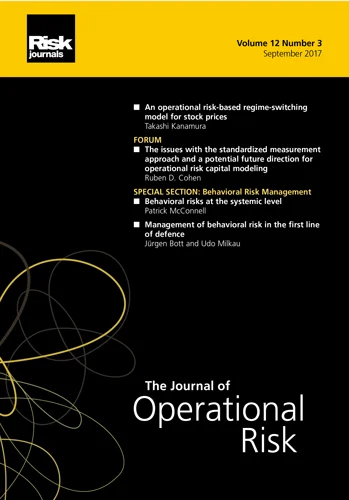
Journal of Operational Risk
ISSN:
1755-2710 (online)
Editor-in-chief: Marcelo Cruz
About this journal
Of the main areas of risk management, operational risk has the shortest history, with the industry beginning to give it serious consideration only 25 years ago. In that time, the industry has made great strides in both the definition and quantification of operational risk. The Journal of Operational Risk has been publishing papers at the forefront of this development since its inception.
On the quantification side, significant progress has been made, with major banks disclosing their operational risk exposures on a yearly basis. For many financial institutions their operational risk exposure is higher than that of market and credit risks. One large operational risk event can be lethal to a financial firm. Operational risk is thus a key concern for the industry as well as for the regulators that supervise financial institutions.
On the definition side, the industry has recently introduced the concept of “Non-Financial Risk” encompassing not just the early definition of operational risk but other risks like strategic, people, cyber, IT, etc. A broader view of operational risk would also consider Enterprise Risk Management, Cyber Risk Management, Information Technology Risks, Data Quality Risks amongst others. The introduction of new technologies like machine learning, artificial intelligence alongside new quantification ideas makes operational risk an intriguing risk domain with a green field for development and implementation of new ideas and theories.
With that in mind, The Journal of Operational Risk welcomes papers on non-financial risks as well as topics including, but not limited to, the following.
- The modeling and management of operational risk;
- Recent advances in techniques used to model operational risk, e.g., copulas, correlation, aggregate loss distributions, Bayesian methods and extreme value theory;
- The pricing and hedging of operational risk and/or any risk transfer techniques;
- Data modeling external loss data, business control factors and scenario analysis;
- Models used to aggregate different types of data;
- Causal models that link key risk indicators and macroeconomic factors to operational losses;
- Regulatory issues, such as Basel II or any other local regulatory issue;
- Enterprise risk management;
- Cyber risk management;
- IT risk management (how systems errors/fails impact an organization and change their risk profile);
- Big data applications to non-financial risk;
- Artificial intelligence and machine learning applications to risk management;
- Qualitative analysis of non-financial risks.
Journal Metrics:
Journal Impact Factor: 0.8
5-Year Impact Factor: 0.7
CiteScore: 1.3
Latest papers
Legal risk management in the Polish banking sector
We carry out a review of the management of legal risk in Polish banks and use empirical research to demonstrate how these risks are managed.
How to choose the dependence types in operational risk measurement? A method considering strength, sensitivity and simplicity
The authors put forward a method for banks to choose the most appropriate dependence type based on an empirical analysis of the Chinese Operational Loss Database.
Operational risk and regulatory capital: do public and private banks differ?
The authors investigate relationships between operational risk and regulatory capital in Indian public and private banks.
A text analysis of operational risk loss descriptions
The authors put forward a workflow for using text analysis to identify underlying risks in operational risk event descriptions.
Integrating text mining and analytic hierarchy process risk assessment with knowledge graphs for operational risk analysis
This paper proposes a new method, entitled the risk-based knowledge graph, which is designed to make analysis of safety records from an operational risk perspective easier and more efficient.
Cyber risk definition and classification for financial risk management
The authors put forward a definition and classification scheme for cyber risk than can be used as a template for data collection by financial institutions.
The information value of past losses in operational risk
The authors argue that past operational losses inform future losses at banks and that the information provided by past losses results from their capturing factors that are hard to quantify in other tests.
Application of the radial basis function in solving an operational risk management model: investigating the probability of bank survival with risk reserves
The authors investigate the probability of bank survival in relation to operational risk and risk reserve and calculate the amount of risk storage necessary to achieve the desired probability of survival.
Does board diversity mitigate firm risk-taking? Empirical evidence from China
The authors explore the relationship between firm risk and both demographic and cognitive-oriented board diversity.
A risk-based internal audit methodology for Greek local government organizations
The authors propose a methodology for evaluating possible risks when preparing an audit plan in Greek municipalities, with applicability beyond this area.
Measuring tail operational risk in univariate and multivariate models with extreme losses
The authors consider operational risk models and derive limit behaviors for the value-at-risk and conditional tail expectation of aggregate operational risks in such models.
Audit committee characteristics and the audit report lag in Greece
The authors review empirical studies investigating the effect of audit committee characteristics on audit report lag, using Greece as an example. and finding that committee diligence is associated with a shorter report audit lag.
Operational risk: a global examination based on bibliometric analysis
The authors quantitively assess the quality of research on operational risk and find that research in this area has grown in popularity in recent years.
Machine learning for categorization of operational risk events using textual description
The authors summarise ways that machine learning can help categorize textual descriptions of operational loss events into Basel II event types.
Systemic operational risk in the Australian banking system: the Royal Commission
The author investigates the Royal Commission into Misconduct in the Banking, Superannuation and Financial Services Industry and its most prominent cases, as well as detailing examples of operational risk events that the commission did not cover.
Imbalanced data issues in machine learning classifiers: a case study
The author outlines characteristics of machine learning classifiers, compares methods for dealing with imbalanced data issues, and proposes terms of best practice in model development, evaluation, and validation.
Modeling very large losses. II
This paper presents a means to estimate very large losses by supposing the event is the result of a succession of factors and estimating the probability of each factor.
The Compliance Index: a behavioral approach to compliance risk management in the (post-) Covid-19 era
This paper proposes the Compliance Index - a behavioral measurement system for controlling and monitoring the effectiveness of compliance programs to mitigate compliance risk - designed in response to the shift to remote working during the Covid-19…
How does the pandemic change operational risk? Evidence from textual risk disclosures in financial reports
The authors investigate changes in operational risk profiles of the financial industry following the Covid-19 pandemic.
Modeling systemic operational risk in the Covid-19 pandemic
This paper introduces existing and novel epidemiology models and investigates how government responses to the Covid-19 pandemic impacted these models.