
Funding valuation adjustment (FVA)

Regulatory-optimal funding
A treasury viewpoint on the funding optimization problem

South African corporates expect to sign CSAs
Power giant Eskom and South African Airways want to cut hedging costs

Cross-currency basis causes pricing headache for dealers in Japan
Yen and dollar funding discrepancies hit Nikkei options market

Nomura books ¥10 billion FVA loss
Japanese bank follows JP Morgan and Deutsche Bank by incorporating funding costs into derivatives valuation

JP Morgan takes $1.5 billion FVA loss
The US bank announces a one-off FVA primarily due to uncollateralised derivatives receivables

Risk management system of the year (vendor): Markit Group
Capital and funding efficiency is a new discipline for derivatives desks, and there is a shortage of comprehensive systems - so Lloyds Banking Group teamed up with Markit to build one

Cutting Edge introduction: another FVA?
Including funding costs and benefits in derivatives prices is a controversial topic, closely tied up with the credit and debit valuation adjustments of counterparty risk. But new research suggests that, even with no default risk, differences in the…

Op risk, FVA and OIS - Risk.net’s top stories of 2013
Operational risks, funding valuation adjustment and the money made by one dealer in the early days of OIS discounting – the top stories of the year on Risk.net

Cutting Edge introduction: fixing FVA
The funding valuation adjustment (FVA) is the biggest controversy of recent times in quantitative finance. Now the authors of the original FVA paper are back – and think there may be a solution. Laurie Carver introduces this month’s technical articles

Funding strategies, funding costs
Funding strategies, funding costs

The law of one price is gone
Sponsored statement: Absa

Liquidity & Funding Risk 2013: FVA will be dead in three years, says Hull
Arch-critic of funding valuation adjustment says regulation will make it obsolete – reducing industry's exposure to arbitrage

Banks at risk of FVA arbitrage, say Hull and White
Academics who ignited fierce debate on funding valuation adjustment return with new paper
Replacement costs add to OTC pricing upheaval
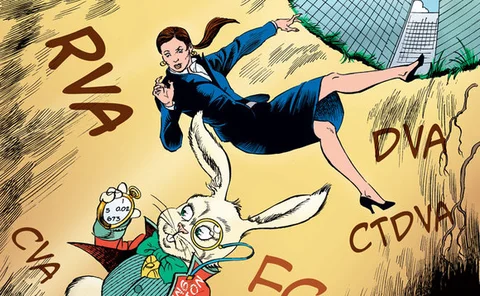
Down the rabbit hole

Barclays and JP Morgan among first to centralise ‘XVA’ desks
Dealers are looking to consolidate desks that manage adjustments for credit, debit and funding valuation

Introducing the XVA desk - a treasurer’s nightmare
Grand centralisation

RVA proving a struggle for derivatives counterparties
In this video discussion, Duncan Wood, editor of Risk, talks to Nick Sawyer, Risk’s editor-in-chief, about attempts to price in a replacement valuation adjustment on derivatives trades

Wrong-way risk, credit and funding
The risk of exposure and counterparty default probability both increasing – so-called wrong-way risk – is usually understood in terms of the correlation between the two variables. But this approach is focused more on the centre of the distribution, and…

Quant Congress Europe: No consensus on FVA accounting
Industry undecided on whether own cost of funds or an industry average funding spread should be used

Flexible technology needed to respond to regulatory change, says Fincad
Regulatory change will force firms to alter their behaviour, and their technology platforms need to keep pace

The black art of FVA: Banks spark double-counting fears
Dealers broadly agree that funding costs and benefits should be priced into uncollateralised trades, and some banks have started recognising this in their financial statements. But there is no standard practice, and there are fears of double-counting. By…


Wrong-way risk, credit and funding
The risk of exposure and counterparty default probability both increasing – so-called wrong-way risk – is usually understood in terms of the correlation between the two variables. But this approach focuses more on the centre of the distribution. This…
Cutting Edge introduction: Wrong-way risk and the limits of correlation
Traditional models for wrong-way risk focus on the correlation between default and exposure – a blunt tool for a tail risk. Alternatives are thin on the ground, but a scenario-based approach may provide some fresh insight. Laurie Carver introduces this…