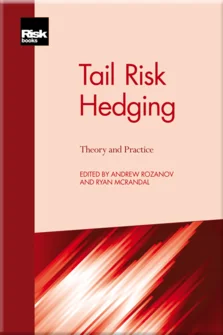
Tail Risk Hedging
First published:
ISBN: 9781782720805
If you are a Risk.net subscriber you are entitled to 20% off your Risk books purchases. Please email enquiries@riskbooks.com for more information.
As part of your Risk.net subscription you are entitled to 20% off all of your Risk Books purchases. If you would like to place an order please email enquiries@riskbooks.com
Strategic Tail Risk Management: A Pension Fund’s Perspective
Chris Limbach
An Introduction to Tail Risk Hedging
Tail Risk Hedging: An Investment Consultant’s Perspective
Strategic Tail Risk Management: A Pension Fund’s Perspective
An Asset Allocator’s Approach to Tail Risk Hedging
Dealing with Wrong-Way Risk: A University Endowment’s Perspective
A Multi-Strategy Approach to Tail Risk Hedging
A Discretionary Approach to Tail Risk Hedging
Insuring Against Hidden Financial Catastrophe Risk
Benchmarking Convexity: Towards a Holistic Approach
Using Equity Options and Volatility to Manage Tail Risk
A Systematic Approach to Tail Risk Hedging
Tail Risk Hedging Using Convertibles
Sourcing Convexity in Asian Markets
This chapter will introduce and describe the concept of strategic tail risk management (STRM), an analytical framework developed by the author for a large Dutch public pension plan. It contains a number of different elements and moving parts, each requiring in-depth analysis, which – when applied in practice – will most likely result in different outcomes for different investors. STRM is agnostic with respect to an investor’s pre-existing beliefs regarding tail risk: whether they start out strongly in favour or strongly prejudiced against tail risk hedging, STRM is designed to be a useful “road map” to help institutional investors ask the right questions and think critically about their portfolios. The objective of STRM is to help investors identify and evaluate the relevant risks and exposures in their portfolios, thus enabling them to make informed and pragmatic decisions. The discussion in this chapter will follow the step-by-step sequence of STRM analysis.
There is no single, universally accepted definition of tail risk. For purposes of this discussion, the term will refer to a situation whereby an investment portfolio (and potentially the entire pension plan or investment
Copyright Infopro Digital Limited. All rights reserved.
As outlined in our terms and conditions, https://www.infopro-digital.com/terms-and-conditions/subscriptions/ (point 2.4), printing is limited to a single copy.
If you would like to purchase additional rights please email info@risk.net
Copyright Infopro Digital Limited. All rights reserved.
You may share this content using our article tools. As outlined in our terms and conditions, https://www.infopro-digital.com/terms-and-conditions/subscriptions/ (clause 2.4), an Authorised User may only make one copy of the materials for their own personal use. You must also comply with the restrictions in clause 2.5.
If you would like to purchase additional rights please email info@risk.net