Keeping score
This month Brett Humphreys and Zach Jonasson show how energy trading firms can compare performance using publicly available corporate information
While companies generally understand charging business units for the cash capital they use, few have a good grasp of how to charge for the risk capital used. Even if they recognise the problem, they often have no idea of an appropriate hurdle rate for risk capital – or risk charge.
In practice, there is no set answer to this problem. But here we suggest three methods that may be used to determine appropriate risk charges: internal auction, historic internal rates or a comparison to peers.
The internal auction of risk is perhaps most appealing to an economist, and the most rarely practised of the approaches. In this structure, the business unit that values the risk capital the most would receive it by bidding the highest price for it. Ideally, this method will efficiently distribute the risk capital between divisions and lead to the highest return to the company at a given level of risk capital.
The historic internal returns method compares the average historic profit within a division against the average risks taken by that and other divisions. The average level can then become the standard risk charge.
While this measure is useful, it does not guarantee that appropriate risk charges are levied. For example, if the average returns had been negative or very small for a number of business units, then we may calculate an extremely low – or even negative – charge for risk.
Another method is to determine the risk charge used by a firm’s peers. Of course, the problem with this method is that few companies use a risk charge and even if they did would be unlikely to share this information.
The obvious alternative is to examine the historic internal returns against the historic risks for other companies. While this may be a useful method, no company is willing to give detailed profit-and-loss and risk reports to competitors. However, companies are forced to reveal enough information in their annual reports for us to determine such information.
Of course, accounting data may be biased for a number of reasons and, therefore, all our performance numbers based on public data are suspect. Profits and losses often include many charges that did not arise from the trading operations. There are also many variations in what companies include in their value-at-risk* (Var) calculations. In addition, if the Var is reported as of December 31, as it frequently is, it may not represent the real risks the company was taking over the previous year.
Annual reports
Nevertheless, we examined the annual reports for nine major natural gas and electricity marketers** for the past four years (1998–2001). From the annual reports, we used Var as the risk measure and the earnings before interest and taxes (Ebit) as the return measure. In some cases, the Var was not reported or the Ebit for the trading division could not be determined. Despite these issues, we identified 29 Var/Ebit pairs.
The next step was to standardise each of the various Var measures to allow for a meaningful comparison.
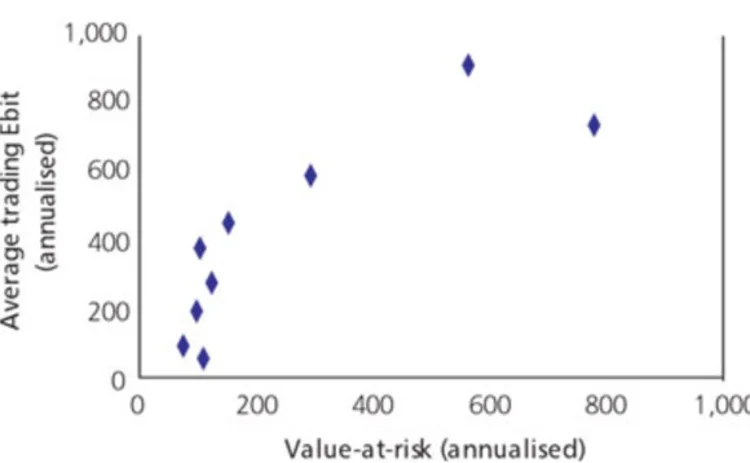
Specifically, we converted all Var measures into a one-year holding period, 95% confidence interval risk measures. We then computed average yearly Var and Ebit for each company. The figure shows each Var/Ebit pair.
As expected, there is a distinct positive relationship between risk and return. Hence, to increase profits, trading groups need to take more risks. But how much is earned per dollar at risk?
Using this data, we can now easily examine the historic risk/return ratio***. While we could take a simple average, a better method is to fit a trend line to the data. If we do this, we find that the relationship between risk and return can be defined by:
Average profit = 129% * Annual risk
We can use this information in a number of ways. As a first step, it provides us with a benchmark against which we can examine the performance of a trading group.
However, this metric can really only be applied to the entire trading division and not to individual units. The reason for this is that by providing diversification, the company’s total risk/return ratio will tend to be better than the risk/return ratio of any single unit.
Alternatively, we might use this measure to decide capital allocation. If we determine that building a generator has an average risk/return ratio of 70%, it might be better for a company to increase the funding of the trading operation rather than build a generator.
The benchmark can also be used as a basis for a risk charge to a division. The risk charge may or may not be an actual cash transfer. But it should have an impact on the performance review.
Speaking of performance, how would you rate your own trading organisation to the top firms mentioned here? Does your return on risk compare favourably to industry benchmarks? Compute average Ebit, divide by your annualised 95% trading Var (market risk only), and see the result.
Notes:
* Var is the worst loss expected to be suffered over a given time period with a given probability
** They were: Dynegy, El Paso, Enron, KN Energy, PG&E, Reliant, Sempra, Utilicorp and Williams
*** Note that the risk/return ratio will depend on the time horizon and confidence interval of the Var measure
Only users who have a paid subscription or are part of a corporate subscription are able to print or copy content.
To access these options, along with all other subscription benefits, please contact info@risk.net or view our subscription options here: http://subscriptions.risk.net/subscribe
You are currently unable to print this content. Please contact info@risk.net to find out more.
You are currently unable to copy this content. Please contact info@risk.net to find out more.
Copyright Infopro Digital Limited. All rights reserved.
As outlined in our terms and conditions, https://www.infopro-digital.com/terms-and-conditions/subscriptions/ (point 2.4), printing is limited to a single copy.
If you would like to purchase additional rights please email info@risk.net
Copyright Infopro Digital Limited. All rights reserved.
You may share this content using our article tools. As outlined in our terms and conditions, https://www.infopro-digital.com/terms-and-conditions/subscriptions/ (clause 2.4), an Authorised User may only make one copy of the materials for their own personal use. You must also comply with the restrictions in clause 2.5.
If you would like to purchase additional rights please email info@risk.net
More on Risk management
How AI agents can join the dots for risk managers
Citi risk expert outlines agentic AI tool that would pull together structured and unstructured data on trading and lending approvals to create single, unified view of risk
The interplay between liquidity and collateral
The evolution of financing solutions as institutional investors raise and preserve cash
Do banks still need to validate GenAI models?
Regulators carved out GenAI models from new risk guidance. Banks shouldn’t see this as a reason to stop validating them.
FSB warns of ‘circles of risks’ in bank risk transfer deals
Credit lines, portfolio financing and NAV facilities for private credit funds could rebound on banks
Barclays built a risk framework for GenAI from scratch
Eleven teams contribute to assessing generative AI use cases in a system that includes 35 controls
Hopes, fears and ‘mass confusion’: the sudden end of SR 11-7
Banks welcome chance to prioritise model reviews, but fret over future policy changes and AI
Bootcamps and peer pressure: Goldman preps staff for AI future
Isda AGM: Tone from the top is not enough, says chief information officer Marco Argenti
In Iran war, VAR models ease cliff effect on Ice and CME margins
At 105%, EEX – using Span model – saw largest single-day jump compared with those CCPs