FSA exposes back-office flaws
A “high level” of credit derivatives trades are going unconfirmed, sometimes for months, according to a warning by the Financial Services Authority (FSA), the UK’s financial regulator.
In February it wrote letters to chief executives of firms active in the over-the-counter (OTC) credit derivatives market after noting the worrying trend during recent supervisory work. “A number of firms in the fast-developing OTC credit derivatives market are failing to resource their back-office functions adequately to allow them to keep pace with the growth of their front-office business,” says Gay Huey Evans, the FSA’s capital markets sector leader.
While credit derivatives are an important tool for diversifying risk and bringing more liquidity to the credit market, she says, “with benefits come risks… If simple operational procedures are unable to keep up with the pace of market development, the risk that misunderstandings and uncertainty will negatively impact market confidence increases.”
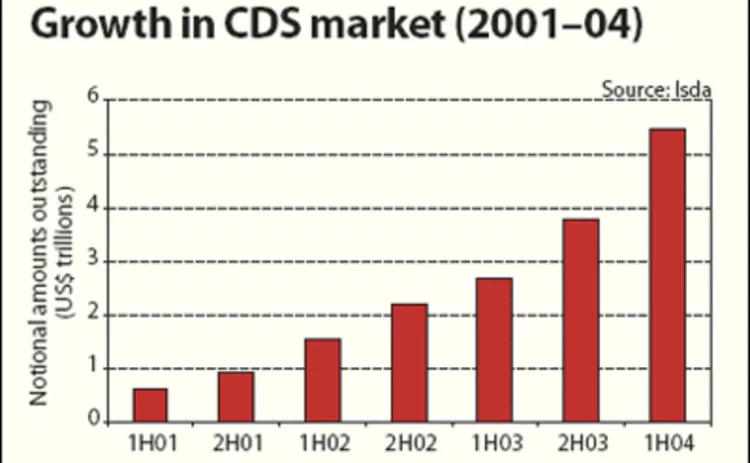
Speed of growth in credit derivatives is at the root of the problem, according to the FSA. Data from the International Swaps and Derivatives Association illustrates this rapid growth clearly. Outstanding notional amounts in credit default swaps soared to $5.44 trillion at the end of the first half of 2004, a 44% growth from $3.78 trillion for the previous half-year.
Failure to confirm trades is a major cause of operational risk in the financial markets – and many cases of “rogue” or fraudulent trading using derivatives have been possible because of poor controls over trade confirmations.
A more likely result of failure to settle trades properly – but potentially equally as damaging – is that a firm may not be aware of its credit and market risk exposure at any given time.
Even the top investment banks are at fault in this area, says a spokesperson for the FSA, although it did not name specific banks. Tools at the FSA’s disposal to encourage firms to upgrade their systems include enforcement actions and fines. But that would be a “long way down the road”, says an FSA spokesperson.
Only users who have a paid subscription or are part of a corporate subscription are able to print or copy content.
To access these options, along with all other subscription benefits, please contact info@risk.net or view our subscription options here: http://subscriptions.risk.net/subscribe
You are currently unable to print this content. Please contact info@risk.net to find out more.
You are currently unable to copy this content. Please contact info@risk.net to find out more.
Copyright Infopro Digital Limited. All rights reserved.
As outlined in our terms and conditions, https://www.infopro-digital.com/terms-and-conditions/subscriptions/ (point 2.4), printing is limited to a single copy.
If you would like to purchase additional rights please email info@risk.net
Copyright Infopro Digital Limited. All rights reserved.
You may share this content using our article tools. As outlined in our terms and conditions, https://www.infopro-digital.com/terms-and-conditions/subscriptions/ (clause 2.4), an Authorised User may only make one copy of the materials for their own personal use. You must also comply with the restrictions in clause 2.5.
If you would like to purchase additional rights please email info@risk.net
More on Regulation
Permanent FRTB reforms seen as vital for IMA adoption
Temporary relief granted in June has done little to encourage internal model use in Europe

How to ensure the next Credit Suisse or SVB fails ‘well’
Regulators are planning changes to resolution rules after criticism that living wills were ignored in previous bank collapses

Asian firms waiting on exemptions from UST clearing mandate
Hoping for relief on extraterritoriality, 51% of Apac firms have yet to start compliance programmes
Already under FRTB, some banks hope for modelling reprieve
Risk Live: BMO and UBS opted for SA, but believe regulators could still opt to follow softer US rules

Regulators better prepared for next Credit Suisse, says SRB head
FSB strengthening guidance on international co-operation, but EU needs more mutual support

From Pillar to Pillar… to post: where now for op risk in Europe?
Experts think enhanced Pillar 2 charge informed by Dora would be more useful than a blunt Pillar 1

PRA struggles to follow Fed’s FRTB modelling moves
Market risk experts say minor differences in US rules add up to more incentives for IMA adoption

Lifeline keeps Europe’s hopes afloat for single-sided reporting
Despite Esma’s proposal for delegated reporting of trades, the industry may yet get its wish