Podcast: Damiano Brigo on derivatives, AI, machine learning and more
Genuine artificial intelligence remains "very, very far away", says Imperial College's Brigo
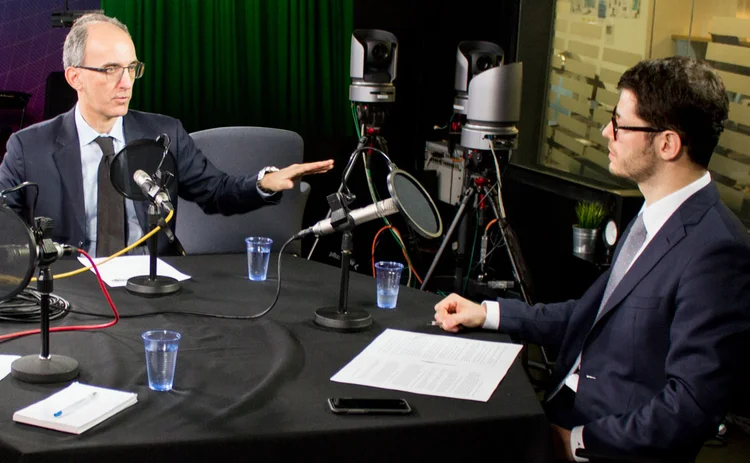

In February, we welcome professor Damiano Brigo, chair of mathematical finance at Imperial College London, as an occasional Risk.net columnist. For this podcast – the first of a monthly series – Brigo visited our office to share his thoughts on the lost causes, current role and future prospects of quantitative finance.
The derivatives market, he says, “has moved from having complex payoffs in a simple system on to simple payoffs in a complex system”, and the models needed in this new environment are still being studied. Elsewhere, quants’ expertise is being applied in a number of newer areas such as risk optimisation, development of machine learning algorithms or analysis of the impact of central clearing on markets.
Brigo sees machine learning and data science having a big impact in finance, but is sceptical of the near-term prospects for artificial intelligence: “We are still very far from a real intelligence and human-like thinking,” he says. Rather, voice recognition, chess and other game-playing applications, or interactive software that is able to answer questions, are simply examples of sophisticated statistical algorithms.
He also explains how the UK government’s plan to change its funding policy for academic research will incentivise projects that have more of an impact on society.
To hear the full interview, listen in the player above, or download. Future podcasts in our Quantcast series will be uploaded to Risk.net. You can also visit the main page here to access all tracks or visit the iTunes store.
Further reading
Only users who have a paid subscription or are part of a corporate subscription are able to print or copy content.
To access these options, along with all other subscription benefits, please contact info@risk.net or view our subscription options here: http://subscriptions.risk.net/subscribe
You are currently unable to print this content. Please contact info@risk.net to find out more.
You are currently unable to copy this content. Please contact info@risk.net to find out more.
Copyright Infopro Digital Limited. All rights reserved.
As outlined in our terms and conditions, https://www.infopro-digital.com/terms-and-conditions/subscriptions/ (point 2.4), printing is limited to a single copy.
If you would like to purchase additional rights please email info@risk.net
Copyright Infopro Digital Limited. All rights reserved.
You may share this content using our article tools. As outlined in our terms and conditions, https://www.infopro-digital.com/terms-and-conditions/subscriptions/ (clause 2.4), an Authorised User may only make one copy of the materials for their own personal use. You must also comply with the restrictions in clause 2.5.
If you would like to purchase additional rights please email info@risk.net
More on Markets
US Treasury clearing: competition, choice and readiness move to the fore
US Treasury clearing mandates and market reforms are reshaping clearing models, risk transfer and market infrastructure ahead of key implementation milestones

Regulatory clarity urged for CME’s single-stock futures
SEC short selling and market access rules may hamper clearing and broker participation

Ripple builds its ‘one-stop’ payments shop
Flurry of acquisitions marks latest step in digital payments specialist’s masterplan to crack trad-fi

Calamos combines rival structures with new autocall ETF
Generic local vol model allows exotic payoff to be packaged in index without vol target

Hedge funds shelved yen basis bet on US deal
Funds exited USD/JPY flatteners tied to Japan’s $550bn pledge and new funding may not revive the trade

BRL bulls hold firm after Bolsonaro first-round win
Hedge funds keep USD/BRL puts ahead of election run-off as protection premiums for Lula upset soar

AI boom turns Morgan Stanley into a hot commodity
Talking Heads 2026: Data centres need long-dated power and gas hedges that only a big bank can provide

PGGM sees a chance to diversify with fourth-trigger CDSs
Dutch pension manager hopes bank demand will continue to grow for derivatives counterparty credit protection