
Wadhwani advocates defensive hedge fund position
Sushil Wadhwani’s route to hedge funds took him through academia into Tudor Investments where he learnt the basics about running a hedge fund and gained the confidence to start his own business
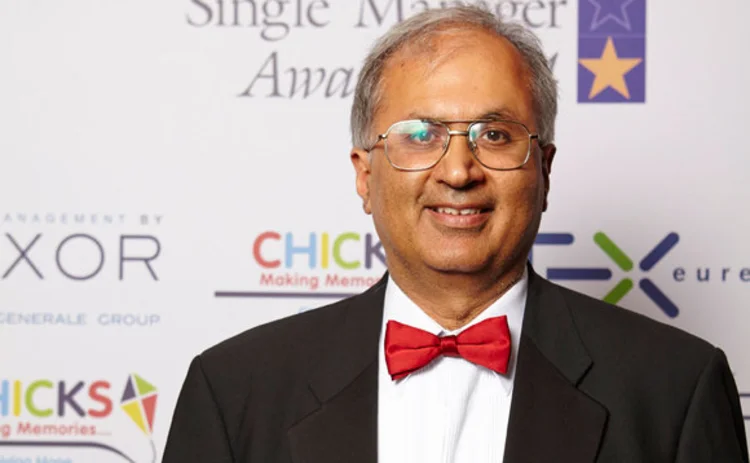
At first glance Sushil Wadhwani is an unlikely candidate for a hedge fund manager. He professes to be more at home in an academic environment and still keeps strong links with the London School of Economics (LSE), where he taught for many years.
Although he professes political neutrality, he is most usually associated with the UK Labour party. This perceived bias came about mainly through his membership of the Bank of England’s (BoE’s) Monetary Policy Committee (MPC) from June 1999 to May 2002 during Sir Edward George’s stint as governor.
Wadhwani’s first interest in stock markets was also not typical. As a child he was already following the market pages. But when the Hang Seng dropped 80% from peak to trough - his parents were living in Hong Kong at the time - he was puzzled by the fall and unable to get a satisfactory answer from the adults around him as to why a market could fall so steeply and suddenly when fundamentals had not changed that much.
The effects of financial markets on unemployment led him to become interested at university in modelling the markets. This is what he calls his true interest and was the subject of his doctoral thesis.
In fact, it was one of the published chapters from his thesis that caught the eye of Gavyn Davies, a partner at Goldman Sachs (and subsequent chairman of the BBC). He passed it around to his colleagues at Goldman and eventually Wadhwani was asked to build on the work in the article under a consulting arrangement with the investment bank.
His quantitative modelling of financial markets was a new experience for the academic-minded Wadhwani.
“Being exposed to these people at the coalface who were very knowledgeable, it was really helpful,” he remembers, adding with a grin, “And academic salaries are not that high, so it was helpful and fun.” So, while keeping his LSE post, he spent a day a week working for Goldman and eventually he was asked to join, initially for two years. Eventually he became director of equity strategy at Goldman Sachs International.
Tudor period
But, once more, fate stepped in when, in 1991, Wadhwani was introduced to one of Goldman’s clients, hedge fund giant Paul Tudor Jones. This led to Wadhwani joining Tudor Investment. “I had learnt a little bit about [the hedge fund] world but it was still different from what you did at Goldman. It was a privilege to go work for [Tudor] and I learnt a lot there, an enormous amount,” says Wadhwani.
At Tudor, Wadhwani was attached to the quant group, which at that time was essentially doing technical analysis on trends. What Tudor Jones wanted was for the quant group to start working on macro issues.
“They had a very good technical model, as Tudor called it, but they wanted it to become a technical fundamental model. He thought I could help them on the fundamental side,” Wadhwani says. “I learnt a lot from what the quant group had done and from Paul himself because he had a very good feel for what should work, why it should work and when it should work.”
This experience at Tudor gave Wadhwani a taste for the hedge fund world and eventually pushed him into starting his own asset management business.
“There are some simple fundamental truths about the investing world that you underestimate until you have it properly explained by a true master like [Tudor Jones],” he says. “His favourite phrase was ‘you must always play a good defence’. He inculcated in me very early on at Tudor that the priority when you develop a system was to know that you’d survive to the next day, that you would still be around in business.”
Because of this, Wadhwani is a firm supporter of stop losses. “We used stop losses quite a lot. You can go to industry conferences for CTAs and someone will stand up and say ‘I don’t use stops because they subtract value’. It is interesting, because there is a clear philosophical difference.”
For Wadhwani, however, the key events in his life so far were largely stimulated through chance encounters and luck. This is how he explains his stint at the MPC. Because of his work on labour markets at the LSE, he came to the attention of people advising the then-chancellor Gordon Brown and prime minister Tony Blair. He had also jointly published papers with Mervyn King, who was deputy-governor of the BoE at that time. Earlier, in the late 1980s, King and others formed a financial markets group at the LSE where Wadhwani was also present.
At the time of the Asian crisis, Wadhwani wrote a paper presented at a London conference that attracted the interest of the International Monetary Fund. That, coupled with his already considerable links to the BoE, led to his appointment on the MPC.
Despite his vast experience, however, Wadhwani says his experience at Tudor was the most relevant. Without this he would never have started his own management company, initially backed by Tudor Jones. “He was my largest investor on day one. I don’t think I would have had the courage to start otherwise.”
London-based Wadhwani Asset Management specialises in systematic/quantitative macro investing and was founded in 2002. The main investment approach is expressed through quantitative models Wadhwani has been working on for over 25 years. This is the foundation of the firm’s Keynes quantitative strategies, reflecting Wadhwani’s deep affection and respect for the economist John Maynard Keynes, who was also keen on studying the relationship between markets and employment.
The primary vehicle offered by the company is the Keynes Leveraged Quantitative Strategies Fund. Wadhwani Asset Management also manages a Ucits-compliant vehicle, the GAM Star Keynes Quantitative Strategies Fund, offered by GAM.
Wadhwani’s business approach is to develop strategic relationships with partners. This has led him to an alliance, not just with GAM, but with US-based investment firm Caxton Associates, which owns a minority interest in Wadhwani.
“The hedge fund industry is in a completely different place now from where it was [when I started] in the mid-1990s. A lot has changed. It is a very different place. I’m very grateful to all the clients who have given me the opportunity to do something I enjoy. It’s like a hobby, what I do, and to be paid to do your hobby is a privilege,” comments Wadhwani.
He believes that over the last decade many conventional asset managers have been moving closer to hedge funds. “Certainly a lot of the absolute return strategies look more and more like what hedge funds do. We’re moving to a world where there are different products. It’s not implausible that there will be some degree of convergence in the coming years.”
Approaching convergence
His own company is moving in that direction. He is eyeing new products and hopes to launch two vehicles in the near future. In both cases they are strategies that straddle the traditional hedge fund area as well as the conventional asset management industry. While he admits they “have a little bit of beta” he thinks of hedge fund strategies as producing pure alpha.
Of the two new strategies, one is a dynamic beta strategy. “What’s interesting about this strategy is the fact that you don’t necessarily market it to the head of alternatives at an institution but to the chief investment officer, which is different because with our existing strategy we got to the head of alternatives.” Although hedge funds are still “part of that box”, with the new strategy he is moving the company into the mainstream. “It’s necessarily uncertain how this is going to evolve, but we are hopeful that we can take part in this trend toward convergence.”
Wadhwani is hopeful of attracting more capital with the new products. At present he runs close to $1 billion through the GAM vehicle, for Caxton and on his own account.
Looking at the broader picture, Wadhwani is still thoughtful about macro events impacting financial markets. On ‘over-concern’ by politicians and central banks regarding market stability, Wadhwani believes the pendulum has swung too far in the wrong direction “having been at completely the wrong place to begin with”. But the financial industry has clearly lost its favoured position with governments and requires rehabilitation. “Finance needs to be reformed in a very fundamental way so that you make another financial crisis much less likely to happen. Financing [also needs] to be re-oriented so that it serves the economy rather than drives the economy,” he remarks.
In this kind of environment, he is philosophical about the regulation and attention being imposed on hedge funds. “If that’s the new narrative, it’s not surprising that they are doing a lot of things to hurt us. I can only say that what they are doing to banks is much worse than they are doing to us. So in that sense, they are interfering much less with us than they are in the banks. It’s very difficult to get a sympathetic hearing for our industry, given this new narrative. They will always remind you, when you complain, that actually they haven’t done all that much to us compared with the banks.”
One consequence of the financial crisis has been a realisation of the greater role played by banks in capital markets in Europe. “It’s a huge pity that the European authorities didn’t sort out the banks in the way the US did,” he says. “When the history books are written, this will be viewed as a huge policy mistake.”
On whether or not a bank-financed system is better or worse than a stock market-based financial system for investment, Wadhwani says: “There is a literature which says that stock market-based financial systems tend to be more short-termist than bank-based financial systems.”
Looking at his own business and the future of hedge funds in general, he believes the post-crisis environment will be a much tougher one for CTAs for a couple of reasons.
“It is true historically that, after a financial crisis, trend-following tends to work a little less well because having just been through the crisis, policy-makers bend over backwards to keep everything calm. What you get is a lot of choppiness and not very many trends developing.”
He cites an academic study looking at both regional and global crises that shows it takes on average three or four years after a crisis for trends to develop once more in markets.
Like many others he is also keeping an eye on where interest rates will be going. The ending of zero interest rate policies should be good for CTAs. “Central banks being able to raise interest rates is a very good thing. The day the bank first raises its interest rates we should all have a glass of champagne because it’s saying the world is healing.”
However, he does not expect the world to get back to ‘normal’ quickly and is sceptical that the new world order for financial markets will look the same as before the crisis. “These things take years to get back to anything that resembles what happened before. Nor is it even obvious it’s desirable to get back to what happened before.”
Sushil Wadhwani was recognised for his outstanding contribution to the hedge fund industry at Hedge Funds Review’s European Single Manager Awards 2014.
Only users who have a paid subscription or are part of a corporate subscription are able to print or copy content.
To access these options, along with all other subscription benefits, please contact info@risk.net or view our subscription options here: http://subscriptions.risk.net/subscribe
You are currently unable to print this content. Please contact info@risk.net to find out more.
You are currently unable to copy this content. Please contact info@risk.net to find out more.
Copyright Infopro Digital Limited. All rights reserved.
As outlined in our terms and conditions, https://www.infopro-digital.com/terms-and-conditions/subscriptions/ (point 2.4), printing is limited to a single copy.
If you would like to purchase additional rights please email info@risk.net
Copyright Infopro Digital Limited. All rights reserved.
You may share this content using our article tools. As outlined in our terms and conditions, https://www.infopro-digital.com/terms-and-conditions/subscriptions/ (clause 2.4), an Authorised User may only make one copy of the materials for their own personal use. You must also comply with the restrictions in clause 2.5.
If you would like to purchase additional rights please email info@risk.net
More on Hedge funds
JP Morgan warns hedge funds to expect intraday margin calls
US bank may demand variation margin ‘up to seven’ times a day after Archegos default

Alternative markets give edge to Florin Court strategy
By concentrating on exotic and alternative markets, Florin Court Capital Fund has sidestepped overcrowding and correlation to the main trend following commodity trading advisers, offering investors a diversified alternative to the standard systemic macro…

Global macro views combine with quantitative models to produce consistent returns
The team behind River and Mercantile Group’s global macro strategy team operates under two key principles: that macro is the most important aspect of any investment decision and that decision-making should incorporate both systematic and discretionary…
On the offensive – Seeking a new edge, buy-side invests in portfolio and risk analytics
A fast-moving, headstrong hedge fund – hit by rare losses after a black swan event touched on an overweight country exposure – ponders adding fresh quantitative expertise. Much to traders’ chagrin, the chief investment officer and chief operating officer…

Esma backtracks on account segregation
Status quo protected for rehypothecation of collateral in tri-party, securities lending and prime brokerage
Redemptions focused within strategies suffering losses in 2016

Hedge fund redemptions a dismal end to a bad year
Managed futures funds saw big inflows in 2016, but left investors disappointed

Larger funds are net losers as outflows continue
Managed futures funds have seen biggest redemptions for three years