Man Tail Protect: Man Investments/GLG Partners
Winner: Best convertible arbitrage/volatility hedge fund; Most innovative hedge fund
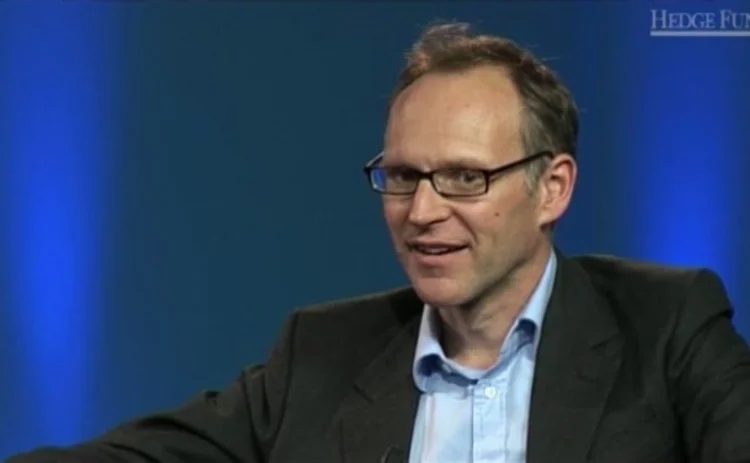
Having spotted demand for tail protection, Man Group identified volatility as the perfect hedge and created its Tail Protect Fund by combining two systematic strategies that invest in volatility. Sandy Rattray (pictured), Man Systematic Strategies’ (MSS) chief investment officer and co-manager of the fund, thinks the fund has the perfect solution to make money in choppy markets without losing too much during the good times.
The Tail Protect Fund was put through its paces in August and September 2011, having opened to external investors just a few months before. The fund performed as expected and finished the year with an impressively positive return of 25.6%.
As the name suggests, the strategy is designed to protect a hedge fund portfolio against tail events. It does this by combining two systematic strategies across three markets.
The forward volatility strategy always holds volatility by investing in the most liquid forward-start variance swaps with maturities ranging from three months to 12 months. This strategy makes up 60% of the portfolio.
The second, which Rattray describes as the “more creative, innovative part of the model”, is a spike-detection strategy. According to Rattray this strategy “looks at noise in markets and tries to translate that noise into when a crisis is more likely to take place”. When a choppy environment is detected, the portfolio increases its exposure to volatility through one and two-month variance swaps.
“It makes sense to mix a rather sensitive short-term model that will very rapidly buy protection because it’s a model that isn’t necessarily going to be perfectly reliable with a second part, which is rather stable and reliable, and always has positions on in case a completely out of the blue crisis occurs,” Rattray explains.
The decision to use volatility as a hedge against tail risk was made after examining several options. “We broadly came down to the conclusion that there were three things that worked and then many other things which might appear to work but don’t,” he continues.
“So the three things that we felt worked – meaning they would reliably make money during crisis periods – were to short equities, or equivalently buy put options or put spreads or other types of option-based strategies. Those strategies will work during the crisis period but we think they will be far too expensive during the good times,” he says.
Another way of hedging is to buy protection on credit. However, because credit instruments often become illiquid during crisis periods and the credit indexes are too new to be able to back-test properly, this hedging strategy was dismissed.
“Equity volatility also reliably goes up during crises. We think we have found ways to limit the cost of holding volatility in the good times,” explains Rattray. “After all the Vix, the most well-known measure of equity volatility, is often called the fear gauge, so it fairly clearly translates into something which will make money during crisis periods.”
As the co-creator of the Vix Index, the measure of S&P 500 volatility, Rattray is well-placed to understand the volatility market. Jean-François Bacmann, head of overlay strategies at MSS, and Darren Hodges complete the investment team.
The fund was born out of demand from Man’s own fund of hedge funds (FoHF) business, Man Multi-Manager. It wanted a solution to protect its portfolio when diversification did not work, says Rattray.
The fund was launched internally in September 2009 and then opened to external investors in January 2011. It ended 2009 in negative territory, down 16.85% after a significant drop in December, but it ended 2010 up almost flat at 0.38%.
After opening to investors, the first test for the strategy came from the escalating eurozone crisis and the impact it had on markets in August and September 2011. “That was very good for the fund. We were very profitable, especially in August 2011 when our spike model triggered prior to the crisis and caused us to significantly increase the positions that we owned,” notes Rattray.
“On top of that we also monetised positions. In other words we took off a lot of risk towards the end of August and during September and we took our profits,” he adds. This is where other tail protection funds went wrong, thinks Rattray, and why they lost money once the markets normalised.
“The other, I suppose in many ways more painful but very different crisis, was the tsunami in Japan in March 2011. We tend to have very small positions in Japan and ultimately it turned out the financial market impact of the tsunami was very small compared with the human impact. But, as a crisis fund, you expect to be profitable in periods like that and we were.” The fund was up 1.81% that month.
The fund’s investment in volatility is limited to the US, European and Asian markets. “We would like to own more markets in Asia and we would like to own more markets in the Americas, particularly South America. Generally, more emerging markets exposure would be a good thing but that’s not the way the world is,” says Rattray. “You are somewhat shaped by where you can trade efficiently.” For example, the costs of trading volatility of South American and some Asian markets are too high, he says.
The high costs incurred by tail protection funds during normal markets have been a big criticism of the strategies as a whole. “I think that is one of the things that is very misunderstood about volatility,” says Rattray. At the start of the year when the Vix was low, some people assumed the fund would be buying a lot of volatility but Rattray says the cost of volatility was too expensive at that point.
Instead the fund seeks to own volatility only where it makes financial sense. “What we are trying to do is to find the places in the term structure of volatility where it is cheaper to own. We are, therefore, sensitive not only to the level of volatility but also the shape of the term structure and momentum in volatility: how volatility is moving.” If volatility is low but declining, it is not attractive to own, he says.
The fund is not suitable for every investor, says Rattray. He describes it as the “opposite of a one-size-fits-all” product. Similar to buying life assurance, he explains, you cannot just turn up and say ‘I want to buy life assurance, how much do I buy?’.
“If you are trying to achieve never losing money but always making money, well that’s an impossible objective. We can’t deliver that,” he says. “If what you are trying to achieve as a fund of funds is ‘I want to do better than other funds of funds during crisis periods by a bit but maybe not an extremely large amount and I don’t want to cost too much in the good times’, that is something we can address.”
Other investors are looking for something they can rely on in a crisis because they are unsure how they will react when one comes along. “I think that’s why those investors that do invest in us are often thinking, ‘well I know I need to have something in place if bad times do come along that I can rely on, so that I can go and actually take risky decisions and not feel very defensive and furthermore be able to defend myself against my board or my outside investors or whoever it is’.”
In order to manage risk to the fund’s own portfolio, a hard stop-loss for each position is set at 7.5 volatility points. Hitting this limit will cause the position to close. A position will also close if the variance swap position reduces each day for a five-day period. Profits are taken in two stages when volatility reduces.
[Pictured: Sandy Rattray, Man Investments/GLG Partners]
Rattray is a firm believer that no one can predict where the next crisis will come from. He thinks it is important that the fund always has some exposure to volatility. “If a natural disaster or some completely random event takes place, we will still have protection in the fund,” he says.
Rattray thinks it is a “very dangerous strategy” to not have protection already in place in case markets quickly turn.
Fund facts
Full name of fund: Man Tail Protect
Portfolio managers: Sandy Rattray, Jean-François Bacmann
Management company: Man Investments/GLG Partners
Contact information: Katie Bennetts (+44 (0)20 7016 7317; katie.bennetts@man.com; www.mangroupplc.com)
Launch date: January 1, 2011 for external class B; class A, open only to internal investors, launched October 2009
Assets under management: $570 million (estimated mid-May 2012)
Net cumulative performance since inception: 9.42% (class A from October 23, 2009 to December 2010 and for class B onwards)
Annualised return: 3.55% (class A from October 23, 2009 to December 2010; for class B onwards)
Annualised volatility: 26.54% (class A from October 23, 2009 to December 2010; for class B onwards)
Strategy: tail protection
Share classes: US dollar
Administrator: SS&C Fund Services (this will soon be part of BNY Mellon)
Auditor: Deloitte & Touche (Cayman Islands)
Prime broker: JP Morgan
Legal counsel: Maples and Calder
Domicile: Cayman Islands
Management fee: 1.5%
Performance fee: none
Minimum investment: $100,000
Redemption/liquidity terms: monthly with 30 days’ notice, five days’ notice before month end for positive P&L
Only users who have a paid subscription or are part of a corporate subscription are able to print or copy content.
To access these options, along with all other subscription benefits, please contact info@risk.net or view our subscription options here: http://subscriptions.risk.net/subscribe
You are currently unable to print this content. Please contact info@risk.net to find out more.
You are currently unable to copy this content. Please contact info@risk.net to find out more.
Copyright Infopro Digital Limited. All rights reserved.
As outlined in our terms and conditions, https://www.infopro-digital.com/terms-and-conditions/subscriptions/ (point 2.4), printing is limited to a single copy.
If you would like to purchase additional rights please email info@risk.net
Copyright Infopro Digital Limited. All rights reserved.
You may share this content using our article tools. As outlined in our terms and conditions, https://www.infopro-digital.com/terms-and-conditions/subscriptions/ (clause 2.4), an Authorised User may only make one copy of the materials for their own personal use. You must also comply with the restrictions in clause 2.5.
If you would like to purchase additional rights please email info@risk.net
More on Awards
Collateral management and optimisation product of the year: CloudMargin
Delivering the modern blueprint for enterprise collateral resilience
Flow market-maker of the year: Citadel Securities
Risk Awards 2026: No financing; no long-dated swaps? “No distractions,” says Esposito
Pricing and analytics: fixed income – Quantifi
Quantifi delivers high-performance, transparent and adaptable pricing and risk analytics for fixed income and credit markets
Derivatives house of the year: Citi
Risk Awards 2026: Rev up, RWAs down, as US bank gets back on track (with added XiNG and XiP)
Technology vendor of the year: SS&C Algorithmics
Risk Awards 2026: From cloud, to chips, to maths tricks – vendor getting more out of existing tech
SS&C Algorithmics: winner’s interview with Curt Burmeister
SS&C Algorithmics wins three categories in this year’s Markets Technology Awards in addition to Technology vendor of the year at the Risk Awards
Best vendor for system support and implementation: Murex
Murex wins Best vendor for system support and implementation at the Markets Technology Awards 2026
Pricing and analytics: cross-asset and structured – Murex
Murex wins Pricing and analytics: cross-asset and structured at the Markets Technology Awards 2026 thanks to its MX.3 platform