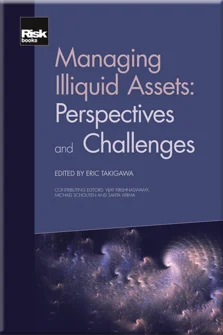
Managing Illiquid Assets
First published:
ISBN: 9781906348410
If you are a Risk.net subscriber you are entitled to 20% off your Risk books purchases. Please email enquiries@riskbooks.com for more information.
As part of your Risk.net subscription you are entitled to 20% off all of your Risk Books purchases. If you would like to place an order please email enquiries@riskbooks.com
Introduction to 'Managing Illiquid Assets'
Introduction to 'Managing Illiquid Assets'
A Brief History of Valuation: A Personal View
Case Study: Funding and Liquidity Considerations in the US Residential Mortgage Market
Foundations of Liquidity Risk Management
Valuation of Illiquid Assets: Third Party Sources
A Model for Estimating the Liquidity Valuation Adjustment on OTC Derivatives
Global Valuation and Dynamic Risk Management
A Regulatory Perspective on Prudent Valuation and Best Practice in Product Control
Beyond Valuation: Basel III and Its Impact on Managing Illiquid Assets
Model Risk, or the Risk of Using Models
Stress Testing in Financial Institutions
Case Study: Risk Governance and Management Practice of the Hana Financial Group
Illiquid assets are assets that cannot be readily converted into cash, in contrast with liquid assets, which either are in the form of cash or can be easily traded for cash. An illiquid asset is not readily saleable, due to uncertainty about its value or the lack of a market in which it may be regularly traded. Derivative products such as the credit default swaps (CDSs) and mortgage-backed securities (MBSs) that played a key role in the 2008–9 financial crisis are examples of illiquid assets, since their value was not readily determinable despite being secured by real property.11This is true especially of the derivative products, which had high-risk, subprime mortgages (mortgage loans to people who would find it difficult (if not impossible) to maintain the repayment schedule) as the underlying assets. Other examples of illiquid assets include large blocks of a stock and real estate, since these assets trade infrequently and are therefore difficult to value.
In general, assets may start out being liquid. A change in market and trading conditions may, however
Copyright Infopro Digital Limited. All rights reserved.
As outlined in our terms and conditions, https://www.infopro-digital.com/terms-and-conditions/subscriptions/ (point 2.4), printing is limited to a single copy.
If you would like to purchase additional rights please email info@risk.net
Copyright Infopro Digital Limited. All rights reserved.
You may share this content using our article tools. As outlined in our terms and conditions, https://www.infopro-digital.com/terms-and-conditions/subscriptions/ (clause 2.4), an Authorised User may only make one copy of the materials for their own personal use. You must also comply with the restrictions in clause 2.5.
If you would like to purchase additional rights please email info@risk.net