HM Treasury’s Brexit surprise
Statutory instruments throw up unwieldy divergence in Mifid II and Emir rules
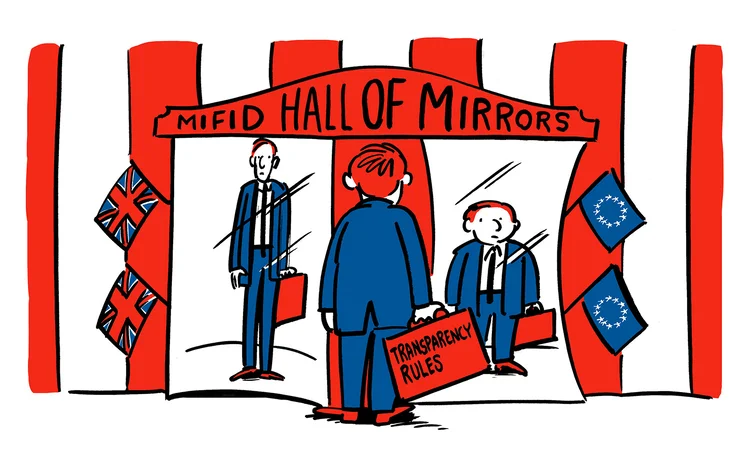

Brexit has been the political thriller of the year, promising frequent and dramatic plot twists at almost every turn. Now, one of the chapters meant to be the least controversial – the part where HM Treasury copies and pastes all European law into UK law – is throwing up nasty surprises for bankers.
Since August 2018, HM Treasury has been publishing a series of draft statutory instruments converting EU regulations into UK law. The task should be straightforward – effectively a copy-and-paste of EU rules and a find-and-replace of references to the EU and powers bestowed upon European regulatory agencies. Nothing else is supposed to change.
In practice, those apparently minor tweaks could have extreme consequences for the way the law will work post-Brexit.
For example, October’s publication of statutory instruments implementing the Markets in Financial Instruments Regulation – sister to the Directive, known as Mifid II – casts doubt over when trades are relieved from transparency requirements.
Mifir requires firms to publicly disclose trades executed on trading venues as well as those transacted with systematic internalisers and investment firms off-venue. Lists governing which instruments must be reported when traded off-venue and when trades are deemed illiquid or large enough to be granted deferrals and waivers from public disclosure, are set to significantly alter under the statutory instrument.
Under the new regime, UK lists would be generated without data from EU venues, while EU lists would exclude data from UK venues. The result is that UK and EU lists could be set to diverge – perhaps dramatically.
The UK’s Financial Conduct Authority has powers to throw the calculation process out of the window and simply align the UK’s transparency regime with the EU’s. But market participants fear perfect alignment will be impossible unless the FCA’s counterpart in the EU – the European Securities and Markets Authority – is given equivalent powers.
A second statutory instrument implementing the European Market Infrastructure Regulation also threatens to throw up operational problems for UK pension funds.
Due to the lapse of an exemption from the EU’s clearing obligation and with negotiations between EU lawmakers to renew the exemption still ongoing, HM Treasury decided not to renew the exemption until revisions have been approved by EU lawmakers.
Those negotiations, however, have stalled, meaning UK pension funds could be required to start clearing swaps subject to the clearing mandate when trading with EU counterparties. The problem would also occur in the opposite situation – if an EU pension fund trades with a UK bank.
The implication for banks is that they’ll have to set up implementation projects to align with the new UK regime.
“Brexit does not just mean we have to think only about setting up new entities in the EU. We also need to be mindful of the way it is impacting the home entity as well,” says a market structure expert at a UK investment bank.
With no-deal still on the table and Brexit less than four months away, it will be almost impossible for banks and pension funds to implement new systems in time to meet the new requirements.
コンテンツを印刷またはコピーできるのは、有料の購読契約を結んでいるユーザー、または法人購読契約の一員であるユーザーのみです。
これらのオプションやその他の購読特典を利用するには、info@risk.net にお問い合わせいただくか、こちらの購読オプションをご覧ください: http://subscriptions.risk.net/subscribe
現在、このコンテンツを印刷することはできません。詳しくはinfo@risk.netまでお問い合わせください。
現在、このコンテンツをコピーすることはできません。詳しくはinfo@risk.netまでお問い合わせください。
Copyright インフォプロ・デジタル・リミテッド.無断複写・転載を禁じます。
当社の利用規約、https://www.infopro-digital.com/terms-and-conditions/subscriptions/(ポイント2.4)に記載されているように、印刷は1部のみです。
追加の権利を購入したい場合は、info@risk.netまで電子メールでご連絡ください。
Copyright インフォプロ・デジタル・リミテッド.無断複写・転載を禁じます。
このコンテンツは、当社の記事ツールを使用して共有することができます。当社の利用規約、https://www.infopro-digital.com/terms-and-conditions/subscriptions/(第2.4項)に概説されているように、認定ユーザーは、個人的な使用のために資料のコピーを1部のみ作成することができます。また、2.5項の制限にも従わなければなりません。
追加権利の購入をご希望の場合は、info@risk.netまで電子メールでご連絡ください。
詳細はこちら 規制
迫りくる米国によるLCRの抜本的な見直しには、割引窓口も含まれるとの予定
銀行規制に連邦準備制度の流動性供給枠組みを取り入れることで、スティグマを克服し、融資能力を高めることができる可能性があります

フランスの規制当局は、EUのアウトプットフロアについて恒久的な変更を求めている
資本緩和を求める動きに対し、フィンランドとオランダの監督当局から抵抗が生じています

理事会、AquisとBMEをESMAの監督対象から外す方針
情報筋によると、ドイツ取引所を適用除外とするドイツ側の動きにより、他の3社も巻き込まれているとのことです

なぜ破綻処理計画を骨抜きにするのは良くないのか
銀行の破綻は避けられないものですが、銀行危機はそうではありません

BISのエルナンデス・デ・コス氏、AI、ノンバンク・リスク、トークン化について語る
ゼネラルマネージャーが、BISが複雑な世界情勢をどのように乗り切っているかについて語りました

「欧州版SEC」は成長の特効薬ではない
EUの政策立案者たちは、単一かつ一元化された監督機関が欧州経済の活性化につながることを期待していますが、批判の声も高まっています

IMAの導入には、FRTBの恒久的な改革が不可欠であると考えられている
6月に認められた一時的な措置は、欧州における内部モデルの利用を促進する上でほとんど効果を上げていません

次回のクレディ・スイスが「円滑に」破綻するよう確保するには
過去の銀行破綻において「リビングウィル」が無視されたとの批判を受け、規制当局は破綻処理規則の改正を計画しています