Quant Guide 2017: University of York
York, UK

MSc in Financial Engineering, MSc in Mathematical Finance | metrics table at end of article
The University of York offers two distinct master’s-level programmes: the MSc in mathematical finance focuses on the mathematical foundations of the discipline, while the MSc in financial engineering leans towards the application of technical skills in finance and economics.
Graduates in each typically follow different career tracks, says Tomasz Zastawniak, co-director of the financial engineering programme: “Our financial engineers apply more successfully for people-facing roles – they’re much better prepared for that, whereas maths finance graduates are more focused on technical skills and they often work as quant developers rather than dealing directly with clients.”
In both cases, however, expectations from employers have changed, and the programmes have tried to respond. “When I started in this business in the 2000s, the industry was happy to employ a physicist and give them in-house training, but now the expectation is for people to have a strong academic background in the field. On top of academic qualifications, many of our students aim to do a CFA – the combination of both seems to help them land a good job,” he says.

The MSc in mathematical finance is a combination of four core modules and three electives, a group project and a dissertation. Every student enrolled in this programme is obliged to complete a course on mathematical methods in finance; discrete time modelling and derivative securities; stochastic calculus and Black-Scholes theory; and modelling of bonds, term structure and interest rate derivatives.
“The programme is mathematically rigorous and our aim is to provide people with the skills to quickly accommodate new developments in the field in the future. We’re not as concentrated on the technical number-crunching aspects, we’re more focused on the theoretical background,” says Zastawniak.
Just over a year ago the programme was expanded to include new modules – an elective on computational finance and a new course on credit risk.
In May 2017, a compulsory group project was added to the curriculum. The plan was to reduce the dissertation size and complement it with more practical work. The project is aimed at mimicking real-life scenarios to give students an opportunity to apply their knowledge in practice.
Since 2009, the programme has also been available for distance learning. It runs alongside the campus-based programme, offering regular one-to-one online meetings with a tutor and supervisory sessions. It usually takes between 18 and 36 months to complete the online programme.
For mathematical finance students who wish to refresh their knowledge of mathematics before starting the programme, there is a pre-sessional course, which is delivered online and takes up to two months to complete. Its syllabus covers sets and functions, convergence, calculus and probability.
The programme has released a series of text books based on lecture notes. “There’s been a void in the book market for master’s students and we’ve made a deal with Cambridge University Press,” says Zastawniak. So far, the collaboration has resulted in the publishing of eight books.
The separate MSc in financial engineering is offered in conjunction with York’s economics department.
“It’s much softer on the technical side – we require less in terms of mathematical background, but more in terms of finance and economics,” says Zastawniak.
This programme consists of four core modules in the first term focusing on econometrics, time series, mathematical methods in finance and continuous-time finance and derivatives. In the second term, students cover financial engineering, topics in financial econometrics, stochastic calculus and Black-Scholes theory. The number of electives available to students varies, as optional modules are assigned various credit weightings, which means some of the modules count for two. Among the optional courses available are modules on C++ programming, credit risk and risk management.
The two programmes have commonalities. All new electives, apart from the group project, are available across both degrees. There is a strong focus on programming skills, and students do a lot of academic work using C++ and MatLab.
Students can get practical experience by participating in the management of a student-run investment fund, which was established via a donation.
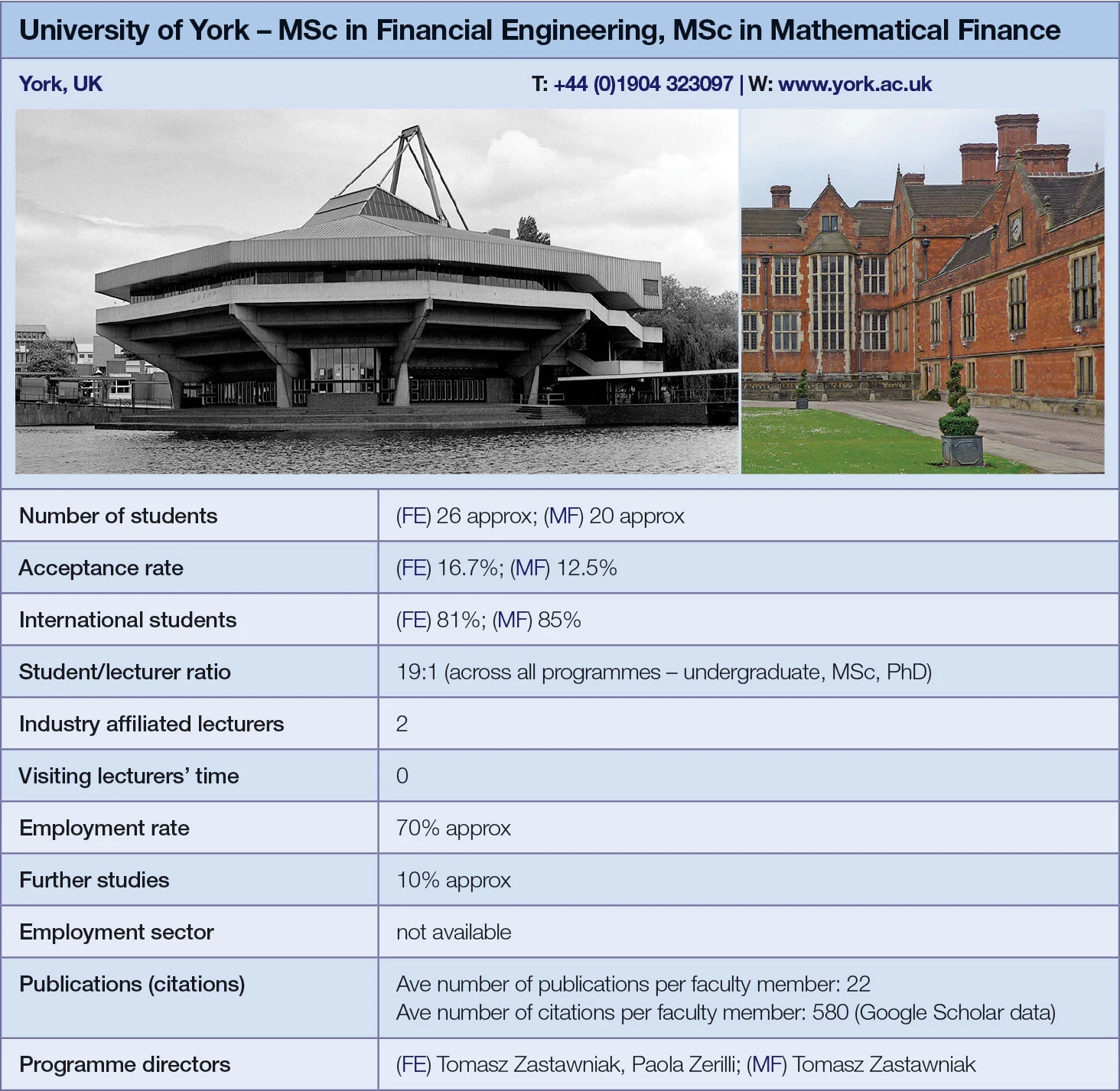
Click here for links to the other universities and an explanation of how to read the metrics tables
コンテンツを印刷またはコピーできるのは、有料の購読契約を結んでいるユーザー、または法人購読契約の一員であるユーザーのみです。
これらのオプションやその他の購読特典を利用するには、info@risk.net にお問い合わせいただくか、こちらの購読オプションをご覧ください: http://subscriptions.risk.net/subscribe
現在、このコンテンツを印刷することはできません。詳しくはinfo@risk.netまでお問い合わせください。
現在、このコンテンツをコピーすることはできません。詳しくはinfo@risk.netまでお問い合わせください。
Copyright インフォプロ・デジタル・リミテッド.無断複写・転載を禁じます。
当社の利用規約、https://www.infopro-digital.com/terms-and-conditions/subscriptions/(ポイント2.4)に記載されているように、印刷は1部のみです。
追加の権利を購入したい場合は、info@risk.netまで電子メールでご連絡ください。
Copyright インフォプロ・デジタル・リミテッド.無断複写・転載を禁じます。
このコンテンツは、当社の記事ツールを使用して共有することができます。当社の利用規約、https://www.infopro-digital.com/terms-and-conditions/subscriptions/(第2.4項)に概説されているように、認定ユーザーは、個人的な使用のために資料のコピーを1部のみ作成することができます。また、2.5項の制限にも従わなければなりません。
追加権利の購入をご希望の場合は、info@risk.netまで電子メールでご連絡ください。
詳細はこちら 計量ファイナンス
トップクオンツたちが語る、AIが一部の仕事に与える変化、そしてどのように仕事を奪うについて
Risk.netの非公式投票によると、クオンツたちは「コーディングスキルは重要度が低下し、リサーチスキルの重要性が高まる」と述べています

クオンツが「クロード」を最大限に活用している方法
エージェント型ツールは生産性を数倍に高めますが、それらを活用するにはスキルが必要です

新しいLLMは、驚くほど優秀なクオンツであることが分かってきた
AIの数学処理能力の飛躍的な向上により、モデルが研究に役立つ可能性が高まっています

Quant Finance Master’s Guide 2026
Risk.net’s guide to the world’s leading quant master’s programmes, with the top 25 schools ranked

2026年クオンツ修士課程ガイド:プリンストン大学とバルーク校が二強体制を確立
コロンビア大学が3位に躍進、チューリッヒ工科大学が欧州のライバル校をリードしております。

クオンツファイナンス マスターズガイド2025
Risk.netによる世界有数のクオンツ修士課程ガイド、上位25校がランクイン

バルーク、2025年クオンツ・マスター・ガイドでトップの座を維持
ソルボンヌ大学が欧州の名門校の首位に返り咲き、米国の給与水準が低下する中でも

Quant Finance Master’s Guide 2023
Risk.net’s guide to the world’s leading quant master’s programmes, with the top 25 schools ranked