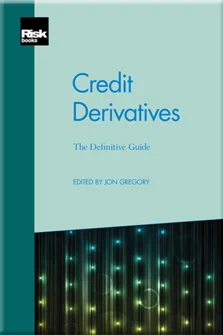
Credit Derivatives
First published:
ISBN: 9781904339120
If you are a Risk.net subscriber you are entitled to 20% off your Risk books purchases. Please email enquiries@riskbooks.com for more information.
As part of your Risk.net subscription you are entitled to 20% off all of your Risk Books purchases. If you would like to place an order please email enquiries@riskbooks.com
Using guarantees and credit derivatives to reduce credit risk capital requirements under the New Basel Capital Accord
Erik Heitfield
Introduction
Credit derivatives: the past, the present and the future
The determinants of credit spread returns
What’s driving the default swap basis?
What is the value of modified restructuring?
The debt and equity linkage and the valuation of credit derivatives
Nth to default swaps and notes: all about default correlation
Portfolio credit risk models
Credit derivatives as an efficient way of transitioning to optimal portfolios
Overview of the CDO market
Synthetic securitisation and structured portfolio credit derivatives
Integrating credit derivatives and securitisation technology: the collateralised synthetic obligation
Considerations for dynamic and static, cash and synthetic collateralised debt obligations
CDOs of CDOs: art eating itself?
Valuation and risk analysis of synthetic collateralised debt obligations: a copula function approach
Extreme events and multi-name credit derivatives
Reduced-form models: curve construction and the pricing of credit swaps, options and hybrids
Dynamite dynamics
Modelling and hedging of default risk
ISDA’s role in the credit derivatives marketplace
Credit linked notes
Using guarantees and credit derivatives to reduce credit risk capital requirements under the New Basel Capital Accord
INTRODUCTION
New bank capital adequacy standards being developed by the Basel Committee on Banking Supervision are intended to align minimum regulatory capital requirements more closely with the underlying economic risks faced by banks. Since financial guarantees and credit derivatives are designed to provide protection against credit risk, the Basel Committee has proposed allowing banks to use these instruments to reduce regulatory capital requirements. This chapter examines the Basel Committee’s proposed capital treatment for hedged credit exposures under the new Capital Accord (Basel II) and compares this treatment with a stylised portfolio credit risk model.
The next section of this chapter provides a brief overview of the development and objectives of Basel II. At the new Accord’s core is a simple portfolio credit risk model that we call the ASRF/Merton model. Basel II uses this model to set regulatory capital charges for unhedged credit exposures that take into account cross-exposure differences in credit risk parameters measuring default probabilities and recovery rates. The section entitled “The Advanced Internal Ratings Based Approach” describes the ASRF/Merton model in
Copyright Infopro Digital Limited. All rights reserved.
As outlined in our terms and conditions, https://www.infopro-digital.com/terms-and-conditions/subscriptions/ (point 2.4), printing is limited to a single copy.
If you would like to purchase additional rights please email info@risk.net
Copyright Infopro Digital Limited. All rights reserved.
You may share this content using our article tools. As outlined in our terms and conditions, https://www.infopro-digital.com/terms-and-conditions/subscriptions/ (clause 2.4), an Authorised User may only make one copy of the materials for their own personal use. You must also comply with the restrictions in clause 2.5.
If you would like to purchase additional rights please email info@risk.net