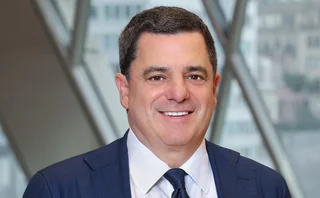
Lifetime achievement award PETER HANCOCK

The decor of the entrance to Integrated Finance Limited's (IFL) New York headquarters is modest by Wall Street standards. Indeed, as one leaves the lift on the fourth floor and walks the long featureless corridor towards a distant front door, the space almost appears disused. The impression gradually fades as the firm's small name plate becomes legible at closer quarters. But while IFL lacks the grand facade so often found at prestigious financial institutions, the pedigree behind the front door is beyond compare.
The trio that co-founded the secretive boutique comprises three Wall Street legends. First, there's Robert Merton, Nobel Laureate and co-creator of the model that provides the theoretical foundation of most derivatives trading. Then there's Roberto Mendoza, an ex-JP Morgan vice-chairman who helped build the firm's mergers and acquisitions group and who is widely regarded on the Street as an architect of JP Morgan's modern day investment banking enterprise. The other is Peter Hancock.
Having led JP Morgan's derivatives group to the pre-eminence it achieved in the 1990s, Hancock was the force behind derivatives becoming a part of nearly every aspect of the investment bank's activities. His belief in the longevity and risk-transforming properties of the over-the-counter derivatives market, alongside his thinking on how a derivatives business should be structured and how banks can most effectively deploy risk capital, helped shape the industry.
For these contributions, and for the ambitious vision of how corporations and governments can better manage risk through financial engineering – something he is trying to realise through IFL – Peter Hancock is this year's winner of Risk's Lifetime Achievement Award.
"The essence of what we are trying to do at IFL is to take insights from academic finance that are well tested in the trading world and apply them to complex strategic corporate and sovereign finance problems," says Hancock, New York-based president of IFL.
To say that the firm tries to keep a low profile is something of an understatement. This had led some on the Street to question whether IFL is struggling to make headway in winning business, and if it has sufficient backing to ultimately succeed. When asked to characterise IFL's progress to date, Hancock says: "We have set ambitious goals and our success is best judged by others."
There are some tentative signs, however, that the nay-sayers may soon be forced to dine on a big slice of humble pie. In addition to its strategic advisory and pension solutions work, IFL has an asset management group and Risk has learnt it very quietly launched a hedge fund in the third quarter of 2005. The firm declined to give any details about this, or future plans in the asset management space. But one potential investor, who viewed the associated investor documentation, told Risk that the fund is a multi-strategy emerging markets vehicle active in currencies, alongside corporate, sovereign and inflation-linked instruments.
Given the previous role of Merton, IFL's chief scientific officer, in the hedge fund world – as a principal and co-founder of the ill-fated Long-Term Capital Management – the firm's hedge fund launch is significant. But it is in the sphere of pensions where IFL looks set to make its first truly big splash. "There are numerous examples of corporates having substantial risk capital tied up in passive activities that don't add value," says Hancock. "The classic case is the defined benefit pension scheme that invests in equities. This asset allocation is an example of the kind of flawed thinking that we are trying to overturn."
At the time Risk was going to press, IFL was in the final stages of negotiation with a major multinational employer, which is likely to result in the creation of a new kind of pension scheme in 2006. "Ordinary people shouldn't be exposed to the kind of risks inherent in defined contribution pension schemes," says Hancock. "We have developed Merton's work on the life cycle of the savings process and optimised it."
IFL's business model, where it acts as an adviser rather than a principal, combined with a staff that has unmatched access to senior decision-makers at corporations and governments, will help ensure the boutique's ambitions are realised, says Hancock. By way of evidence, Hancock claims that IFL is currently working towards some significant transactions involving strategic swap trades between sovereigns. He declines to give further details.
It certainly sounds like there may soon be some impressive feathers in the cap of IFL, which during the three years since its creation has quietly amassed a 70-strong staff in New York, London and Tokyo – the roster for which at times reads like a who's who in corporate finance and financial academia.
Of course, if his negotiations with Warren Buffett in 2001 had panned out differently, Hancock's vision for a new kind of financial firm may have been realised on a much more accelerated basis. The proposed buyout of Gen Re Securities ultimately came to nothing. Hancock says he was initially introduced to Buffett, Berkshire Hathaway's chief executive and reportedly the world's second wealthiest individual, by a former boss. In essence, Berkshire wanted to limit its liability on Gen Re's derivatives book, which at the time had a notional value of several hundred billion dollars, including very long-dated and complex instruments such as power-reverse dual-currency contracts. "It was a complex portfolio and we did a lot of due diligence," says Hancock. "Our objective was to see what we could do with the company, while satisfying Buffett's requirements – the idea being to take its critical mass of infrastructure and people in a different direction."
The precise reason for the collapse of the deal with the Berkshire Hathaway subsidiary after nine months of intense negotiation has always been shrouded in mystery and speculation.
According to Hancock, the real story is somewhat more prosaic. Negotiations spanned the September 11 terrorist attacks, and after this calamity financial markets were pricing counterparty credit risk much more expensively. "It became less and less attractive to use this as a vehicle," says Hancock. Discussions were ended and Buffett decided to put the firm and its portfolio into liquidation.
For Hancock, the failed Gen Re bid gave him an opportunity to work again with former JP Morgan colleagues. As with his negotiations with Buffett's team, Hancock's resignation from JP Morgan, just days before details emerged in September 2000 of the proposed $34 billion merger with Chase Manhattan, prompted fevered speculation. Hancock scoffs at some of the press reports back then that implied the apparent proximity of the timing of his resignation to the announcement of the Chase deal was some kind of protest. "In reality, I was not aware of the Chase deal. I had told my bosses of my intention to leave months before and had spent the summer off."
Still, the question remains, why did Hancock decide to leave JP Morgan having only served as chief financial officer (CFO) for just over one year? "JP Morgan's business had always been about the quality of its relationships and the clients it dealt with. Others wanted to go in a completely different direction," he says.
Although he favoured a more organic approach to growth, Hancock wasn't completely opposed to acquisitions. He was, for example, a major proponent of the firm seeking opportunities in the reinsurance industry. "It would have been a more logical move," he says.
He was on the losing end of this strategic argument, with the board pursuing traditional opportunities with other banks. "I had found myself chief risk officer and CFO by the age of 40. I felt flattered and privileged to be in such a strategic role," Hancock says. "But I also felt removed from the things I loved doing most, such as solving client problems and developing new markets."
And so the exit beckoned. Although there were some interesting job offers – to become CFO of Freddie Mac, for example – few matched his interests or skills, hence his banding together with former colleagues to look at Gen Re Securities, he says.
Hancock speaks with genuine affection about the two decades he spent at JP Morgan; he is also modest about his achievements. And although, as he points out, he owes a debt of gratitude to many colleagues, it's fair to say that Hancock was the force behind a group that would spawn many product innovations and markets, such as structured credit. This innovation was, in part, born from his determination to understand how JP Morgan could optimally allocate its risk capital.
He was also an innovator when it came to thinking about how a derivatives group should be organised, and how it can add value to every facet of an investment bank's business – something that many competitors were quick to ape. Back in the late 1980s and early 1990s when some still questioned the longevity of the OTC market, Hancock was a vehement believer. "I have no doubt that the protectionist instincts of futures exchanges would have crushed the innovation of the OTC market back then, but for the work of the International Swaps and Derivatives Association and its supporters," he says.
Having graduated from Oxford University, the young Englishman had joined Morgan Guaranty Trust (a predecessor of the modern-day JP Morgan) in London in September 1980 – due in no small part to the appeal of a one-year training programme in New York. Hancock initially worked as a credit officer – a background that would serve him especially well later. But Hancock's next move was to be more in line with his long-term career path. In 1984, he became a Eurobond trader. "Some of the trades were quite creative and it sparked my interest in options," Hancock says.
The Eurobond market had evolved for tax and regulatory reasons, and was the venue for the debut of a variety of fixed-income structures in the 1980s. Companies issued whatever investors wanted and then swapped back into their target currency and format. Morgan Guaranty was one of the first firms that began to exploit the profit potential of warehousing of derivatives risk.
Having demonstrated his trading savvy, Hancock was asked to move over to New York in 1986 to run a proprietary desk, trading Group of Seven interest rate markets, using bonds alongside interest rate and currency swaps. The following year, a large chunk of the firm's derivatives specialists defected to found a derivatives group at Merrill Lynch. "I was fortunate – the exodus created an opportunity for anyone with any derivatives knowledge," says Hancock. He subsequently took over responsibility for market-making JP Morgan's rapidly growing cap and swaption business. These were early days: JP Morgan's book only had $10 billion–15 billion in notional outstandings.
In some ways, 1987 proved to be the making of Hancock – although at times it might have seemed quite the opposite. On the afternoon of Friday October 16, Hancock happened to be visiting the floor of the Chicago Mercantile Exchange. Typically, Friday afternoon trading sessions were relatively quiet. This Friday was different – it was the trading day before the 1987 crash. Right up until the peeling of the closing bell, the noise surrounding the S&P 500 futures pit was building to a crescendo. "The market was in free fall. Locals were getting wiped out – some literally had to be carried out. I'll never forget that day," Hancock says.
Beyond the spectacle he witnessed, he would not forget it for another reason. Under a then fledgling chairman, Alan Greenspan, the Federal Reserve jumped into action following the crash. It poured liquidity into the market by buying Treasuries, lending and encouraging banks to extend credit to the Street. "Bonds rallied dramatically in response," says Hancock. "This exposed a substantial strike mismatch in the caps book I was running and we took a several-million-dollar hit."
While Hancock had been careful to make the book neutral in terms of the main Greeks, or option sensitivities, it was short gamma on low-strike trades and long gamma on high strikes. "The gapping of the market caused our neutral positions to become very short overnight," he says. Needless to say, Hancock's bosses weren't too pleased. But he insists that it actually helped his career. His forensic analysis of the losses and his ability to explain what could be learnt gave reassurance. The episode demonstrated to Hancock the need to hedge not just micro noise in the trading book profit and loss, but also to hedge the possibility of more extreme events.
In 1989, Hancock created a commodity derivatives group in partnership with JP Morgan's bullion trading team. The timing proved to be fortunate when, in 1990, Iraq's invasion of Kuwait prompted short-dated oil volatility to spike up to around 125%. Hancock was appointed global head of swaps trading in 1990; the following year he took on responsibility for the global currency options business and also launched a hybrid derivatives group. In 1992, he co-founded an equity derivatives division and formally created the global derivatives group, with a head count of around 60.
Hancock says his fundamental business strategy was to broaden out the knowledge base of derivatives across the entire firm. He also redefined the boundaries between sales and trading. "In a traditional securities culture, it's the trader that occupies the position of power, while sales people are agents or messengers," he explains. "That approach is limiting with complex derivatives." Consequently, Hancock gave his marketers greater responsibility for pricing and hedging the initial transaction, leaving traders responsible for risk management thereafter.
The new head of the global derivatives group was developing a reputation as a radical. And his decisions were not always met with instant approval. When, for example, he had taken on responsibility for JP Morgan's currency options business, it was run as three separate books in London, New York and Tokyo with totally separate profit and loss accounts. So, New York-based traders would be woken up three times a night to rebalance their hedges. Still shy of his first month in charge, Hancock forced the group to switch to a single global book, where at the end of New York trading hours full trading authority on the entire book was handed over to the Tokyo-based team, which would subsequently hand over to the team in London. "There was a huge outcry initially," says Hancock. "But within a couple of weeks they were asking why we hadn't done it earlier. They got a full night's sleep and the judgement of someone awake is so much greater."
His star in the ascendant, the industry viewed Hancock as a suitable choice to lead the market risk component of the Group of 30 global derivatives study in 1992, which helped shape the OTC derivatives industry, including what is thought to be the first publication of the term value-at-risk.
By 1994, JP Morgan's global derivatives group had expanded to a head count of around 400. By many metrics, its derivatives book – which by the end of 1994 had a net replacement cost of around $30 billion – was the largest on the Street. Derivatives had become such a big profits generator and important adjunct to the underlying cash markets that it was decided to split the group into its component parts. Hancock retained control of fixed-income derivatives and a year later took on responsibility for the cash business too.
Credit risk – in terms of the counterparty credit exposure of derivatives trades – had long been something that Hancock had thought carefully about. "I had a strong view that a change in the firm's risk capital allocation was needed," he says. So, in November 1997, Hancock was given additional responsibility for managing JP Morgan's $170 billion credit portfolio encompassing counterparty risk, lending and commitments. The Asian crisis had prompted a sea change. In January 1998, the firm publicly announced a massive reallocation of risk capital. JP Morgan planned to halve the passive credit risk taken via its loans, guarantees, commitments and counterparty credit exposure over a three-year period. At the time, these accounted for around half the firm's economic capital.
As part of its so-called credit transformation, the firm shifted to a mark-to-market framework for measuring credit risk. It started using the credit default swaps (CDS) market extensively as a benchmarking mechanism for new loans and holding credit officers, who were using credit as a way to deepen client relationships with the firm, accountable for the amount of capital they were using. Hancock centralised credit extension authority in a small group responsible for pricing and sizing extensions in the context of the overall portfolio. "We used single-name CDSs extensively to hedge concentrations," says Hancock. "The first synthetic collateralised debt obligation [called Bistro] was also a direct result of our strategic decision."
The targeted 50% reduction in credit risk was achieved after only 18 months. By early 1999, Hancock had been appointed chief risk officer and CFO. He made strenuous efforts to convince the rating agencies that JP Morgan's groundbreaking strategy had genuinely reduced risk and hence could buy back $2.5 billion worth of its stock without fear of detrimental impact to its ratings. "It was the first time a firm had used credit derivatives in a major way to shift its whole risk profile," he says. It is also a prime example of how Hancock's work has helped influence contemporary thinking around derivatives and risk.
Only users who have a paid subscription or are part of a corporate subscription are able to print or copy content.
To access these options, along with all other subscription benefits, please contact info@risk.net or view our subscription options here: http://subscriptions.risk.net/subscribe
You are currently unable to print this content. Please contact info@risk.net to find out more.
You are currently unable to copy this content. Please contact info@risk.net to find out more.
Copyright Infopro Digital Limited. All rights reserved.
As outlined in our terms and conditions, https://www.infopro-digital.com/terms-and-conditions/subscriptions/ (point 2.4), printing is limited to a single copy.
If you would like to purchase additional rights please email info@risk.net
Copyright Infopro Digital Limited. All rights reserved.
You may share this content using our article tools. As outlined in our terms and conditions, https://www.infopro-digital.com/terms-and-conditions/subscriptions/ (clause 2.4), an Authorised User may only make one copy of the materials for their own personal use. You must also comply with the restrictions in clause 2.5.
If you would like to purchase additional rights please email info@risk.net
More on Awards
Market data provider of the year: S&P Global Market Intelligence
S&P Global Market Intelligence has consistently met demands across Apac’s fast‑evolving capital markets, securing its win at the Risk Asia Awards 2025

Best user interface innovation: J.P. Morgan
J.P. Morgan wins Best user interface innovation thanks to its Beta One portfolio solution

Market liquidity risk product of the year: Bloomberg
Bringing clarity and defensibility to liquidity risk in a fragmented fixed income market

FRTB (SA) product of the year: Bloomberg
A globally consistent and reliable regulatory standardised approach for FRTB

Best use of cloud: ActiveViam
Redefining high-performance risk analytics in the cloud

Best use of machine learning/AI: ActiveViam
Bringing machine intelligence to real-time risk analytics

Collateral management and optimisation product of the year: CloudMargin
Delivering the modern blueprint for enterprise collateral resilience

Flow market-maker of the year: Citadel Securities
Risk Awards 2026: No financing; no long-dated swaps? “No distractions,” says Esposito