Litigation threats seen delaying SEC climate disclosure rules
Efforts to demonstrate materiality of exposures to investment decision-making is taking longer than expected, say lawyers
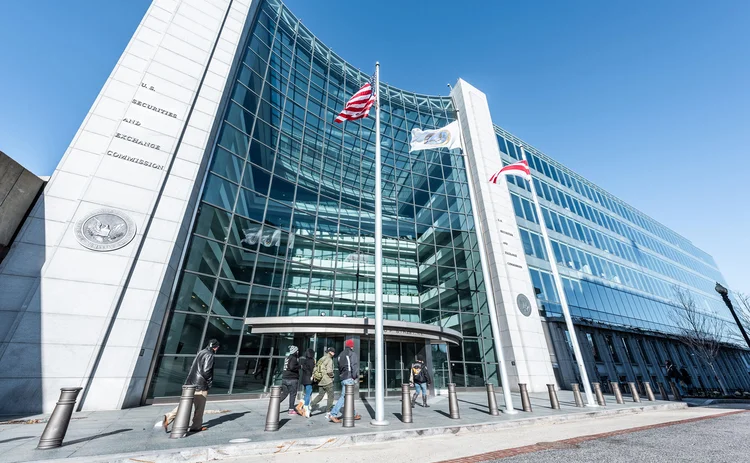
Efforts by the US Securities and Exchange Commission (SEC) to ensure the drafting of its landmark climate risk disclosures rulemaking is legally watertight are taking longer than expected, securities lawyers say, risking delays to the rulemaking’s publication.
The watchdog’s anticipated rulemaking on climate disclosures – which could force companies to reveal their exposure to greenhouse gas emissions, financial impacts of climate change and their progress towards mitigating them – has proved to be one of its most contentious of recent years, with an army of corporate lobby groups, Republican lawmakers and state attorney generals queuing up to oppose them since the proposals were first mooted.
In a speech this summer, SEC chair Gary Gensler ordered the agency’s rule-writing staff to draft a proposal for commissioners to review by the end of 2021. But while work on the rulemaking is due to be completed this year, one person familiar with the matter says they do not expect its publication before February 2022.
Neither staff for SEC commissioner Allison Herren Lee – who led the agency’s climate push while serving as acting chair – nor the SEC press office responded to requests for comment before publication.
Much hinges on the agency’s ability to demonstrate that climate exposure data is material to the price of a security, and an investor’s decision on whether to buy it or not, says Todd Phillips, director of financial regulation at the Center for American Progress.
“The SEC is trying to collect data showing that investors need this information, and whether a business’s cost of furnishing the information is less than the benefits that investors will receive. [SEC staff] need data about how investors would use the disclosed information, or whether they want the information disclosed in order to protect it from litigation.”
Being sued for noncompliance creates defence costs, and if such suits become commonplace, it can have an impact on the cost of directors’ and officers’ insurance coverage
Doug Henkin, Dentons
It is this key aspect that is said to be causing delays, suggest senior legal sources, speaking to Risk.net for this article.
Susan Schroeder, a partner at US law firm WilmerHale, and a former head of enforcement at the Financial Industry Regulatory Authority (Finra), says the SEC will anticipate complaints that it has failed to prove that markets need environmental, social, and governance (ESG) data.
The watchdog is therefore amassing a “corpus of evidence” that supports its case as thoroughly as possible, she says.
“They will be doing data collection, and will want to be able to show they found a number of investor protection problems [and] enforcement actions that the SEC has needed to bring, which will underscore the need for enhanced obligations,” Schroeder tells Risk.net.
Lawyers experienced in cases involving the SEC say they expect a number of legal challenges on several fronts, depending on what information the SEC requires firms to disclose. The current ESG reporting benchmark, developed by the Financial Stability Board’s Task Force on Climate-related Financial Disclosures (TCFD) has three keys areas.
Scopes 1, 2 and 3 respectively cover: direct greenhouse gas (GHG) emissions; indirect GHG emissions produced on its behalf; and indirect GHG emissions produced through its value chain.
The big question is whether Scope 3 of the TCFD disclosures will be mandated, says Phillips: “I don’t think anyone knows where the SEC is going to come down on that question.”
A former senior SEC staffer, who recently departed the agency, is uncertain the SEC will be able to make full TCFD disclosures mandatory: “[To] make it mandatory will be difficult to do – that might actually require some additional factfinding. I’m sceptical they’ll make progress.”
Burden of proof
The SEC will have to determine and prove with the information it receives from investors whether or not these disclosures are material to investment decisions or not.
As well as disputing the materiality aspect, opponents of the rulemaking argue it would place an additional compliance burden on firms, particularly the data-gathering and -reporting obligations, which they claim would cause unnecessary costs. Regulated firms could also complain that their liabilities will unnecessarily increase, as the disclosures provide a new angle of attack for private litigants who could bring suits alleging that companies are failing to comply.
“Being sued for noncompliance creates defence costs, and if such suits become commonplace, it can have an impact on the cost of directors’ and officers’ insurance coverage,” says Doug Henkin, a partner and co-US financial institutions lead at law firm Dentons.
The simplest challenge would involve a litigant demonstrating the SEC has taken actions that aren’t authorised by its governing statutes, says Henkin. Such challenges have precedent, notably in exchange operators’ fight against the SEC’s market data fees rules.
But the legal challenges the agency might fear most, according to Phillips, relate to the Administrative Procedure Act (APA), which governs the rulemaking process of federal bodies.
“The way the SEC would lose this lawsuit is [through failing to meet a] standard [that rules be neither] arbitrary nor capricious,” he says.
Plaintiffs could accuse the SEC of making procedural mistakes in its rule drafting that contravene APA terms, or of failing to undertake a proper cost-benefit analysis, says Dentons’ Henkin.
Consequently, the SEC will need to justify all facets of its ESG disclosure rules and prove that they are neither “arbitrary” nor “capricious”. For this reason, the SEC is compiling evidence to demonstrate that ESG disclosures are necessary, material to investors, and that the benefits exceed the costs.
Promise to sue
The SEC’s highest-profile critics on this issue include Republican SEC commissioner Hester Peirce and a coalition of state attorney generals, some of whom have promised to sue the agency if it proceeds with the planned rulemaking.
The US Chamber of Commerce’s Center for Capital Markets Competitiveness – the largest lobbying group in the US – has indicated its intention to sue if the SEC appears to have stepped beyond its established legal boundaries.
“We have a history of the SEC operating outside the bounds of the law, and we’ve not been afraid to go in and sue,” Tom Quaadman, executive vice-president of the CCMC, tells Risk.net.
“We’ve been supportive of climate disclosures within the legal bounds of materiality: beyond [those boundaries] is where the SEC has traditionally got in trouble.”
In 2015, the CCMC successfully brought a suit against the SEC that found that it had violated the First Amendment and its rulemaking was unconstitutional. Parts of an SEC rule to compel companies to disclose their use of ‘conflict minerals’ were quashed by the US Court of Appeals for the District of Columbia Circuit.
First Amendment violations are also the basis of the 15 Republican state attorney generals’ threat to sue. Such challenges appeal to the “compelled speech” concept, which says the government should not force people to express things they don’t want to.
In a letter to the SEC in March 2021, West Virginia attorney general Patrick Morrisey told the agency that climate risk is not “information that is material to future financial performance”. He also said mandatory disclosures would “help some customers and investors advance prejudice and animus towards groups and activities they disfavour”.
However, Amy Greer, a partner at law firm Baker McKenzie, and a former chief litigation counsel at the SEC’s Philadelphia office, says such suits are typically brought by plaintiffs, such as public companies, that can “demonstrate significant cost and harm caused by new rulemaking.”
“The state attorney generals could participate in that challenge, but they would not lead it,” says Greer. None of the 15 attorney generals opposed to the rulemaking could be reached for comment.
The former senior SEC staffer, agrees with Greer: “I’d be more nervous about corporate companies suing the SEC, honestly, than the state agencies.”
Only users who have a paid subscription or are part of a corporate subscription are able to print or copy content.
To access these options, along with all other subscription benefits, please contact info@risk.net or view our subscription options here: http://subscriptions.risk.net/subscribe
You are currently unable to print this content. Please contact info@risk.net to find out more.
You are currently unable to copy this content. Please contact info@risk.net to find out more.
Copyright Infopro Digital Limited. All rights reserved.
As outlined in our terms and conditions, https://www.infopro-digital.com/terms-and-conditions/subscriptions/ (point 2.4), printing is limited to a single copy.
If you would like to purchase additional rights please email info@risk.net
Copyright Infopro Digital Limited. All rights reserved.
You may share this content using our article tools. As outlined in our terms and conditions, https://www.infopro-digital.com/terms-and-conditions/subscriptions/ (clause 2.4), an Authorised User may only make one copy of the materials for their own personal use. You must also comply with the restrictions in clause 2.5.
If you would like to purchase additional rights please email info@risk.net
More on Investing
How investment firms are innovating with quantum technology
Banks and asset managers should be proactive in adopting quantum-safe strategies
Top 10 investment risks for 2026
AI, strained governments, inflated private assets: risky bets have become hard to avoid
Review of 2025: It’s the end of the world, and it feels fine
Markets proved resilient as Trump redefined US policies – but questions are piling up about 2026 and beyond
Asset managers prep autocall ETFs with assets tipped to hit $30bn
Actively managed strategies wait in the wings after systematic approach nets Calamos $500m
Citi launches core inflation QIS
Custom indexes eliminate energy and food prices to ease trading of stickier inflation trends
BlackRock appoints Pierre Sarrau as chief risk officer
Current CRO Edward Fishwick will be head of research at BlackRock’s RQA group
Japan’s yen swaps go global
JSCC isn’t just clearing swaps, it is clearing the way for the next stage of Japan’s financial evolution
How Bessent learned to stop worrying and love the T-bill
Short-dated issuance shows no signs of slowing. Some fear it could end badly.