HM Treasury’s Brexit surprise
Statutory instruments throw up unwieldy divergence in Mifid II and Emir rules
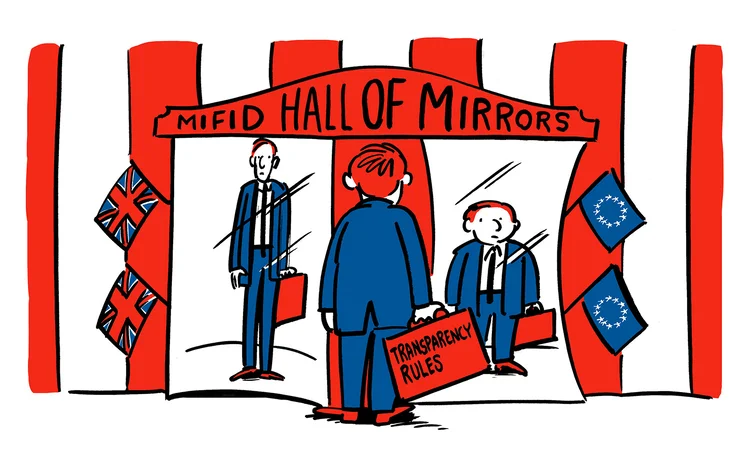

Brexit has been the political thriller of the year, promising frequent and dramatic plot twists at almost every turn. Now, one of the chapters meant to be the least controversial – the part where HM Treasury copies and pastes all European law into UK law – is throwing up nasty surprises for bankers.
Since August 2018, HM Treasury has been publishing a series of draft statutory instruments converting EU regulations into UK law. The task should be straightforward – effectively a copy-and-paste of EU rules and a find-and-replace of references to the EU and powers bestowed upon European regulatory agencies. Nothing else is supposed to change.
In practice, those apparently minor tweaks could have extreme consequences for the way the law will work post-Brexit.
For example, October’s publication of statutory instruments implementing the Markets in Financial Instruments Regulation – sister to the Directive, known as Mifid II – casts doubt over when trades are relieved from transparency requirements.
Mifir requires firms to publicly disclose trades executed on trading venues as well as those transacted with systematic internalisers and investment firms off-venue. Lists governing which instruments must be reported when traded off-venue and when trades are deemed illiquid or large enough to be granted deferrals and waivers from public disclosure, are set to significantly alter under the statutory instrument.
Under the new regime, UK lists would be generated without data from EU venues, while EU lists would exclude data from UK venues. The result is that UK and EU lists could be set to diverge – perhaps dramatically.
The UK’s Financial Conduct Authority has powers to throw the calculation process out of the window and simply align the UK’s transparency regime with the EU’s. But market participants fear perfect alignment will be impossible unless the FCA’s counterpart in the EU – the European Securities and Markets Authority – is given equivalent powers.
A second statutory instrument implementing the European Market Infrastructure Regulation also threatens to throw up operational problems for UK pension funds.
Due to the lapse of an exemption from the EU’s clearing obligation and with negotiations between EU lawmakers to renew the exemption still ongoing, HM Treasury decided not to renew the exemption until revisions have been approved by EU lawmakers.
Those negotiations, however, have stalled, meaning UK pension funds could be required to start clearing swaps subject to the clearing mandate when trading with EU counterparties. The problem would also occur in the opposite situation – if an EU pension fund trades with a UK bank.
The implication for banks is that they’ll have to set up implementation projects to align with the new UK regime.
“Brexit does not just mean we have to think only about setting up new entities in the EU. We also need to be mindful of the way it is impacting the home entity as well,” says a market structure expert at a UK investment bank.
With no-deal still on the table and Brexit less than four months away, it will be almost impossible for banks and pension funds to implement new systems in time to meet the new requirements.
Only users who have a paid subscription or are part of a corporate subscription are able to print or copy content.
To access these options, along with all other subscription benefits, please contact info@risk.net or view our subscription options here: http://subscriptions.risk.net/subscribe
You are currently unable to print this content. Please contact info@risk.net to find out more.
You are currently unable to copy this content. Please contact info@risk.net to find out more.
Copyright Infopro Digital Limited. All rights reserved.
As outlined in our terms and conditions, https://www.infopro-digital.com/terms-and-conditions/subscriptions/ (point 2.4), printing is limited to a single copy.
If you would like to purchase additional rights please email info@risk.net
Copyright Infopro Digital Limited. All rights reserved.
You may share this content using our article tools. As outlined in our terms and conditions, https://www.infopro-digital.com/terms-and-conditions/subscriptions/ (clause 2.4), an Authorised User may only make one copy of the materials for their own personal use. You must also comply with the restrictions in clause 2.5.
If you would like to purchase additional rights please email info@risk.net
More on Regulation
Industry pushes EU exchanges to solve equity post-trade frictions
Deutsche Bank, Goldman Sachs and JP Morgan join calls for mandatory cash CCP interoperability

Regulatory clarity urged for CME’s single-stock futures
SEC short selling and market access rules may hamper clearing and broker participation

Imminent US shake-up of LCR slated to include discount window
Adding Fed liquidity facility to bank regulation may help overcome stigma, raise lending capacity

French regulator wants permanent changes to EU’s output floor
Push for capital relief faces resistance from supervisors in Finland and the Netherlands

Council plans take Aquis, BME out of Esma oversight
German push to exempt Deutsche Börse catches three others, according to sources

Why watering down resolution plans is a bad idea
Bank failures are inevitable; banking crises are not

BIS’s Hernández de Cos on AI, non-bank risk and tokenisation
General manager talks about how the BIS is navigating a complex global environment

‘European SEC’ no silver bullet for growth
EU policymakers hope a single, centralised supervisor will help rev up Europe’s economy but critics are mustering