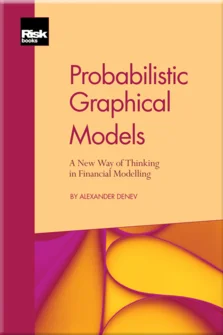
Probabilistic Graphical Models
First published:
ISBN: 9781782720973
If you are a Risk.net subscriber you are entitled to 20% off your Risk books purchases. Please email enquiries@riskbooks.com for more information.
As part of your Risk.net subscription you are entitled to 20% off all of your Risk Books purchases. If you would like to place an order please email enquiries@riskbooks.com
Credit Risk in Loan Portfolios
Credit Risk in Loan Portfolios
Background and Motivation
Probabilistic Graphical Models: An Introduction
Probabilistic Graphical Models: Filling in the Information
Stress Testing
Asset Allocation
Credit Risk in Loan Portfolios
Financial Networks
Hedging
Case Study: When a Country is Split
Case Study: The Impact of an Interest Rate Hike on Mortgage Default Rates
The previous chapter described the application of PGMs to the problem of how to optimally determine the asset side of a firm with an investment mandate. We also showed a case study of liability-driven investment (LDI) by including in the optimisation the liability side for either an insurer or a pension fund. In this chapter we show how to use PGMs to assess the tail risk of a portfolio of assets that are not marked-to-market but nevertheless subject to default risk.
The asset composition of banks is divided into banking and trading books11 An asset can be switched between the two books over the course of its life. The trading book includes supposedly tradeable and liquid instruments (eg, bonds, derivatives) and must to be marked-to-market. The banking book comprises assets that are meant to be held to maturity. For example, it includes loans made to third parties. This is usually the core business of a commercial bank and one for which there is a negligible liquid secondary market. The risk measures for the two books are different in the Basel rules: VaR for the trading book and RWA for the banking book (we discussed these in Chapter 1).22 Recall that the VaR for assets in the
Copyright Infopro Digital Limited. All rights reserved.
As outlined in our terms and conditions, https://www.infopro-digital.com/terms-and-conditions/subscriptions/ (point 2.4), printing is limited to a single copy.
If you would like to purchase additional rights please email info@risk.net
Copyright Infopro Digital Limited. All rights reserved.
You may share this content using our article tools. As outlined in our terms and conditions, https://www.infopro-digital.com/terms-and-conditions/subscriptions/ (clause 2.4), an Authorised User may only make one copy of the materials for their own personal use. You must also comply with the restrictions in clause 2.5.
If you would like to purchase additional rights please email info@risk.net