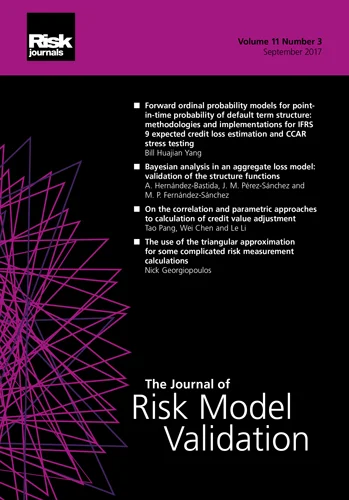
Journal of Risk Model Validation
ISSN:
1753-9587 (online)
Editor-in-chief: Steve Satchell

Need to know
- We construct an interbank network based on tail dependence and identify systemically important banks by computing the smallest eigenvalue of the grounded Laplacian matrix.
- The accuracy of the method is validated using the SIR model. Systemic risk is quantified via the t-copula-CoVaR approach, and regression analysis is conducted to examine the relationship between systemic importance indicators derived from the network and risk spillovers.
- The study reveals that traditional centrality metrics are largely redundant, while the smallest eigenvalue approach provides a more accurate differentiation of systemic importance. Large banks are identified as central nodes that play a pivotal role in information diffusion and risk transmission.
- The smallest eigenvalue and PageRank centrality exhibit positive correlations with systemic risk, whereas degree centrality shows negative correlation. These findings highlight the role of network position in risk transmission and offer insights for financial risk regulation.
Abstract
The systemic importance of banks is closely related to the topology of banking networks. We construct a banking network based on tail dependence, conduct an in-depth analysis of its node characteristics and explore the network structure and systemic importance of individual banks using the Laplacian matrix method to compute the smallest eigenvalue of the grounded matrix. In addition, we employ the susceptible–infected–recovered model to validate the accuracy of this method, and we quantify systemic risk using the t-copula conditional value-at-risk approach. Regression analysis is conducted to examine the relationship between network topology metrics and systemic risk spillovers. The results indicate that traditional network centrality metrics, such as degree centrality, closeness centrality, betweenness centrality and PageRank centrality, suffer from redundancy issues, making it challenging to effectively differentiate the systemic importance of certain banks. In contrast, the method of taking the smallest eigenvalue of the grounded Laplacian matrix accurately identifies banks with significant systemic impact. Further analysis reveals that large banks, such as the Industrial and Commercial Bank of China, the Agricultural Bank of China, the Bank of China and the China Construction Bank, occupy central positions in the network, serving as key nodes for information dissemination and risk transmission, thereby exhibiting notable systemic importance. There is a significant positive correlation between the smallest eigenvalue, PageRank centrality and systemic risk, indicating that the position and global characteristics of financial institutions within the network are closely linked to systemic risk. On the other hand, degree centrality shows a significant negative correlation with systemic risk, revealing the positive role of enhancing interinstitutional connections in risk dispersion. This study provides new perspectives and theoretical support for the identification and regulation of financial network risks, which is of particular importance for strengthening the prevention and control of systemic financial risks.
Copyright Infopro Digital Limited. All rights reserved.
As outlined in our terms and conditions, https://www.infopro-digital.com/terms-and-conditions/subscriptions/ (point 2.4), printing is limited to a single copy.
If you would like to purchase additional rights please email info@risk.net
Copyright Infopro Digital Limited. All rights reserved.
You may share this content using our article tools. As outlined in our terms and conditions, https://www.infopro-digital.com/terms-and-conditions/subscriptions/ (clause 2.4), an Authorised User may only make one copy of the materials for their own personal use. You must also comply with the restrictions in clause 2.5.
If you would like to purchase additional rights please email info@risk.net